


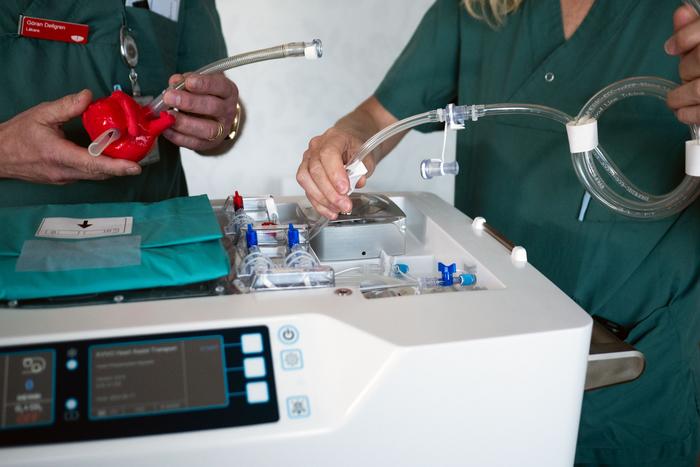
The risk of early heart failure after heart transplantation is lower if the donor heart is stored in a so-called heart-in-a-box instead of in the usual cooler with ice. This is according to a study where researchers at the University of Gothenburg are now presenting the results.

Credit: Photo by Jakob Lundberg/University of Gothenburg.
The risk of early heart failure after heart transplantation is lower if the donor heart is stored in a so-called heart-in-a-box instead of in the usual cooler with ice. This is according to a study where researchers at the University of Gothenburg are now presenting the results.
The established way of storing donated hearts before transplantation is to keep them at four degrees in potassium solution in a cooler with ice. Handling is a race against time, where matching, transportation and surgery need to happen within four hours to avoid increasing the risk of complications for the recipient.
Research has shown that transport times of up to nine hours are no longer an obstacle if hypothermic oxygenated machine perfusion (HOPE) or a “heart-in-a-box” is used instead of static cold storage. In the box, the heart is kept at eight degrees and is oxygenated using a pump, a set of tubes, a reservoir and a fluid that is circulated through the resting heart while waiting for the transplantation.
The aim of the current study, published in The Lancet, was to compare the methods, “heart-in-the-box” and cooler, in terms of safety and health outcomes of heart recipients in the first 30 days after transplantation. The study is the first so-called randomized controlled study of its kind.
Eight countries in Europe
The study included 204 adult patients registered for heart transplantation at fifteen different clinics in eight European countries. Half of the participants were randomly assigned to receive hearts handled in a “heart-in-a-box”, while half received hearts from cold static storage according to standard procedures. All hearts came from brain-dead donors.
The results show that heart recipients were significantly less likely to experience heart failure in their new heart if it had been handled in a “heart-in-a-box” before transplantation, compared to standard cold static storage. The risk of severe organ failure, primary graft dysfunction (PGD), was 11% in the heart-in-a-box group and 28% in those whose hearts were stored according to standard practice.
Otherwise, there were no differences in clinical events between the groups during the follow-up period. The researchers will later present analyses of the health outcomes in participants during the first year after heart transplantation.
One of the driving forces of the study is the author Andreas Wallinder, MD, PhD cardiothoracic surgeon and now Medical Director of the Swedish company XVIVO AB, who, together with Stig Steen, Senior Professor at Lund University, developed the used “heart-in-a-box” concept.
“The oxygenation of the heart that takes place in the box is crucial. During normal cold storage and transportation, we have no oxygenation or circulation in the cells, but when we use the box, oxygenated and nutrient-rich fluid is continuously pumped through the heart, which allows the heart to function better and results in fewer complications in the recipient after the transplant,” he says.
More transplants on the horizon
Göran Dellgren is Professor of Transplantation Surgery at Sahlgrenska Academy at the University of Gothenburg, and a cardiothoracic surgeon at Sahlgrenska University Hospital and the Swedish Principal Investigator of the study, responsible for about twenty participants:
“The results represent a breakthrough in transplantation, which could expand the field. Used correctly, the heart-in-a-box can reduce a number of complications that otherwise often result in suffering, poor outcomes, in the worst cases premature death, and also high costs,” he says.
“In terms of time, organs can also be shipped longer distances, thus making more organs available for transplantation. It is also likely that we can start using less ideal organs from older donors, which could increase the number of heart transplants,” concludes Göran Dellgren.
Journal
The Lancet
Method of Research
Randomized controlled/clinical trial
Subject of Research
People
Article Title
Hypothermic oxygenated perfusion of the donor heart in heart transplantation; Short term outcome from a randomized, controlled, open label, multicenter clinical trial (NIHP2019)
Article Publication Date
15-Aug-2024
Cite Scienmag News
Reid Dalton. (August 20, 2024). ‘Heart-in-a-box’ better than cooler for heart transplants. Scienmag. https://scienmag.com/heart-in-a-box-better-than-cooler-for-heart-transplants/
Reid Dalton. "‘Heart-in-a-box’ better than cooler for heart transplants." Scienmag, 20 August 2024, https://scienmag.com/heart-in-a-box-better-than-cooler-for-heart-transplants/. Accessed 5 September 2026.
Reid Dalton. "‘Heart-in-a-box’ better than cooler for heart transplants." Scienmag. August 20, 2024. https://scienmag.com/heart-in-a-box-better-than-cooler-for-heart-transplants/

