


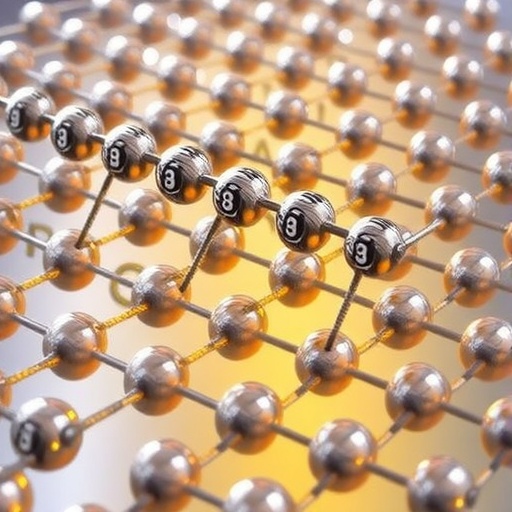
Lithium titanate, a material already widely recognized for its durability and safety in rechargeable batteries, has revealed an unexpected new capability. Researchers at Graz University of Technology have shown that the material can be transformed from a relatively poor lithium-ion conductor into a substantially faster one without changing its overall chemical composition or adding more lithium. Their strategy relies on removing a small number of oxygen atoms from the crystal lattice, creating microscopic defects that unlock a migration route for lithium ions. The finding offers a striking demonstration that the performance of a solid material can depend not only on which elements it contains, but also on how precisely its atoms are arranged and which defects are present. The experimental study, led by Bernhard Gadermaier and Martin Wilkening at TU Graz’s Institute of Chemistry and Technology of Materials, was published in Science Advances.
Lithium titanate, commonly abbreviated as LTO and represented chemically as Li₄Ti₅O₁₂, is an oxide material used in battery research and commercial energy-storage applications. It is valued for its excellent structural stability, rapid charging potential and strong safety characteristics. Unlike graphite, a conventional lithium-ion battery anode, LTO undergoes very little volume change during charging and discharging, which can contribute to long service life. Yet pristine, non-lithiated LTO is not naturally an efficient conductor of lithium ions. Its ionic conductivity becomes much higher when additional lithium ions and electrons enter the structure during charging. The TU Graz team pursued a different question: could the original, non-lithiated material be made highly conductive by activating pathways already hidden inside its crystal structure?
The researchers found that the answer lies in the behavior of oxygen within the LTO lattice. They heated the material to approximately 300 degrees Celsius in an atmosphere containing very little oxygen. Under these relatively mild conditions, individual oxygen atoms leave their normal positions, generating oxygen vacancies. These vacancies are not simply empty spaces with no chemical consequence. In an oxide crystal, the removal of an oxygen ion changes the local balance of charge and alters the forces acting on nearby atoms and mobile lithium cations. The resulting defect environment can reduce barriers that otherwise prevent lithium ions from moving through the lattice. In effect, a pathway that is structurally present but functionally dormant becomes available for rapid ion transport.
At the atomic scale, lithium-ion conduction occurs through a sequence of jumps between energetically favorable sites. For an ion to move, it must pass through an energy barrier created by the surrounding oxygen and titanium framework. Even when a potential route exists geometrically, the barrier may be too high for significant transport under normal conditions. Oxygen vacancies modify this landscape. They change local electrostatic interactions and open space within the rigid oxide framework, allowing lithium ions to access a previously blocked route. The researchers describe the process as the activation of a pre-formed diffusion pathway. This is important because it suggests that improved conductivity does not always require designing an entirely new crystal structure; it may be possible to reveal a hidden function by carefully controlling defects in an existing one.
The team verified the enhanced transport using two complementary techniques. Conductivity spectroscopy provided information about how readily electrical charge moved through the treated material over a range of conditions. Because ionic and electronic contributions can behave differently, this type of measurement helps identify changes in the material’s transport properties. Nuclear magnetic resonance spectroscopy supplied a more direct view of lithium motion at the atomic level. NMR can detect how lithium nuclei respond to their local environment and how rapidly they move between different sites. The measurements provided experimental evidence that lithium ions were not merely becoming more mobile in a general sense; they were using a newly activated pathway associated with the oxygen-deficient structure.
The results challenge the assumption that a material’s behavior can be predicted from its chemical formula alone. Two samples with the same nominal composition may display very different properties if they have different defect populations, local atomic arrangements or thermal histories. In the case of LTO, heating in an oxygen-poor environment produced a controlled deviation from the ideal crystal structure, and that deviation had a major effect on lithium transport. The work demonstrates the practical importance of anionic defect chemistry, a field that examines how missing or substituted negatively charged ions influence the structure and properties of solids. By manipulating oxygen vacancies, scientists can alter conductivity, charge distribution and ion mobility without necessarily changing the material’s principal composition.
The discovery may also broaden the technological possibilities of lithium titanate beyond its established role in batteries. Faster ion transport is valuable wherever the movement of charged species must be controlled precisely, including solid-state electrochemical devices, sensors and systems that convert ionic signals into electronic responses. The researchers point to possible applications in iontronic devices, which use ions to process or transmit information, as well as memristive and neuromorphic technologies designed to reproduce aspects of the behavior of biological neural networks. In such systems, the controlled movement of ions can determine whether a device retains, changes or communicates a particular state. Materials whose conductivity can be tuned through stable defect structures could therefore become useful components in future microelectronics and nanoelectronics.
The work is also a reminder that surprising advances can emerge from fundamental materials research rather than from efforts aimed directly at a commercial product. LTO was not redesigned from the ground up, and the researchers did not rely on a complicated new synthesis route. Instead, they used a carefully selected thermal treatment to alter the crystal’s oxygen content and then combined macroscopic conductivity measurements with atomic-scale NMR analysis. That combination allowed them to connect a processing step, a specific defect, and a newly observed transport mechanism. By showing that oxygen vacancies can unlock dormant lithium pathways in Li₄Ti₅O₁₂, the TU Graz study provides a blueprint for exploring similar effects in other oxide materials, where microscopic defects may be waiting to activate properties that conventional chemical descriptions fail to reveal.
News Publication Date: 19-Aug-2026
Web References: https://doi.org/10.1126/sciadv.aef5575
References: Science Advances, DOI: 10.1126/sciadv.aef5575
Keywords
Lithium titanate, LTO, lithium-ion transport, oxygen vacancies, defect chemistry, battery materials, ionic conductivity, nuclear magnetic resonance, solid-state materials, iontronics, memristors, neuromorphic electronics
Cite Scienmag News
Faith Mcneil. (August 20, 2026). Oxygen vacancies enable rapid ion transport in advanced battery materials. Scienmag. https://scienmag.com/oxygen-vacancies-enable-rapid-ion-transport-in-advanced-battery-materials/
Faith Mcneil. "Oxygen vacancies enable rapid ion transport in advanced battery materials." Scienmag, 20 August 2026, https://scienmag.com/oxygen-vacancies-enable-rapid-ion-transport-in-advanced-battery-materials/. Accessed 4 September 2026.
Faith Mcneil. "Oxygen vacancies enable rapid ion transport in advanced battery materials." Scienmag. August 20, 2026. https://scienmag.com/oxygen-vacancies-enable-rapid-ion-transport-in-advanced-battery-materials/


