


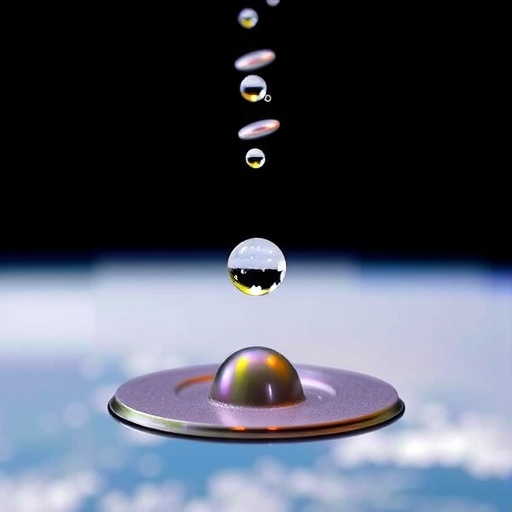
A research team from Saarland University is taking a potentially transformative class of metals beyond Earth to investigate how they solidify, flow and respond to heat under near-weightless conditions. Beginning 31 August, materials scientists led by Professor Ralf Busch are scheduled to spend a week controlling experiments aboard the International Space Station, where nickel-based metallic-glass alloys will be melted into levitating droplets and studied at temperatures approaching 1,700 degrees Celsius. The mission is designed to produce exceptionally precise measurements of properties that are difficult to determine on Earth, including viscosity, surface tension, thermal expansion, heat capacity, supercooling and oscillation behavior. The results could help engineers design stronger and more adaptable materials for aerospace systems, electric motors, medical devices, metal 3D printing and everyday products.
The ISS offers an experimental environment that cannot easily be reproduced on the ground. Although Earth’s gravitational pull remains substantial at the station’s orbital altitude of roughly 400 kilometers, the ISS and everything inside it are in continuous free fall around the planet. The station’s high forward velocity prevents it from falling directly to Earth, creating the apparent weightlessness familiar from spaceflight. For Busch’s team, this condition is crucial because it allows a molten metal droplet to remain suspended with only minimal electromagnetic forces. On Earth, much stronger fields are needed to counteract gravity, and those forces can distort the droplet or influence the fluid motion researchers are trying to measure. In orbit, the sample can be held in place more gently, reducing experimental interference and allowing scientists to observe its intrinsic behavior.
The materials under examination belong to a remarkable family known as metallic glasses. Unlike conventional metals, whose atoms are arranged in an orderly crystalline lattice, metallic glasses contain atoms in a disordered, amorphous arrangement similar to the structure of ordinary glass. Their name can be misleading: these materials are not fragile like a drinking glass. Many metallic glasses combine very high strength with elasticity and can be shaped at elevated temperatures in ways that resemble the processing of plastics. Their unusual combination of properties makes them attractive for injection molding, precision components and metal additive manufacturing, where complex three-dimensional forms must be produced without sacrificing mechanical performance. Busch’s group has spent decades developing alloys whose composition is carefully adjusted to create specific combinations of strength, toughness, processability and resistance to crystallization.
Producing a metallic glass requires preventing atoms from organizing themselves into crystals as the molten alloy cools. In an ordinary metal, atoms rapidly settle into repeating patterns when the temperature falls below the melting point. In a metallic-glass alloy, researchers combine elements in carefully selected proportions so that crystal formation becomes energetically or kinetically difficult. The liquid can then be cooled into a solid before its atoms have time to establish long-range order. This process depends on a complex relationship between composition, temperature, cooling rate, viscosity and the movement of atoms within the liquid. Even small changes in the proportions of the constituent elements can alter the material’s ability to resist crystallization. Researchers therefore design these alloys across a multidimensional compositional space, searching for formulations that remain stable in the liquid state and solidify into a durable amorphous structure.
The ISS experiments will focus on nickel-niobium and nickel-niobium-sulfur alloys. Nickel-niobium metallic glass was first developed at the Massachusetts Institute of Technology in 1967, while the nickel-niobium-sulfur composition was produced in Busch’s laboratory at Saarland University. Small beads of the alloys were manufactured on the Saarbrücken campus and tested extensively on Earth before being transported to the station. Because the molten alloys are highly reactive, they can be melted without a conventional crucible. Instead, the samples will be suspended and heated electromagnetically, avoiding contact with a container that could contaminate the liquid or influence its thermal and chemical behavior. The droplets will be heated to temperatures of up to 1,700 degrees Celsius while scientists monitor how they respond to controlled changes in their environment.
The experiments will take place inside the European Space Agency’s Columbus laboratory module using the Electromagnetic Levitator, or EML. Installed in 2014 by German ESA astronaut Alexander Gerst, the instrument can position, heat and cool electrically conductive samples without physical contact. Electromagnetic fields first induce currents in the metal and then interact with those currents to hold the sample in suspension. The same system can alter the droplet’s position and temperature while optical and other measurements track its response. From the German Aerospace Center’s control center in Cologne, doctoral researcher Lucas Eisenhut and senior researcher Dr. Fan Yang will remotely direct the experimental sequence with the Saarbrücken team. A live data stream from the ISS will allow them to observe the droplets in real time and adjust process parameters while each experiment is underway.
The researchers are seeking data that are difficult to obtain with sufficient accuracy under terrestrial conditions. A levitated droplet can reveal its surface tension through the way it oscillates, while its response to heating and cooling provides information about thermal expansion, heat capacity and the extent to which it can remain liquid below its normal crystallization temperature. Viscosity measurements show how easily the molten alloy flows, a property that is essential for manufacturing and for predicting how atoms move during cooling. Supercooling is particularly important because it describes how far a liquid can be cooled below its equilibrium freezing temperature without crystallizing. The larger the supercooling range and the slower the crystallization process, the greater the chance that a metallic glass can form. By combining these measurements, scientists can build more accurate models of the alloy’s liquid and solid states.
The team has already conducted a broad campaign of ground-based experiments, including tests in vacuum and in electromagnetic and electrostatic fields at DLR in Cologne. At DESY, the German Electron Synchrotron facility, X-rays were used to examine the droplets and probe their internal structure. Former doctoral researcher Lucas Ruschel also completed 30 parabolic-flight maneuvers in a single day over the Atlantic, studying the alloys during brief periods of weightlessness lasting approximately 22 seconds each. Those flights provided valuable experience, but they also imposed severe limits. The short intervals restricted the number of measurements, while aircraft motion and residual gravitational effects introduced disturbances. On the ISS, individual experimental cycles can last as long as 45 minutes, allowing several hours of measurements over the course of the mission and creating a much larger statistical foundation for the results.
The scientific payoff could extend well beyond a better understanding of one family of alloys. Metallic glasses developed in Saarbrücken are being considered for components in engines and machinery, more efficient electric motors, high-strength screws and geometrically complex parts capable of surviving the extreme conditions of aerospace applications. Their ability to combine hardness, elasticity and high-temperature formability could also support new approaches to medical technology and precision manufacturing. The group has developed patented ultra-high-strength alloys, and it is already preparing a follow-up series of space experiments involving additional compositions, including a palladium-nickel-phosphorus alloy. By measuring materials in a cleaner and more stable environment, researchers hope to refine existing formulations and identify new ones that would be difficult to design using incomplete terrestrial data.
The mission also highlights the growing role of materials science in space research. Saarland University’s materials scientists have collaborated for years with NASA, the Jet Propulsion Laboratory and the German Aerospace Center, while other researchers at the university have investigated antimicrobial surfaces aboard the ISS. The current project is supported by the German Research Foundation and ESA, with the University of Münster and DLR’s Institute of Materials Physics in Space contributing to the measurements and preparatory work. If the levitating droplets behave as expected, the resulting data will help connect atomic-scale disorder with the practical performance of advanced alloys. A material that looks like a tiny glowing bead in orbit could therefore provide the foundation for stronger spacecraft parts, more efficient machines and a new generation of precision-manufactured products on Earth.
Web References: https://mediasvc.eurekalert.org/Api/v1/Multimedia/58340cec-a65a-4f01-90e6-4572402cfbd3/Rendition/low-res/Content/Public
References: Saarland University; European Space Agency; German Aerospace Center (DLR); University of Münster; DLR Institute of Materials Physics in Space; DESY; NASA Jet Propulsion Laboratory.
Keywords
Metallic glass, materials science, International Space Station, ISS, electromagnetic levitation, nickel-niobium alloy, nickel-niobium-sulfur alloy, amorphous metals, space research, Saarland University, ESA, DLR, metal 3D printing, advanced materials, crystallization, microgravity experiments
Cite Scienmag News
Neil Sanderson. (August 18, 2026). Metallic Glass to Be Tested Aboard ISS Using Levitated Droplets in Microgravity. Scienmag. https://scienmag.com/metallic-glass-to-be-tested-aboard-iss-using-levitated-droplets-in-microgravity/
Neil Sanderson. "Metallic Glass to Be Tested Aboard ISS Using Levitated Droplets in Microgravity." Scienmag, 18 August 2026, https://scienmag.com/metallic-glass-to-be-tested-aboard-iss-using-levitated-droplets-in-microgravity/. Accessed 6 September 2026.
Neil Sanderson. "Metallic Glass to Be Tested Aboard ISS Using Levitated Droplets in Microgravity." Scienmag. August 18, 2026. https://scienmag.com/metallic-glass-to-be-tested-aboard-iss-using-levitated-droplets-in-microgravity/


