


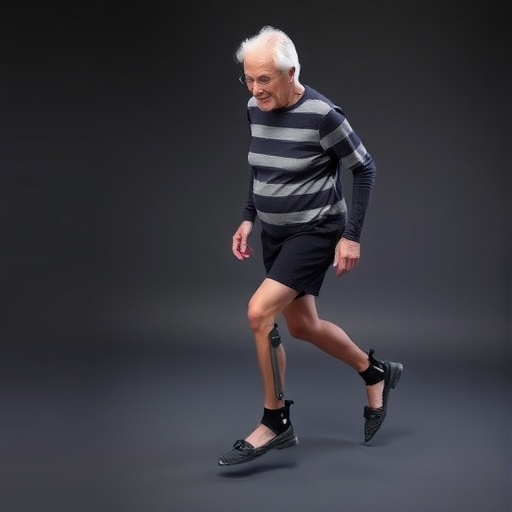
The knee may soon become one of the most important targets for wearable robotics, as researchers in China have developed a flexible assistive exoskeleton designed to help older adults walk across ordinary outdoor environments. Unlike many powered exoskeletons that rely on separate motors for each leg, the new system uses a single motor to deliver assistance alternately to the left and right knees. The design, known as the single-source dual-drive flexible knee assistive exoskeleton, or FKAE, combines mechanical engineering, wearable sensors, artificial intelligence-inspired control methods, and elastic actuation to support walking on level ground, ramps, and stairs.
The development addresses a growing health and mobility challenge. The knee is one of the body’s primary weight-bearing joints, helping people maintain balance, absorb forces, and generate movement during walking. As people age, declining muscle strength and endurance can make it more difficult to support body weight, climb stairs, or walk uphill. Reduced mobility can also increase the risk of falls and negatively affect independence and quality of life. Although powered exoskeletons have shown promise, many existing systems remain too heavy, too rigid, or too specialized for practical daily use. Motors mounted near the knees can add unwanted inertia, while pneumatic systems often require bulky power supplies and can be difficult to operate outside controlled environments.
The FKAE was designed to reduce these burdens by moving its main drive system to the user’s back. The exoskeleton consists of a back-mounted drive and control module, bilateral lower-limb braces, Bowden cable transmissions, and a locomotion perception system. Bowden cables transmit mechanical force through flexible sheaths, allowing the motor and much of the associated hardware to remain away from the knee joint. This arrangement reduces the mass attached to the lower limbs, potentially making the device easier to wear and less disruptive to natural leg movement. A clutch and dual-drive mechanism then distribute power from the single motor to the two knees in sequence rather than attempting to power both joints simultaneously.
At the heart of the actuator is a moving mesh gear that can engage with either the left-side or right-side drive gear. By switching the engagement between these two pathways, the system sends assistance to one knee and then the other. The researchers reported that the switching interval between left- and right-knee assistance was approximately 0.10 to 0.12 seconds. That timing is short enough to fit within the rapid sequence of events that occurs during walking, allowing one motor to serve both legs without creating a major interruption in the gait cycle. Although the architecture cannot apply torque to both knees at exactly the same moment, it reduces the number of high-power motors required and may lower the total weight, energy demand, and mechanical complexity of the wearable device.
To make the interaction between the machine and the wearer safer, the researchers incorporated a series elastic actuator based on disc-shaped spring elements. Series elasticity places a compliant spring structure between the motor and the user, allowing the system to absorb sudden changes in force and regulate the torque delivered to the joint. This can reduce the risk of rigid, uncomfortable interactions and provide more accurate measurement of the force being applied. In an assistive exoskeleton, compliance is especially important because the wearer’s movements are never perfectly identical from one step to the next. The elastic components can help compensate for small differences in timing, posture, and joint motion while limiting excessive mechanical loading.
The system also needs to determine what the user is doing before it can provide the correct assistance. Four inertial measurement units, or IMUs, were placed on the thigh and calf sections of the exoskeleton. These sensors measure motion-related variables such as acceleration and angular velocity, enabling the controller to calculate knee angles in real time and extract features associated with different gait patterns. The researchers focused on five everyday locomotion modes: level walking, ramp ascent, ramp descent, stair ascent, and stair descent. Recognizing these modes is technically challenging because the same knee may move differently depending on terrain, speed, step height, and whether the person is beginning or ending a transition.
To solve this problem, the FKAE uses a dual-detection strategy combining fuzzy control with a finite state machine. Fuzzy control is useful when movement patterns are not defined by sharp boundaries. Instead of treating a sensor measurement as simply belonging or not belonging to a category, fuzzy logic can evaluate degrees of membership, such as whether a motion is more consistent with level walking or the beginning of ramp ascent. The finite state machine then tracks the sequence of locomotion states and identifies transitions between them. This combination helps the system respond quickly without confusing brief fluctuations in motion with a genuine change in terrain.
The outdoor tests included three young participants and three older participants who walked across level surfaces, ramps, and stairs. Across the tested locomotion modes, the system achieved an average recognition accuracy of 98.89 percent, while stair ascent recognition reached 100 percent in the reported experiments. The finite state machine also reduced delays during transitions. In some changes from level walking to stairs or ramps, the system detected the upcoming mode approximately half a gait cycle in advance. Such anticipation could be critical for assistive robotics: support that begins too late may be ineffective, while assistance delivered for the wrong movement could interfere with balance or comfort.
Indoor metabolic and surface electromyography experiments were used to examine whether the assistance reduced the physical effort required from participants. Compared with walking under a zero-torque condition, the exoskeleton lowered metabolic cost by approximately 5.4 to 12.8 percent during level walking, 11.9 to 28.2 percent during ramp ascent, and 10.9 to 18.8 percent during stair ascent. Surface electromyography measurements also showed reduced activation in several lower-limb muscles, with some reductions exceeding 60 percent. These findings suggest that the device was not merely detecting movement accurately; it was also producing assistance that could reduce muscular workload during demanding tasks. The results are particularly relevant for uphill walking and stair climbing, activities that often place substantial demands on the knee extensors and surrounding muscle groups.
The researchers emphasize that the FKAE remains an early-stage demonstration rather than a finished clinical product. The participant group was small, and the single-motor arrangement cannot provide simultaneous assistance to both knees or meet every assistance demand throughout the full gait cycle. The current recognition system also relies mainly on kinematic information from IMUs, which may not be sufficient for complex conditions such as turning, irregular or nonperiodic walking, uneven terrain, or substantial differences between individuals. Future versions could combine inertial sensing with foot-pressure measurements, electromyography, and adaptive control algorithms that learn a user’s preferred assistance pattern. Human-in-the-loop optimization could further personalize torque timing and intensity. Even with these limitations, the study presents a striking example of how lighter mechanical architectures and fast locomotion recognition could move knee exoskeletons closer to real-world use for older adults who want to remain mobile in everyday environments.
News Publication Date: August 11, 2026
References: Published in Cyborg and Bionic Systems; authors Shisheng Zhang, Yang Zhang, Yanzong Xu, Jinke Li, Yuquan Leng, and Xinyu Wu.
Keywords
Knee exoskeleton, wearable robotics, assistive technology, elderly mobility, gait recognition, locomotion pattern recognition, Bowden cable, series elastic actuator, rehabilitation robotics, human–robot interaction, metabolic cost, surface electromyography, artificial intelligence, stairs, ramps, healthcare technology
Cite Scienmag News
Denise Maddox. (August 18, 2026). Flexible Single-Source, Dual-Drive Knee Exoskeleton Assists Elderly Daily Walking. Scienmag. https://scienmag.com/flexible-single-source-dual-drive-knee-exoskeleton-assists-elderly-daily-walking/
Denise Maddox. "Flexible Single-Source, Dual-Drive Knee Exoskeleton Assists Elderly Daily Walking." Scienmag, 18 August 2026, https://scienmag.com/flexible-single-source-dual-drive-knee-exoskeleton-assists-elderly-daily-walking/. Accessed 4 September 2026.
Denise Maddox. "Flexible Single-Source, Dual-Drive Knee Exoskeleton Assists Elderly Daily Walking." Scienmag. August 18, 2026. https://scienmag.com/flexible-single-source-dual-drive-knee-exoskeleton-assists-elderly-daily-walking/


