


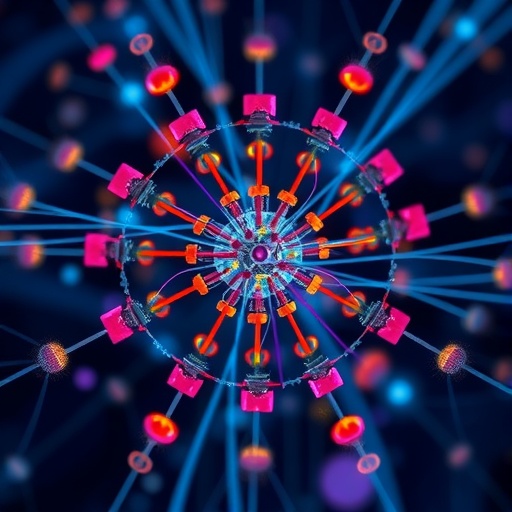
A new study has brought scientists one step closer to building artificial cell communities that can sense signals, reorganize themselves and distribute molecular cargo with the coordination of living tissues. In research published in Nature Chemistry, Z. Yin, R. Sun, M. Li and colleagues describe “recruitment” and “dispatchment” inside networks of reconfigurable protocells—cell-like compartments assembled from nonliving chemical components. The work focuses on a fundamental challenge in synthetic biology: how to make artificial cells do more than simply contain reactions. Real cells constantly detect information, gather the machinery they need and send materials to precisely selected destinations. By combining phase separation with signal-responsive interactions, the researchers created a system in which protocell communities can dynamically change their internal organization and communication patterns. The result is a striking chemical model of cellular logistics, with potential relevance to programmable materials, targeted delivery and the earliest stages of life.
The central idea depends on liquid–liquid phase separation, a process that allows chemically different molecules to separate into concentrated, droplet-like compartments within a surrounding solution. Although the phenomenon may sound familiar from oil and water, biological cells use a far more sophisticated version of it. Inside cells, phase-separated condensates gather enzymes, nucleic acids and regulatory proteins without requiring a membrane around every reaction. Their composition can change rapidly when the cell receives a signal. The protocell networks explored in this study use a related principle. Instead of relying entirely on rigid boundaries, the system allows molecular components to assemble into distinct liquid phases whose contents and interactions can be reconfigured. This gives the artificial cells a form of chemical flexibility: components can be recruited into a compartment, released from it or redirected toward another protocell when the surrounding conditions change.
The word “recruitment” describes the selective gathering of molecular components into a particular protocell or phase-separated domain. In living systems, recruitment is essential for almost every coordinated response. A signal at the cell surface can attract proteins to a membrane, assemble an enzyme complex or concentrate genetic material in a specialized region. The researchers’ synthetic network recreates this principle using programmable molecular interactions. A chemical cue can alter the affinity between components, effectively changing which molecules prefer one another and where they accumulate. As a result, a previously dispersed molecular population can become concentrated in one protocell. This concentration is not merely a visual rearrangement. Bringing reactants together can accelerate chemical reactions, protect fragile components or create a local environment with properties different from those of the surrounding solution. The protocells therefore behave less like passive droplets and more like responsive microscopic workstations.
The complementary process, described as dispatchment, gives the network a way to redistribute material after a signal has been received. In biology, cellular communication is rarely useful if information remains trapped at its point of origin. Cells must pass instructions, metabolites and molecular cargo across compartments and sometimes across entire tissues. In the artificial network, a signal-induced change in phase behavior can destabilize one arrangement and favor another. Components that were concentrated in one protocell can be released, transferred or captured by a neighboring compartment. This creates a chemical version of routing. Rather than moving cargo through a machine built from fixed channels, the network changes its own organizational state so that the preferred destination becomes available. Such behavior is particularly important for synthetic systems because it offers a route toward autonomous operation: the same chemical rules that detect a signal can also determine where resources should go next.
The reported network is significant because it combines two capabilities that are often studied separately. Phase-separated protocells can provide spatial organization, while signal-responsive systems can provide controlled changes in behavior. Joining them allows the artificial community to respond collectively rather than simply switching between isolated states. A local molecular event may influence the composition of one protocell and then reshape interactions across the network. Neighboring compartments can consequently become recruited into a new configuration or participate in the dispatch of material toward another location. This type of reconfiguration resembles the distributed organization found in biological systems, where no single central controller directs every action. Instead, local interactions produce coordinated behavior across many units. The study presents that principle in a simplified chemical setting, showing how complex organization can emerge when compartments exchange information through changes in affinity, phase preference and material partitioning.
The technical challenge is considerable. A useful protocell network must maintain enough separation to create distinct functional compartments, yet remain connected enough to exchange signals and cargo. If the phases mix completely, the system loses its ability to localize reactions. If they become too stable or isolated, communication stops and the network cannot adapt. The researchers’ approach addresses this tension by making the phase-separated states reconfigurable. Molecular interactions are tuned so that external or internal signals can shift the balance between association and dissociation. At the physical level, these changes alter the free-energy landscape governing droplet formation, fusion, dissolution and partitioning. At the functional level, they determine whether a component stays in place, joins a new compartment or travels through the network. This coupling between thermodynamics and information processing is one of the most intriguing aspects of the work.
The study also offers a new way to think about the origins of cellular organization. Before modern cells evolved elaborate membranes, transport proteins and genetic control circuits, simple chemical compartments may have helped concentrate reactions and separate incompatible processes. A network of protocells capable of responding to signals would have represented an important step beyond isolated droplets. It could have supported division of labor, selective exchange and primitive coordination without requiring a fully developed biological cell. The work does not recreate life, and the researchers’ system remains a controlled laboratory model rather than a self-sustaining organism. Yet it demonstrates how lifelike behaviors can arise from physical chemistry alone. Recruitment, dispatchment and network-wide reconfiguration do not necessarily require a nervous system, a genome or a mechanical pump; they can emerge from carefully designed molecular interactions operating within phase-separated compartments.
Beyond origins-of-life research, the platform could influence the design of future synthetic materials. Engineers are seeking soft materials that can sense their environment and change structure on demand. Reconfigurable protocell networks could eventually serve as microscopic reaction factories, in which different compartments perform different steps of a multistage process. A signal might activate one protocell, attract a catalyst and then trigger the release of a product toward another compartment. Similar principles could be adapted for molecular delivery, although practical biomedical applications would require major advances in stability, biocompatibility, targeting and control. The system may also inspire chemical circuits that process information through spatial redistribution rather than electrical signals. In such circuits, the location of a molecule becomes part of the message. A component is not simply present or absent; it is recruited, retained, dispatched or redirected according to the state of the network.
The broader message from Yin, Sun, Li and their colleagues is that organization can be dynamic without being centrally commanded. Their reconfigurable phase-separated protocell networks show how a population of cell-like compartments can translate chemical signals into coordinated changes in structure and cargo distribution. By linking sensing to recruitment and dispatchment, the researchers have created a model in which information is converted into movement, and movement changes the future behavior of the network. That feedback between signal, organization and transport is a defining feature of living matter. As synthetic biology moves toward increasingly complex artificial cells, such systems could provide the missing middle ground between simple droplets and fully engineered organisms. The study offers a vivid glimpse of chemical communities that do not merely sit in solution, but respond, reorganize and work together.
Cite Scienmag News
Bethany Barker. (August 18, 2026). Signals Recruit and Dispatch Components Across Reconfigurable Phase-Separated Protocell Networks. Scienmag. https://scienmag.com/signals-recruit-and-dispatch-components-across-reconfigurable-phase-separated-protocell-networks/
Bethany Barker. "Signals Recruit and Dispatch Components Across Reconfigurable Phase-Separated Protocell Networks." Scienmag, 18 August 2026, https://scienmag.com/signals-recruit-and-dispatch-components-across-reconfigurable-phase-separated-protocell-networks/. Accessed 4 September 2026.
Bethany Barker. "Signals Recruit and Dispatch Components Across Reconfigurable Phase-Separated Protocell Networks." Scienmag. August 18, 2026. https://scienmag.com/signals-recruit-and-dispatch-components-across-reconfigurable-phase-separated-protocell-networks/


