


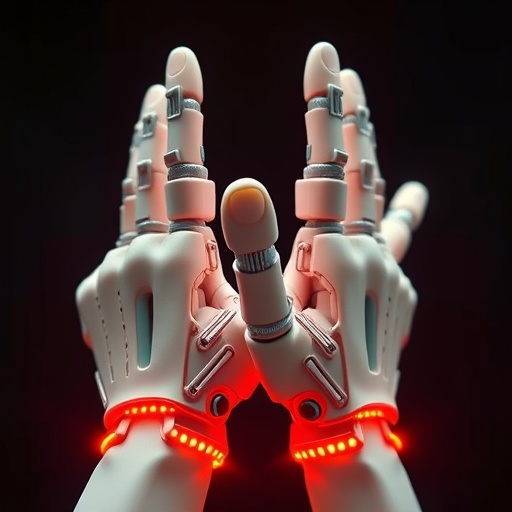
A new study suggests that imagining movement with both an ordinary human thumb and an additional robotic thumb may do more than exercise the mind: it may strengthen the brain networks responsible for sensing and controlling movement. The research, led by Alsuradi, Hong, Korres and colleagues, examines how the brain responds when people simultaneously imagine moving a natural thumb and a supernumerary robotic thumb. Published in Communications Engineering in 2026, the work offers a striking glimpse into how the human nervous system could adapt to wearable robotic limbs that expand the body’s physical capabilities rather than simply restore abilities that have been lost.
The concept of a supernumerary robotic thumb is different from that of a conventional prosthetic. A prosthetic generally replaces a missing body part and is designed to reproduce a function that the user no longer has. A supernumerary device, by contrast, adds an extra limb or digit to an intact body. The robotic thumb explored in this line of research is therefore not intended to substitute for the user’s biological thumb. It is designed to work alongside it, potentially allowing a person to grasp, stabilize or manipulate objects in ways that would be impossible with the natural hand alone. The central scientific challenge is determining whether the brain can incorporate such an additional device into its existing movement system.
The study focuses on motor imagery, the ability to mentally simulate an action without physically performing it. When a person imagines moving a hand or finger, many of the same brain regions involved in real movement become active, including areas within the motor cortex, premotor cortex and parietal cortex. Motor imagery is widely used in rehabilitation, sports training and brain-computer interfaces because it can engage motor networks without requiring visible muscle movement. In the new research, participants imagined moving their natural thumb and the robotic thumb concurrently, creating a demanding mental task that required the brain to represent two coordinated effectors at once.
This kind of dual imagery provides researchers with a way to investigate the limits of the human body schema—the brain’s internal model of the body and its possible actions. Under ordinary conditions, the nervous system must coordinate a fixed number of limbs and digits, combining visual, tactile and proprioceptive information into a coherent sense of bodily control. Introducing a robotic thumb complicates that model. The brain must distinguish between the biological digit and the artificial one while also planning how their movements might interact. The findings reported by the researchers indicate that this process is not merely possible; concurrent imagery may actively reinforce the kinesthetic sensorimotor networks that support the experience and control of movement.
The term “kinesthetic” refers to the brain’s representation of movement and bodily position, including the imagined feeling of an action unfolding. Kinesthetic networks integrate signals from muscles, joints and skin with higher-level motor planning. They allow people to estimate where a limb is located, how it is moving and what force may be required to complete a task. Strengthening these networks is important for technologies that depend on intuitive control, because a robotic limb becomes more useful when operating it feels less like issuing commands to a machine and more like directing part of the body.
The researchers’ approach is especially relevant to the development of human-machine interfaces. Many robotic devices are controlled through buttons, switches, gestures or electrical signals recorded from muscles. These methods can work effectively, but they may require conscious effort and can impose a cognitive burden. A system that responds to motor imagery could offer a more natural pathway, particularly if the brain develops a stable internal representation of the device. By showing that imagined actions involving a natural and an additional robotic thumb are associated with strengthened sensorimotor connectivity, the study points toward training methods that could help users acquire more fluid control.
The findings also raise the possibility that motor imagery could prepare the brain before a robotic limb is used physically. Mental rehearsal is already known to influence neural plasticity, the nervous system’s ability to reorganize its connections in response to learning and experience. If imagining a robotic thumb can reinforce the networks involved in movement representation, structured imagery sessions might eventually be incorporated into the calibration of wearable robots. Users could practice coordinating the biological and artificial digits mentally, allowing control algorithms and the nervous system to adapt together. Such an approach could be valuable when physical training is tiring, impractical or limited by the device’s availability.
The study’s implications extend beyond robotic thumbs. Researchers are increasingly exploring extra robotic fingers, arms, tails and other wearable systems designed to augment human action. These technologies could support workers who need additional stability or precision, assist individuals performing complex assembly tasks, or enable new forms of interaction with tools and environments. Yet augmentation introduces questions that conventional prosthetics do not fully address. How many additional effectors can the brain represent? Can an artificial limb become part of a person’s perceived body? What types of sensory feedback are required for reliable control? The new work contributes to these questions by showing that even imagined coordination with a supernumerary digit can engage and strengthen relevant sensorimotor systems.
The results should not be interpreted as evidence that robotic limbs can immediately be controlled effortlessly or that mental imagery alone can replace extensive practice. A robotic device must still be engineered to respond accurately, safely and with minimal delay, while users need feedback that tells them whether an imagined action has succeeded. The study instead provides evidence for a neural foundation on which future systems may be built. Its significance lies in demonstrating that the brain’s movement networks can be trained to accommodate the idea of an additional robotic body part, a finding that could influence neurorehabilitation, prosthetic design, wearable robotics and brain-computer interface research.
As robotic augmentation moves from laboratory demonstrations toward practical devices, the boundary between biological and artificial movement may become increasingly flexible. The work by Alsuradi, Hong, Korres and colleagues suggests that the first step toward operating an extra thumb may not be physical movement at all, but the ability to imagine it. By repeatedly engaging the brain’s kinesthetic sensorimotor networks, users may be able to develop a more integrated representation of a machine attached to the body. That possibility makes the study a compelling signal of where human-machine interaction may be headed: not toward replacing the body, but toward expanding what the brain considers part of its capacity to act.
Cite Scienmag News
Denise Maddox. (August 15, 2026). Imagining natural and extra robotic thumbs together strengthens kinesthetic sensorimotor networks. Scienmag. https://scienmag.com/imagining-natural-and-extra-robotic-thumbs-together-strengthens-kinesthetic-sensorimotor-networks/
Denise Maddox. "Imagining natural and extra robotic thumbs together strengthens kinesthetic sensorimotor networks." Scienmag, 15 August 2026, https://scienmag.com/imagining-natural-and-extra-robotic-thumbs-together-strengthens-kinesthetic-sensorimotor-networks/. Accessed 4 September 2026.
Denise Maddox. "Imagining natural and extra robotic thumbs together strengthens kinesthetic sensorimotor networks." Scienmag. August 15, 2026. https://scienmag.com/imagining-natural-and-extra-robotic-thumbs-together-strengthens-kinesthetic-sensorimotor-networks/


