


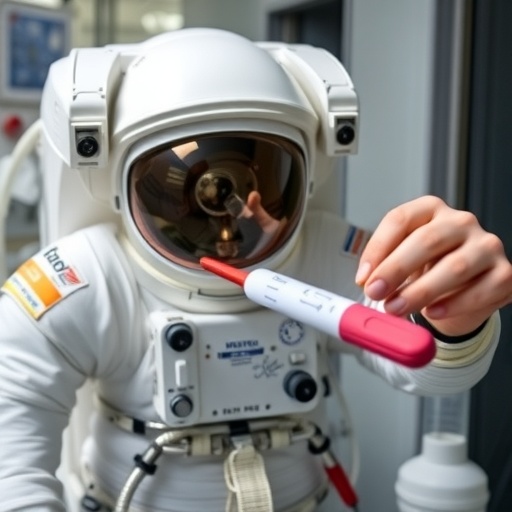
For astronauts living aboard the International Space Station, constipation is a familiar but poorly understood consequence of spaceflight. A new study from the University of Copenhagen, conducted in collaboration with NASA, offers evidence that the problem may begin with a fundamental change in the way intestinal microbes process food when gravity is removed. By analyzing blood samples from 52 astronauts who completed missions lasting several months, researchers identified metabolic signals showing that gut bacteria increasingly fermented protein soon after the astronauts reached orbit. The shift persisted throughout their time in space and returned toward normal after they came back to Earth, suggesting that spaceflight alters intestinal function in a consistent and measurable way.
The findings, published in Nature Communications, provide one of the clearest indications yet that the human gut responds rapidly to the physical conditions of space. Under normal circumstances, food moves through the digestive tract with the help of coordinated muscular contractions known as peristalsis. Gravity is not the only force involved in intestinal transit, but its absence may contribute to slower movement of food through the gut. When material remains in the intestine for longer periods, the balance of microbial activity can change. Instead of primarily consuming dietary fiber, bacteria may begin breaking down available proteins, producing a different collection of chemical compounds that can enter the bloodstream.
This process, known as protein fermentation, is not inherently abnormal. It can occur on Earth whenever intestinal bacteria have limited access to fiber or when food passes slowly through the digestive system. However, increased protein fermentation can generate metabolites associated with undesirable biological effects. These compounds include substances produced when microbes convert amino acids into smaller molecules, some of which may influence inflammation, kidney function, neurological signaling and the communication network linking the gut with the brain. The new study does not establish that these metabolites directly cause illness in astronauts, but it shows that the microbial shift is a recurring feature of spaceflight and may help explain why digestive problems are so common in orbit.
The researchers reached their conclusions by examining blood metabolites, small molecules that reflect ongoing biochemical activity in the body. Rather than searching only for a predetermined list of compounds, the team used a non-targeted metabolomics approach, measuring a broad range of substances and looking for patterns that changed during space missions. Blood samples came from three studies involving astronauts who traveled to the International Space Station. Because the samples were collected from many individuals across different missions and years, the researchers could compare a wide range of biological backgrounds and mission conditions. Despite that variation, the protein-fermentation signal appeared consistently, strengthening confidence that it was linked to spaceflight rather than to the characteristics of a single crew.
Giorgia La Barbera, a joint first author and associate professor at the University of Copenhagen’s Department of Nutrition, Exercise and Sports, said the astronauts’ blood profiles indicated that gut bacteria began fermenting protein to a greater extent within weeks of arrival in space. The pattern continued until the astronauts returned to Earth. Henrik Roager, a co-author and associate professor in the same department, said the most likely explanation is that reduced gravity slows the movement of food through the intestine. That interpretation is compatible with the astronauts’ reported constipation, although the study measured metabolic consequences rather than directly tracking intestinal transit in every participant.
The biological importance of the finding extends beyond bowel regularity. The intestine is home to a vast microbial ecosystem that continually transforms components of food into metabolites. Some of these products remain in the gut, while others cross the intestinal barrier and circulate through the body. Through the gut-brain axis, they may affect brain activity indirectly by altering immune signals, hormone pathways or neuronal communication. Lars Ove Dragsted, senior author of the study, noted that products associated with protein fermentation have been linked in previous research to potential effects such as kidney stress, changes in mood and reduced ability to concentrate. These associations do not prove that astronauts will experience such outcomes, but they raise concerns for missions in which crews must maintain cognitive performance for months or years.
The issue could become more urgent as space agencies plan longer journeys to the Moon and prepare for eventual missions to Mars. A trip to Mars would expose astronauts to an extended period of altered gravity, restricted living conditions and limited opportunities to modify their environment. Digestive changes that are manageable during a mission to low Earth orbit could become more consequential when medical support is far away. Diet may offer one of the simplest countermeasures. Increasing the availability of fermentable dietary fiber, adding prebiotics that selectively nourish beneficial microbes, or using treatments that encourage peristalsis could help reduce the time food remains in the intestine and limit the microbial shift toward protein fermentation. Any intervention would need to be tested carefully, since excessive fiber or poorly chosen supplements can also cause bloating and discomfort in confined spacecraft.
The study may also have relevance for patients on Earth who spend long periods in bed or have severely limited mobility. Bedridden people frequently develop constipation, and reduced physical activity can slow intestinal transit in ways that may resemble some effects of spaceflight. If they also experience increased protein fermentation, the resulting metabolites could contribute to existing health problems. The researchers suggest that insights gained from astronauts could therefore guide nutritional or clinical strategies for patients whose digestive systems are affected by immobility. Space medicine, in this sense, may offer a model for understanding how the human body responds whenever movement, gravity or normal daily activity is sharply reduced.
The investigation also illustrates how the International Space Station can serve as a platform for extracting new information from existing biological samples. Small amounts of blood collected during earlier missions were sufficient for extensive metabolic analysis, allowing scientists to revisit material gathered for other purposes. The collaboration brought together researchers at the University of Copenhagen and NASA, including Sara R. Zwart and Scott M. Smith, alongside La Barbera, Jan Stanstrup, Henrik M. Roager and Lars Ove Dragsted. Although the results reveal a strong and reproducible metabolic pattern, further work is needed to determine exactly how gravity, diet, exercise, medication and individual microbiomes interact. Future studies that combine blood metabolomics with direct measurements of gut transit, stool microbiota and dietary intake could show whether preventing protein fermentation improves astronauts’ comfort, cognition and long-term health during deep-space travel.
News Publication Date: 14-Aug-2026
Web References: https://doi.org/10.1038/s41467-026-74979-w
References: Nature Communications, DOI: 10.1038/s41467-026-74979-w
Keywords
Spaceflight, astronauts, gut microbiome, protein fermentation, constipation, microgravity, metabolomics, gut-brain axis, intestinal health, NASA, International Space Station, dietary fiber, Mars missions
Cite Scienmag News
Morgan Morrow. (August 14, 2026). Blood tests reveal why constipation is common among astronauts. Scienmag. https://scienmag.com/blood-tests-reveal-why-constipation-is-common-among-astronauts/
Morgan Morrow. "Blood tests reveal why constipation is common among astronauts." Scienmag, 14 August 2026, https://scienmag.com/blood-tests-reveal-why-constipation-is-common-among-astronauts/. Accessed 4 September 2026.
Morgan Morrow. "Blood tests reveal why constipation is common among astronauts." Scienmag. August 14, 2026. https://scienmag.com/blood-tests-reveal-why-constipation-is-common-among-astronauts/


