


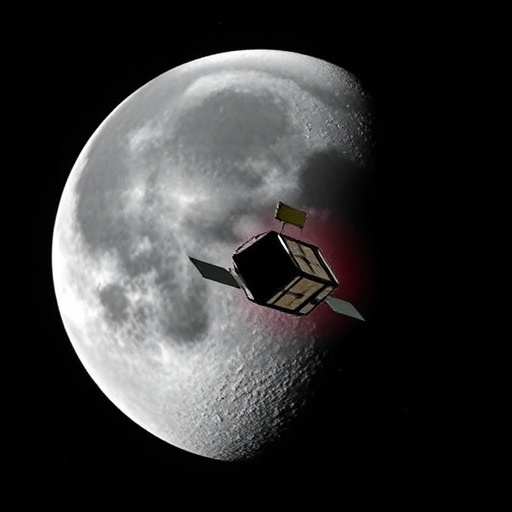
A satellite no larger than a small carry-on suitcase could soon attempt to listen to one of the faintest signals in the history of the universe. Developed in the United Kingdom, CosmoCube is designed to orbit the Moon and investigate the cosmic “dark ages,” the poorly understood period that began after the Big Bang’s afterglow faded but ended before the first stars ignited. Led by researchers at the University of Cambridge, the mission aims to detect radio emissions from primordial hydrogen more than 13.5 billion years old. If successful, it could provide the first direct observational evidence of how the universe evolved from a nearly empty, dark state into the structured cosmos filled with stars and galaxies today.
The target is the hydrogen 21-centimetre line, a natural radio signal produced by the spin state of neutral hydrogen atoms. In the early universe, hydrogen was the dominant element, and its atoms interacted with the surrounding radiation and matter in ways that encoded information about temperature, density and the influence of gravity. The signal is expected to contain clues about the conditions between the end of the Big Bang’s afterglow and the formation of the first stars, a period often described as the cosmic dark ages. Because the first stars had not yet begun producing light, hydrogen is one of the only available messengers from this otherwise invisible chapter of cosmic history.
Observing the signal from Earth is exceptionally difficult. As the universe expanded, the original 21-centimetre emission was stretched to much longer wavelengths, shifting it into a frequency range of approximately 10 to 50 megahertz. These frequencies are strongly affected by Earth’s ionosphere, which can absorb, distort or reflect incoming radio waves. Even when a signal reaches the ground, it is buried beneath powerful interference generated by radio stations, satellites, mobile communications and other human technologies. The Milky Way also produces intense radio emission, creating a foreground that can be millions of times brighter than the cosmological signal scientists are trying to isolate.
CosmoCube’s solution is to use the Moon as a natural radio shield. In lunar orbit, the spacecraft will spend roughly 40 minutes of every two-hour orbit above the far side, where the bulk of the Moon blocks radio noise from Earth. This temporary radio silence will not make the universe quiet, but it will remove one of the largest sources of contamination facing low-frequency astronomy. During an expected two-year mission, the satellite could collect approximately 1,000 hours of observations while shielded from terrestrial interference. By combining measurements gathered across many orbits, researchers hope to build a statistically reliable picture of the early hydrogen signal.
The spacecraft will carry a miniature, fully integrated radiometer, an instrument designed to measure extremely weak variations in radio brightness. Its antenna will unfold in lunar orbit and scan the sky for the broad spectral signature of neutral hydrogen. Rather than producing a conventional image of individual stars or galaxies, CosmoCube will measure how the average radio signal changes with frequency and direction. Those changes could reveal the thermal history of the early universe and indicate when the first sources of light began altering the surrounding hydrogen. Because the mission is expected to operate at frequencies inaccessible to most ground-based observatories, it will explore a region of cosmic history that remains largely beyond the reach of existing facilities.
Extreme sensitivity creates its own technical problems. Tiny changes in the spacecraft’s electronics, temperature or antenna response can imitate the gradual signal variations expected from the early universe. To combat this, CosmoCube will use a Dicke-switched calibration system that repeatedly compares the sky with several built-in reference sources. This process allows the instrument to track and correct internal gain changes and electronic noise. The calibration strategy is essential because the spacecraft is not simply searching for a bright, isolated transmission; it is attempting to identify a minute cosmological imprint hidden inside the instrument’s own response and the much stronger radiation of the Galaxy.
After the data return to Earth, the team will apply Bayesian statistical methods to separate the likely cosmological signal from foreground emission. Bayesian analysis allows researchers to combine measurements with physical models and calculate which possible signal histories best fit the observations. Computer simulations and in-flight measurements will also be used to reconstruct the antenna’s response to different parts of the sky. This response, known as the beam pattern, determines how much radiation from each direction contributes to a measurement. Correcting for it will help the scientists subtract distortions and distinguish genuine features of the 21-centimetre signal from artefacts introduced by the spacecraft or observing geometry.
The scientific payoff could extend beyond the history of the first stars. CosmoCube may also test how dark matter shaped the early universe. Although dark matter does not emit or absorb light in the ordinary way, its gravity helped pull hydrogen into denser regions, eventually creating the seeds of the first stars and galaxies. Different dark-matter properties would leave different signatures in the distribution and temperature of early hydrogen. By comparing the observed radio spectrum with theoretical models, scientists could investigate how rapidly matter clumped together and how the unseen component of the universe influenced the transition from darkness to Cosmic Dawn. Such measurements could complement observations from larger telescopes that study later stages of cosmic evolution.
The mission has received support from the UK Space Agency, the Kavli Foundation and the Science and Technology Facilities Council, part of UK Research and Innovation. Surrey Space Technology Limited is developing the spacecraft platform, known as SSTL-21, while researchers at the University of Cambridge, the University of Portsmouth and STFC RAL Space are contributing to the science and engineering. Partners from European countries, including Malta, are also involved. Working laboratory prototypes have already been built, and representative spacecraft and payload models are undergoing environmental testing to assess whether the instrument can maintain the required thermal and electronic stability in lunar orbit. The team has participated in the European Space Agency’s mini-Fast mission call, with a proposed mission cost below €50 million, and hopes CosmoCube could launch within the next five years.
CosmoCube will not be the only project seeking shelter behind the Moon. Space agencies in the United States, India and other countries are developing concepts for lunar-orbiting or lunar-surface radio observatories, recognizing that the far side offers a rare zone protected from Earth’s technological noise. What makes the British proposal especially notable is its compact scale: a relatively small spacecraft is being designed to perform precision cosmology in one of the most demanding environments accessible to modern space science. If its calibration systems and analysis techniques work as planned, CosmoCube could turn the Moon into a listening post for the universe’s earliest audible trace, bringing scientists closer to understanding how the first stars emerged from the darkness.
News Publication Date:
14-Aug-2026
Web References:
https://www.nature.com/articles/s41550-026-02946-y
References:
Nature Astronomy, DOI: 10.1038/s41550-026-02946-y
Keywords
CosmoCube, lunar mission, cosmic dark ages, Cosmic Dawn, 21-centimetre cosmology, neutral hydrogen, dark matter, radio astronomy, Moon, University of Cambridge, low-frequency astronomy, early universe
Cite Scienmag News
Grant Pearson. (August 14, 2026). Tiny satellite to use Moon’s far side to detect early-universe signals. Scienmag. https://scienmag.com/tiny-satellite-to-use-moons-far-side-to-detect-early-universe-signals/
Grant Pearson. "Tiny satellite to use Moon’s far side to detect early-universe signals." Scienmag, 14 August 2026, https://scienmag.com/tiny-satellite-to-use-moons-far-side-to-detect-early-universe-signals/. Accessed 3 September 2026.
Grant Pearson. "Tiny satellite to use Moon’s far side to detect early-universe signals." Scienmag. August 14, 2026. https://scienmag.com/tiny-satellite-to-use-moons-far-side-to-detect-early-universe-signals/


