


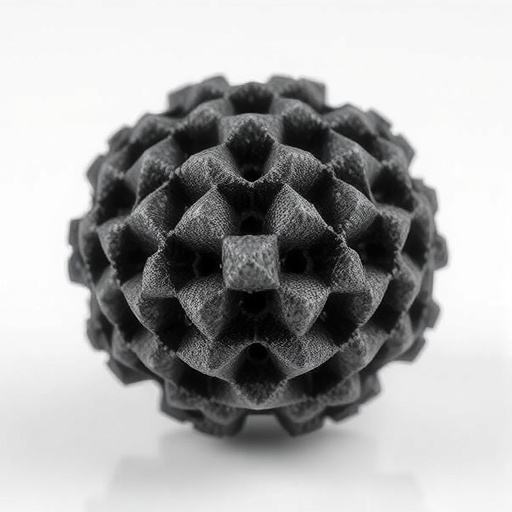
Volatile organic compounds, or VOCs, are among the most elusive pollutants in the air around us. Released by paints, fuels, solvents, adhesives, plastics, cleaning products and industrial processes, these carbon-based chemicals can evaporate readily at room temperature and travel far beyond their original source. Some contribute to smog formation, while others pose direct risks to human health after prolonged exposure. A new study by B. Szczęśniak, A. Kapusta, J. Choma and colleagues presents a materials-based strategy that could make capturing these pollutants more efficient: transforming ordinary graphite through mechanical forces and then activating it to create porous, graphene-containing sorbents.
Published in Scientific Reports, the research focuses on a deceptively simple starting material. Graphite is familiar as the “lead” in pencils, but at the atomic level it consists of layers of carbon atoms arranged in a hexagonal structure. These layers are held together relatively weakly compared with the strong bonds within each sheet. That layered architecture makes graphite a promising precursor for graphene-related materials, yet converting it into a form with useful adsorption properties is not straightforward. The researchers investigated mechanochemical conversion, a process in which intense grinding, milling or other mechanical treatment drives chemical and structural changes without relying primarily on conventional solvents or high-temperature reactions.
Mechanochemistry is attracting growing attention because it can alter materials using physical energy rather than large volumes of liquid reagents. During milling, collisions between hard particles can generate localized pressure, friction and heat. These forces may fracture graphite flakes, reduce their dimensions, disrupt the stacking of carbon layers and create new edges or structural imperfections. In some cases, the process can partially separate graphitic sheets or produce graphene-like fragments. The result is not necessarily pristine, single-layer graphene, but rather a complex carbon material containing graphitic domains, exfoliated layers and defects. For adsorption, that complexity can be an advantage: defects and exposed edges may provide additional sites where pollutant molecules can attach.
The researchers then examined activation, a crucial stage in the development of porous carbon sorbents. Activation generally means creating or enlarging a network of microscopic voids inside a carbon material. These pores can range from relatively large channels to nanometre-scale cavities, dramatically increasing the internal surface area available for contact with gases. Physical and chemical activation methods can remove less stable carbon regions, open blocked pathways and tune the distribution of pore sizes. In a graphene-containing sorbent, the interaction between porous architecture and graphitic surfaces may be especially important. Pores can concentrate VOC molecules inside the material, while aromatic carbon surfaces can attract them through dispersion forces and other non-covalent interactions.
This combination addresses a central challenge in air purification: VOC molecules differ widely in size, shape, polarity and chemical behaviour. A sorbent designed for one compound may perform less effectively against another. A highly porous material offers abundant space for adsorption, but pore dimensions must also be compatible with the pollutants being captured. If pores are too narrow, molecules may be unable to enter; if they are too large, the material may lose some of the strong confinement effects associated with smaller pores. Surface chemistry matters as well. Graphene-like carbon is largely hydrophobic and can interact strongly with many non-polar organic molecules, while activation-induced functional groups may influence the capture of more chemically diverse compounds.
The work is significant because it connects three areas of materials science that are often investigated separately: graphite conversion, graphene-related structures and environmental sorption. Rather than treating graphite as a finished material, the study explores it as a feedstock that can be mechanically transformed and chemically activated into a new class of carbon adsorbents. This approach may offer practical advantages in resource use. Mechanochemical processing can reduce dependence on solvents, and graphite is widely available compared with some specialized nanomaterial precursors. If the resulting sorbents can be manufactured consistently, they could eventually support applications ranging from industrial emission control to air-cleaning devices and protective filtration systems.
The potential environmental impact is substantial, although the performance of any sorbent must be judged through detailed measurements rather than its structure alone. Useful evaluation includes determining surface area, total pore volume, pore-size distribution, elemental composition and the degree of graphitic ordering. Researchers also need to measure how quickly VOCs are captured, how much pollutant the material can hold, and whether adsorption remains effective in humid air. Water vapour can compete with organic molecules for active sites or alter the behaviour of narrow pores. Real-world air streams may also contain mixtures of VOCs, particulate matter and reactive gases, making regeneration and long-term stability essential considerations.
Regeneration is particularly important for the sustainability of adsorption-based technologies. A sorbent that captures VOCs but cannot be reused may simply shift the pollution problem into a solid waste stream. Thermal treatment, pressure changes, purging or other methods may release the trapped compounds and restore the material’s capacity, but each option requires energy and must avoid producing hazardous by-products. The mechanochemical route described in the study therefore raises questions that extend beyond initial adsorption performance: how many capture-and-release cycles can the material survive, whether its pores remain open, and whether the surface chemistry changes after exposure to complex gas mixtures. These factors will determine whether graphite-derived sorbents can move from laboratory research toward practical devices.
The study arrives as demand grows for low-cost technologies capable of controlling air pollution at its source. Conventional activated carbons already play an important role in filtration, but researchers continue searching for materials with improved capacity, tunable pore structures and simpler production routes. Graphene-containing porous carbons occupy an intriguing middle ground between traditional activated carbon and highly engineered nanomaterials. By using mechanical energy to reorganize graphite and activation to sculpt its internal structure, Szczęśniak, Kapusta, Choma and their colleagues highlight a pathway toward carbon sorbents designed for the molecular challenge of VOC removal. The broader message is striking: a material as ordinary as graphite may become the starting point for advanced air-cleaning technologies when its layered structure is unlocked through force, chemistry and nanoscale engineering.
Cite Scienmag News
Neil Sanderson. (August 14, 2026). Mechanochemistry Converts Graphite into Porous Graphene Sorbents for Capturing VOCs. Scienmag. https://scienmag.com/mechanochemistry-converts-graphite-into-porous-graphene-sorbents-for-capturing-vocs/
Neil Sanderson. "Mechanochemistry Converts Graphite into Porous Graphene Sorbents for Capturing VOCs." Scienmag, 14 August 2026, https://scienmag.com/mechanochemistry-converts-graphite-into-porous-graphene-sorbents-for-capturing-vocs/. Accessed 3 September 2026.
Neil Sanderson. "Mechanochemistry Converts Graphite into Porous Graphene Sorbents for Capturing VOCs." Scienmag. August 14, 2026. https://scienmag.com/mechanochemistry-converts-graphite-into-porous-graphene-sorbents-for-capturing-vocs/


