


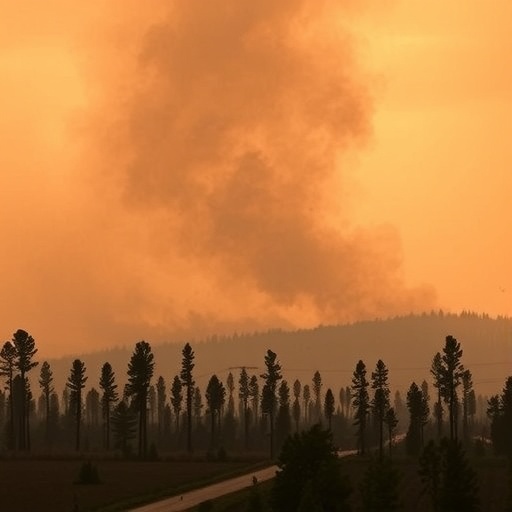
Richmond Hill, Ontario, Canada, 13 August 2026 — A mid-July wave of wildfire smoke from Canada exposed people across Canada and the United States to unhealthy, very unhealthy or hazardous air for nearly 106 million person-days, according to a new analysis by the United Nations University Institute for Water, Environment and Health. During the broader peak period from 13 to 18 July, moderate or worse air quality affected more than 769 million person-days, illustrating how smoke from remote boreal forests can become a continent-scale public-health emergency within days. Toronto briefly recorded the poorest air quality of any major city in the world as plumes from fires in Ontario spread across densely populated regions.
The findings are presented in “The July 2026 Wildfires in Canada and Their Transboundary Smoke Problem,” an Incident Brief that combines satellite-derived fire perimeters, ground-based air-quality observations and gridded population data. The researchers assessed wildfire activity across Canada through 21 July and estimated human exposure in both Canada and the United States during the mid-July smoke episode. Their use of “person-days” captures not only how many people encountered polluted air, but also how long the exposure lasted: one person breathing unhealthy air for five days represents five person-days, as does five people exposed for one day. The measure provides a clearer picture of the cumulative burden than a single daily population estimate.
Canada’s fire season initially appeared relatively quiet. By 28 June, the country had burned more than 1.2 million hectares below its 10-year average for that date. The situation changed rapidly after a major North American heat dome settled over much of the continent. By 21 July, the national fire area had moved from a substantial deficit to a surplus of approximately 367,000 hectares. In total, 3,915 fires had burned nearly 3.04 million hectares, making 2026 the third-largest year-to-date fire season at that point, behind only 2023 and 2025. The abrupt reversal demonstrates how a short period of extreme heat and drying can overwhelm seasonal averages and transform wildfire conditions across a vast area.
Ontario was the main driver of that shift. The province recorded 565 fires covering more than 728,000 hectares, approximately three and a half times its 10-year average. Although Ontario’s annual precipitation was close to normal, weather conditions in the southwest told a different story. Rainfall during the preceding two months was more than two standard deviations below normal in parts of the region, while temperatures averaged more than 2°C above the historical norm. Those combined stresses rapidly reduced moisture in vegetation and soils. In forest ecosystems, low fuel moisture allows flames to spread more efficiently, increases the likelihood of intense burning and promotes the formation of powerful smoke plumes capable of travelling far beyond the fire zone.
The composition and structure of Canada’s forests amplified the event. Dense, carbon-rich vegetation can release enormous quantities of fine particulate matter when it burns, especially particles smaller than 2.5 micrometres in diameter, commonly known as PM2.5. These particles are small enough to penetrate deep into the lungs and, in some cases, enter the bloodstream. Smoke exposure can aggravate asthma and chronic obstructive pulmonary disease, increase stress on the cardiovascular system and raise risks for vulnerable groups, including children, older adults and people with heart or lung conditions. Because smoke can remain suspended and be transported hundreds or even thousands of kilometres, the health consequences are not confined to communities near the flames.
Smoke from Ontario moved across southern Ontario and parts of Quebec before crossing into the United States. Detroit, Minneapolis, Milwaukee, Chicago, New York City and Washington, D.C., all experienced deteriorating air quality during the episode. Authorities in numerous states advised residents to remain indoors, reduce strenuous outdoor activity and use additional precautions when exposure could not be avoided. Some municipalities cancelled public events or moved them indoors. For many urban residents, the crisis arrived not as a visible wall of flame but as an orange or hazy sky, the smell of burning forests and air-quality alerts issued hundreds of kilometres from the nearest active fire.
The event also exposed the political sensitivity of transboundary air pollution. Canada and the United States have a long history of cooperation in firefighting, emergency management and environmental monitoring, yet climate-driven smoke can strain relationships even between close partners. Pollution generated in one country can rapidly affect public health, transportation, schools, workplaces and outdoor economies in another. The Incident Brief argues that fire response and public-health planning must therefore be coordinated across borders, with compatible warning systems, shared data and contingency plans for prolonged smoke episodes. Treating wildfire smoke as a local problem is increasingly out of step with the physical behaviour of the atmosphere.
The most direct displacement occurred in Indigenous communities located near active fires. More than 3,500 First Nations residents were displaced nationally by mid-July, while as many as 11 Ontario First Nations faced evacuation orders or other wildfire-related disruptions. Approximately 1,800 people left remote communities in northwestern Ontario, many of which can be reached only by air or water. Ontario requested federal assistance, including support from the Canadian Armed Forces, to help reach and evacuate isolated areas. In Namaygoosisagagun First Nation, residents escaped by boat as an approaching fire destroyed the community, while Whitewater Lake First Nation was also affected. The fires disrupted transportation and economic activity as well, temporarily halting Canadian National Railway operations and isolating communities dependent on critical supply routes.
The researchers say the response must extend beyond emergency evacuations. National and provincial authorities should strengthen evacuation preparedness, expand shelter capacity in remote and Indigenous communities and establish clean-air shelters for residents who cannot adequately filter indoor air. Public-health guidance should be specific, timely and accessible, explaining when people should reduce outdoor activity, how to improve indoor air quality and which symptoms require medical attention. Investments in early fire detection, satellite monitoring and fire-resistant infrastructure could reduce losses in high-risk regions, while coordinated cross-border communication would help residents understand the risks before smoke becomes severe. Climate mitigation remains central: warming conditions are drying landscapes, increasing fire intensity and lengthening the period in which large fires can develop.
“Climate change has not only increased the frequency of wildfires, especially in the mesic vegetation types, but also made them more intense,” said Mojtaba Sadegh, Climate and Wildfire Analytics Lead at UNU-INWEH. “When these dense forests burn, they release a huge amount of smoke that impacts millions of people far away from the burn perimeters.” Kaveh Madani, Director of UNU-INWEH, described the problem as inherently shared, noting that smoke generated in northern Ontario can be inhaled in a Chicago schoolyard a day later. The July episode, the institute’s third Incident Brief on North American fires following assessments of the January 2025 Los Angeles fires and the May–June 2025 Central Canada fires, offers a warning for a hotter future: cities that have learned to prepare for heat must now plan for smoke, while the communities facing evacuation first require sustained investment and protection.
News Publication Date: 13 August 2026
Web References: https://unu.edu/publication/july-2026-wildfires-canada-and-their-transboundary-smoke-problem; https://unu.edu/inweh
References: Teymoor, S., Abatzoglou, J., AghaKouchak, A., Pigeon, J., Madani, K., Matin, M., and Sadegh, M. (2026). The July 2026 Wildfires in Canada and Their Transboundary Smoke Problem. United Nations University Institute for Water, Environment and Health. DOI: 10.53328/INI26IMS001
Cite Scienmag News
Russell Cooper. (August 13, 2026). Ontario wildfire smoke exposed Americans to unhealthy air for 106 million person-days. Scienmag. https://scienmag.com/ontario-wildfire-smoke-exposed-americans-to-unhealthy-air-for-106-million-person-days/
Russell Cooper. "Ontario wildfire smoke exposed Americans to unhealthy air for 106 million person-days." Scienmag, 13 August 2026, https://scienmag.com/ontario-wildfire-smoke-exposed-americans-to-unhealthy-air-for-106-million-person-days/. Accessed 3 September 2026.
Russell Cooper. "Ontario wildfire smoke exposed Americans to unhealthy air for 106 million person-days." Scienmag. August 13, 2026. https://scienmag.com/ontario-wildfire-smoke-exposed-americans-to-unhealthy-air-for-106-million-person-days/


