


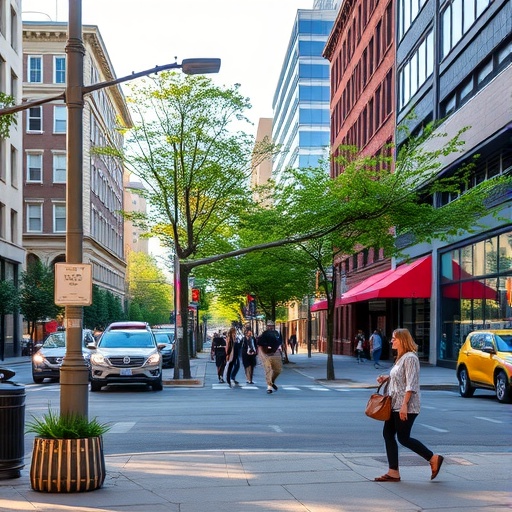
Cities may be approaching one of their most consequential design decisions with the wrong question. Instead of asking how to move more cars through increasingly crowded streets, planners may need to ask what people want those streets to become. A new study published in npj Urban Sustainability presents large-scale evidence that residents often favor urban redesigns that give more space to pedestrians, cyclists, greenery and public life—even when those changes require removing or reducing space currently devoted to automobiles. The research, led by Matthias Wicki, C. Sinatra and A. Huang, used a visual choice experiment to show participants alternative versions of urban streets and asked them to choose which environments they preferred. The approach transforms an abstract planning debate into a direct test of public perception, revealing how people respond when road space is visibly redistributed.
The central idea is simple but powerful: people do not experience streets as traffic diagrams. They encounter them as places where they walk, wait, meet friends, shop, cycle, cross roads, sit, play and breathe. Conventional transport models often measure speed, vehicle capacity and travel time, but those indicators capture only one function of a street. The new research focuses instead on the street as a shared public environment. Participants were shown visual representations of possible redesigns, allowing researchers to compare reactions to different combinations of sidewalks, cycle infrastructure, planting, seating, parking and motor-vehicle lanes. Because the experiment could present many respondents with standardized images, it offered a way to measure preferences at a scale that is difficult to achieve through conventional neighborhood consultations.
Visual choice experiments are increasingly important in urban research because the effects of street redesigns are often difficult to describe in words. A plan stating that “one traffic lane will be converted into public space” can sound either modest or disruptive, depending on what the listener imagines replacing it. A rendered street scene makes the trade-off concrete. Participants can see whether a wider pavement creates room for trees and benches, whether a protected cycle lane separates riders from traffic, or whether fewer parked cars opens sightlines and improves pedestrian movement. In technical terms, the method allows researchers to estimate the relative value people assign to different design attributes. By observing repeated choices across changing visual scenarios, analysts can identify which features consistently influence decisions and which combinations produce the strongest support.
The findings point toward a broad appetite for streets designed around human activity rather than vehicle storage. Across the alternatives, configurations that increased space for walking, cycling, greenery and social use emerged as attractive choices, while designs dominated by parked cars and uninterrupted vehicle lanes were less appealing. That result matters because parking occupies a remarkable share of public land in many urban areas, even though a parked vehicle serves no immediate transport function. Converting some of that space into planting, seating, safer crossings or cycling facilities can change the character of a street without requiring a completely new road network. The study does not suggest that cars become irrelevant or that every street should follow one identical template. Instead, it indicates that residents may be more receptive to reallocating space when the benefits are visible and tangible.
The visual evidence also helps explain why proposed car-reduction projects can trigger political resistance before construction begins. People may fear losing convenience, access or neighborhood identity when they hear that parking or driving lanes will be removed. Yet the finished alternative can look very different from the mental image created by a technical policy description. A street with fewer cars is not necessarily an empty street; it may be a more useful street, with room for shade, deliveries, accessible walking routes, children’s movement and informal encounters. By presenting complete environments rather than isolated interventions, the experiment captures the combined effect of multiple changes. A protected cycle lane may be welcomed more strongly when paired with trees and improved crossings, while a narrower road may seem less problematic when the reclaimed space becomes an attractive public realm.
This combined perspective is critical for climate and public-health policy. Transport is a major source of urban greenhouse-gas emissions, while traffic noise and air pollution are associated with cardiovascular disease, respiratory illness and reduced quality of life. Streets that encourage walking and cycling can support physical activity and reduce dependence on short car trips. Vegetation may provide shade and help moderate heat at ground level, although its effectiveness depends on species, soil, irrigation and the surrounding built form. The redesigns examined in the study therefore represent more than aesthetic improvements. They are examples of how infrastructure can influence behavior and exposure: the way a street is arranged affects whether people feel safe enough to walk, whether cycling seems practical, and whether public space is inviting during hot or polluted periods.
At the same time, the research highlights a challenge that planners cannot solve with attractive images alone: preferences are not identical across all residents. People differ in how often they drive, whether they own a car, how far they travel, whether they have mobility limitations, and how dependent they are on parking near home or work. Families, older adults, disabled travelers, tradespeople and delivery operators may evaluate the same redesign differently. A street that improves everyday life for one group could create difficulties for another if accessibility, loading, public transport and emergency access are neglected. The value of a large-scale choice experiment is that it can reveal these patterns rather than reducing public opinion to a single average. For policymakers, the implication is clear: reallocating street space should be accompanied by careful accessibility planning and alternatives for essential vehicle trips.
The study also offers a potential antidote to a recurring weakness in urban democracy. Public meetings often attract people who are already highly motivated, while quieter preferences remain invisible. Online visual experiments can reach larger and more diverse populations, test many design combinations and identify which changes generate support before expensive construction begins. They cannot replace local engagement, engineering assessments or on-street trials, but they can improve the evidence base. Temporary installations, painted curb extensions and pop-up cycle lanes could then test whether stated preferences translate into real behavior. Researchers will still need to examine traffic displacement, business impacts, safety outcomes, maintenance costs and distributional effects over time. A popular image is not proof that a project will work, but it can show which futures are worth testing.
The larger message is that the urban street is not a fixed natural habitat for cars; it is a policy choice embedded in concrete, asphalt and regulations. When cities allocate most visible space to moving and storing vehicles, they communicate what kinds of activity matter. When they make room for people, they create opportunities for healthier travel, cooler neighborhoods and more social public life. Wicki and colleagues’ experiment brings that choice into focus by asking residents to compare streets as they might actually appear, not merely as lines on a plan. Its viral potential lies in a deceptively simple conclusion: the future city may not need more space, only a different idea of what existing space is for. The question is no longer whether streets can be redesigned, but whether cities are willing to let people see—and choose—the alternatives.
Cite Scienmag News
Courtney Benton. (August 13, 2026). Study finds people favor urban streets designed for pedestrians over cars. Scienmag. https://scienmag.com/study-finds-people-favor-urban-streets-designed-for-pedestrians-over-cars/
Courtney Benton. "Study finds people favor urban streets designed for pedestrians over cars." Scienmag, 13 August 2026, https://scienmag.com/study-finds-people-favor-urban-streets-designed-for-pedestrians-over-cars/. Accessed 4 September 2026.
Courtney Benton. "Study finds people favor urban streets designed for pedestrians over cars." Scienmag. August 13, 2026. https://scienmag.com/study-finds-people-favor-urban-streets-designed-for-pedestrians-over-cars/


