

Wednesday, July 29, 2026
Science
No Result
View All Result
  • Login
  • HOME
  • SCIENCE NEWS
  • CONTACT US
  • HOME
  • SCIENCE NEWS
  • CONTACT US
No Result
View All Result
Scienmag
No Result
View All Result
Home Science News Chemistry

New bacteria-derived hydrogel heals tissue

August 19, 2024
in Chemistry
Reading Time: 2 mins read
0
New bacteria-derived hydrogel heals tissue
67
SHARES
610
VIEWS
Share on FacebookShare on Twitter
ADVERTISEMENT

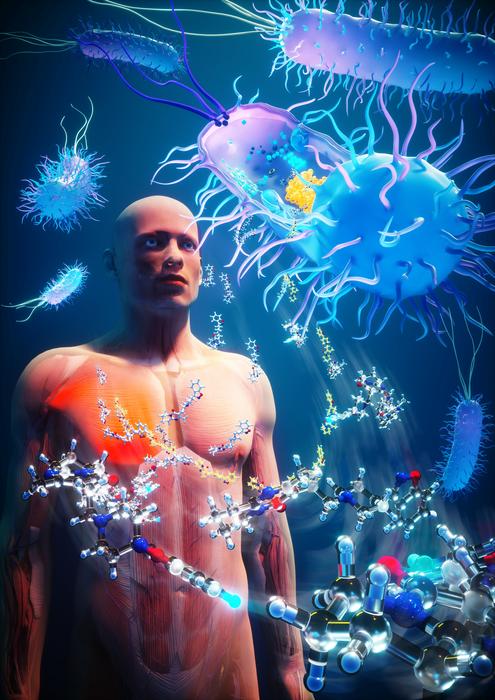
DTU researchers harness the power of bacteria to heal tissues.

New bacteria-derived hydrogel heals tissue

Credit: DTU

DTU researchers harness the power of bacteria to heal tissues.

A research team at the Technical University of Denmark, led by Alireza Dolatshahi-Pirouz, has recently uncovered new ground in tissue engineering and cell therapy by harnessing the healing power of bacteria.

The group harnessed the native bioproduction facilities in bacteria to synthesize a new biopolymer with tissue-healing properties. They used this polymer to manufacture a durable, resilient, and elastic hydrogel for muscle tissue regeneration. The study is published in the journal Bioactive Materials and details a new biopolymer – Pantoan Methacrylate, PAMA for short -with muscle regeneration properties derived from bacteria.

They have implemented this new hydrogel – or “bactogel” – to treat muscle injuries in rats with promising results. The in vivo study showed a significant increase in muscle tissue formation and reduced fibrous tissue. With nearly 100% mechanical recovery, good biocompatibility, and healing capacity, the PAMA bactogel presents a new path in the field.

“This combination of feats is rarely encountered in the field, as most bioactive hydrogels display subpar mechanical properties that do not fit the mechanically demanding milieu of musculoskeletal tissues, such as muscles, says Associate Professor Alireza Dolatshahi-Pirouz from DTU Health Tech.

“I believe that our new results could foster better therapies against musculoskeletal injuries in athletes, the elderly, as well as in wounded soldiers or others involved in accidents giving rise to traumatic muscle injuries,”

With PAMA, the team has shown that they can achieve tissue regeneration in rats without using cells, and they expect much better healing by combining their bactogels with either muscle progenitor cells or stem cells.

“I imagine a future where bacteria-derived polymers or put simply “bactomers” revolutionize the field of regenerative medicine. A future where bacteria in so-called regenerative bacto-baths secrete regenerative bactomers on demand to heal injured tissues in patients,” says Alireza Dolatshahi-Pirouz.


Journal

Bioactive Materials

DOI

10.1016/j.bioactmat.2024.04.006

Article Title

Enhancing volumetric muscle loss (VML) recovery in a rat model using super durable hydrogels derived from bacteria

Article Publication Date

1-Jun-2024

COI Statement

The authors declare that they have no known competing financial interests or personal relationships that could have appeared to influence the work reported in this paper.

Share27Tweet17
Previous Post

Herbal-based nutraceuticals in management of lifestyle diseases: Experience from Indian population

Next Post

International Society of Biomechanics recommendations for wearables-based motion capture

Related Posts

Dynamic Nanopore Breathing Boosts Efficiency for Molecule Separation and Diffusion
Chemistry

Dynamic Nanopore Breathing Boosts Efficiency for Molecule Separation and Diffusion

July 28, 2026
Astronomers Present Strongest Evidence Yet That Betelgeuse Has a Companion
Chemistry

Astronomers Present Strongest Evidence Yet That Betelgeuse Has a Companion

July 28, 2026
Cryogenic environment enables strong strain tuning of excitons in ZrSe3
Chemistry

Cryogenic environment enables strong strain tuning of excitons in ZrSe3

July 28, 2026
Xi’an Jiaotong Achieves Low-Cost Roll-to-Roll 3D Nanobowl Light-Trapping Films
Chemistry

Xi’an Jiaotong Achieves Low-Cost Roll-to-Roll 3D Nanobowl Light-Trapping Films

July 28, 2026
Biomimetic Superhydrophobic Coating Shows Flame Retardancy and Self-Extinguishing Performance
Chemistry

Biomimetic Superhydrophobic Coating Shows Flame Retardancy and Self-Extinguishing Performance

July 28, 2026
Soft Stretchy Biosensors Improve Connections with Better Adhesion
Chemistry

Soft Stretchy Biosensors Improve Connections with Better Adhesion

July 28, 2026
Next Post
International Society of Biomechanics recommendations for wearables-based motion capture

International Society of Biomechanics recommendations for wearables-based motion capture

  • Mothers who receive childcare support from maternal grandparents show more

    Mothers who receive childcare support from maternal grandparents show more parental warmth, finds NTU Singapore study

    27656 shares
    Share 11059 Tweet 6912
  • University of Seville Breaks 120-Year-Old Mystery, Revises a Key Einstein Concept

    1061 shares
    Share 424 Tweet 265
  • Bee body mass, pathogens and local climate influence heat tolerance

    682 shares
    Share 273 Tweet 171
  • Researchers record first-ever images and data of a shark experiencing a boat strike

    546 shares
    Share 218 Tweet 137
  • Groundbreaking Clinical Trial Reveals Lubiprostone Enhances Kidney Function

    531 shares
    Share 212 Tweet 133
Science

Embark on a thrilling journey of discovery with Scienmag.com—your ultimate source for cutting-edge breakthroughs. Immerse yourself in a world where curiosity knows no limits and tomorrow’s possibilities become today’s reality!

RECENT NEWS

  • Queen Bee Pheromones Guide Daughters in Choosing to Stay or Leave
  • Inequality rises in cities as heat and daylight patterns reshape life
  • Gut Microbiome Signatures Enable Detection of Colorectal Lesions in FIT Screening
  • Premature Infants Show Abnormal Eye Movements, New Study Finds

Categories

  • Agriculture
  • Anthropology
  • Archaeology
  • Athmospheric
  • Biology
  • Biotechnology
  • Blog
  • Bussines
  • Cancer
  • Chemistry
  • Climate
  • Earth Science
  • Editorial Policy
  • Marine
  • Mathematics
  • Medicine
  • Pediatry
  • Policy
  • Psychology & Psychiatry
  • Science Education
  • Social Science
  • Space
  • Technology and Engineering

Subscribe to Blog via Email

Enter your email address to subscribe to this blog and receive notifications of new posts by email.

Join 5,147 other subscribers

© 2025 Scienmag - Science Magazine

Welcome Back!

Login to your account below

Forgotten Password?

Retrieve your password

Please enter your username or email address to reset your password.

Log In
No Result
View All Result
  • HOME
  • SCIENCE NEWS
  • CONTACT US

© 2025 Scienmag - Science Magazine

Discover more from Science

Subscribe now to keep reading and get access to the full archive.

Continue reading
