

Sunday, May 24, 2026
Science
No Result
View All Result
  • Login
  • HOME
  • SCIENCE NEWS
  • CONTACT US
  • HOME
  • SCIENCE NEWS
  • CONTACT US
No Result
View All Result
Scienmag
No Result
View All Result
Home Science News Biology

Going slow is better for fast cycling

August 19, 2024
in Biology
Reading Time: 2 mins read
0
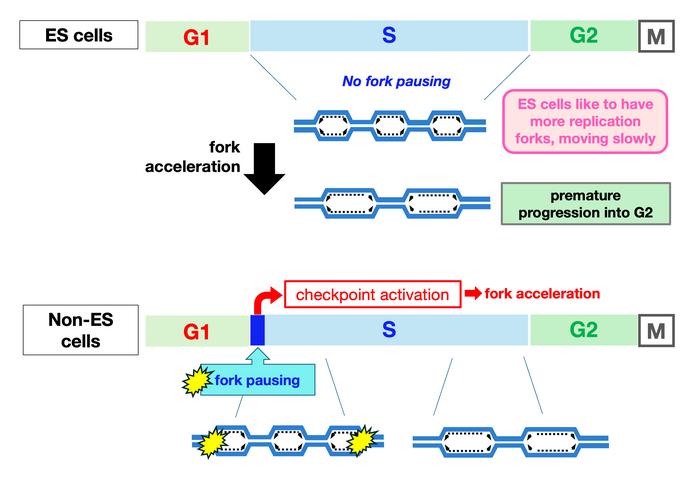
Comparison of DNA Replication Mechanism in ES and non-ES cells
67
SHARES
610
VIEWS
Share on FacebookShare on Twitter
ADVERTISEMENT

Embryonic stem (ES) cells are pluripotent stem cells that can produce all cell types of an organism. ES cells proliferate rapidly and have been thought to experience high levels of intrinsic replication stress. However, a recent report published in EMBO Reports by Kurashima et al. challenges this assumption by providing a detailed molecular investigation of replication dynamics in these cells.

Comparison of DNA Replication Mechanism in ES and non-ES cells

Credit: T. Tsubouchi

Embryonic stem (ES) cells are pluripotent stem cells that can produce all cell types of an organism. ES cells proliferate rapidly and have been thought to experience high levels of intrinsic replication stress. However, a recent report published in EMBO Reports by Kurashima et al. challenges this assumption by providing a detailed molecular investigation of replication dynamics in these cells.

Led by Dr. Tomomi Tsubouchi at the National Institute for Basic Biology (NIBB) in Japan, the research team explored replication fork dynamics – such as replication fork speed, pausing frequency, and origin firing density – across different substages of the S phase. Their findings reveal previously overlooked aspects of replication not only in ES cells but also in other non-pluripotent cells.

Dr. Kiminori Kurashima, the first author in the study, explains, “By fractionating cells in substages of the S phase and performing DNA fiber assays on these sorted populations, we discovered that mammalian pluripotent stem cells maintain a slow fork speed and high active origin density throughout the S phase, with minimal fork pausing”. This contrasts with their finding that in non-pluripotent cells, which exhibit slower fork speeds at the beginning of the S phase but accelerate thereafter. Non-pluripotent cells also experience fork pausing specifically in the early S phase, likely activating checkpoint mechanisms to facilitate fork acceleration and reduce pausing.

The research also shows that upon differentiation, mouse ES cells adopt replication characteristics similar to those of non-pluripotent cells. Furthermore, some features of DNA replication observed in mouse ES cells are shared with human iPS cells, suggesting that the slow replication fork with high origin density may be a hallmark of pluripotency. Surprisingly, forcing an acceleration of replication forks led to miscoordination between genome replication completion and cell cycle progression.

Dr. Tsubouchi concludes, “We propose that slow replication forks are not the manifestation of replication impediments but rather an integral feature of DNA replication in ES cells. Our study underscores the dynamic regulation of DNA replication and highlights how different cell types employ distinct mechanisms.”


Journal

EMBO Reports

DOI

10.1038/s44319-024-00207-5

Method of Research

Experimental study

Subject of Research

Cells

Article Title

Embryonic stem cells maintain high origin activity and slow forks to coordinate replication with cell cycle progression

Article Publication Date

25-Jul-2024

Share27Tweet17
Previous Post

Florida’s red flag gun law and firearm and nonfirearm homicide and suicide rates

Next Post

AI model aids early detection of autism

Related Posts

Rising Sightings of Blue and Fin Whales in the South East Atlantic — Biology
Biology

Rising Sightings of Blue and Fin Whales in the South East Atlantic

May 23, 2026
New Maps Reveal How European Landscapes Can Simultaneously Promote Climate Action and Biodiversity Conservation — Biology
Biology

New Maps Reveal How European Landscapes Can Simultaneously Promote Climate Action and Biodiversity Conservation

May 22, 2026
University of Cincinnati Structural Biologists Achieve World First in Visualizing Crucial Cell Protein — Biology
Biology

University of Cincinnati Structural Biologists Achieve World First in Visualizing Crucial Cell Protein

May 22, 2026
Reducing Fertilizer Use Through Strategic Scientific Partnerships — Biology
Biology

Reducing Fertilizer Use Through Strategic Scientific Partnerships

May 22, 2026
How the Gut Reprograms the Brain to Crave Essential Nutrients — Biology
Biology

How the Gut Reprograms the Brain to Crave Essential Nutrients

May 22, 2026
Decoding the Mechanisms Behind Collective Cell Movement — Biology
Biology

Decoding the Mechanisms Behind Collective Cell Movement

May 22, 2026
Next Post
Kristiina Tammimies

AI model aids early detection of autism

  • Mothers who receive childcare support from maternal grandparents show more parental warmth, finds NTU Singapore study

    Mothers who receive childcare support from maternal grandparents show more parental warmth, finds NTU Singapore study

    27649 shares
    Share 11056 Tweet 6910
  • University of Seville Breaks 120-Year-Old Mystery, Revises a Key Einstein Concept

    1052 shares
    Share 421 Tweet 263
  • Bee body mass, pathogens and local climate influence heat tolerance

    680 shares
    Share 272 Tweet 170
  • Researchers record first-ever images and data of a shark experiencing a boat strike

    543 shares
    Share 217 Tweet 136
  • Groundbreaking Clinical Trial Reveals Lubiprostone Enhances Kidney Function

    529 shares
    Share 212 Tweet 132
Science

Embark on a thrilling journey of discovery with Scienmag.com—your ultimate source for cutting-edge breakthroughs. Immerse yourself in a world where curiosity knows no limits and tomorrow’s possibilities become today’s reality!

RECENT NEWS

  • AI Insights Uncover Causes of Injury Deaths
  • Comparing Robust Intelligent Controls for 3-DOF Robots
  • Predicting Flashover on Polluted Insulators with CNN-LSTM
  • New Framework Enhances Survey Response Quality Assessment

Categories

  • Agriculture
  • Anthropology
  • Archaeology
  • Athmospheric
  • Biology
  • Biotechnology
  • Blog
  • Bussines
  • Cancer
  • Chemistry
  • Climate
  • Earth Science
  • Editorial Policy
  • Marine
  • Mathematics
  • Medicine
  • Pediatry
  • Policy
  • Psychology & Psychiatry
  • Science Education
  • Social Science
  • Space
  • Technology and Engineering

Subscribe to Blog via Email

Success! An email was just sent to confirm your subscription. Please find the email now and click 'Confirm Follow' to start subscribing.

Join 5,146 other subscribers

© 2025 Scienmag - Science Magazine

Welcome Back!

Login to your account below

Forgotten Password?

Retrieve your password

Please enter your username or email address to reset your password.

Log In
No Result
View All Result
  • HOME
  • SCIENCE NEWS
  • CONTACT US

© 2025 Scienmag - Science Magazine
