


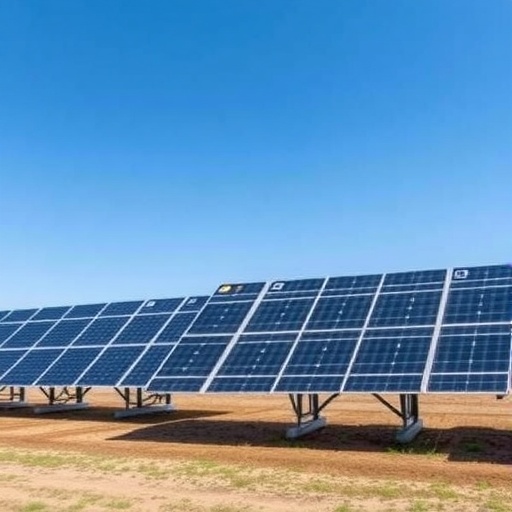
Two-terminal perovskite/silicon tandem solar cells have long been viewed as one of the most promising routes beyond the efficiency limits of conventional silicon photovoltaics. Yet a new study suggests that their performance in the real world depends on more than how efficiently they convert sunlight under laboratory conditions. The color of sunlight—how much blue, red, and infrared radiation reaches a solar module—can significantly affect how well the two active layers work together. Researchers have now mapped this spectral vulnerability across several climate zones and found that, despite measurable losses, tandem modules can still generate substantially more electricity per unit of land than today’s leading silicon technology.
The study, conducted by researchers from Southwest Petroleum University, Tongwei Solar (Chengdu) Ltd., the Shanghai Institute of Microsystem and Information Technology of the Chinese Academy of Sciences, and collaborating institutions, examined how changing outdoor spectra influence two-terminal, or 2T, perovskite/silicon tandems. The work was published online on May 9, 2026, in eScience Energy. Rather than relying solely on the standard test conditions used to rate solar cells, the researchers combined laboratory measurements, long-term outdoor sunlight data, device modeling, and economic simulations to estimate how tandem cells would perform under geographically and seasonally varying skies.
The central challenge arises from the architecture of a 2T tandem. In these devices, a high-energy perovskite sub-cell is stacked on top of a lower-energy silicon sub-cell. The perovskite layer preferentially absorbs shorter-wavelength, higher-energy photons, while silicon captures much of the red and near-infrared portion of the spectrum that passes through. The two sub-cells are connected in series, meaning that the same electrical current must flow through both. If one layer produces less current than the other, the weaker sub-cell limits the output of the entire device. This current-matching requirement makes 2T tandems particularly sensitive to changes in the spectrum of incoming sunlight.
Sunlight is not spectrally constant. Clouds, atmospheric aerosols, water vapor, air mass, seasonal solar angles, and local geography can all alter the balance of wavelengths reaching the ground. A blue-rich spectrum may favor one sub-cell, while a red-rich spectrum may favor the other. Under these conditions, a tandem can experience “spectral mismatch,” in which the current generated by the perovskite and silicon layers no longer aligns. A cell that performs impressively under the internationally standardized sunlight spectrum used in laboratories may therefore produce less energy per watt when exposed to the changing skies of an actual solar farm.
To measure this effect, the researchers fabricated 2T perovskite/silicon tandem cells and tested them with a tunable light-emitting diode solar simulator. The system allowed the team to reproduce standard illumination as well as blue-rich and red-rich sunlight conditions. Their experiments showed that current mismatch reached 4.98% under blue-rich illumination and 4.32% under red-rich illumination. Corrected measurements confirmed that both short-circuit current density and conversion efficiency were governed by the sub-cell generating the lower current. In practical terms, adding more photons to one portion of the spectrum does not necessarily increase tandem output if the other sub-cell cannot produce a comparable current.
The team then developed a model that combined the measured spectral response of the devices with a spectral mismatch factor, or MMF. Spectral response describes how efficiently a solar cell converts photons of different wavelengths into electrical current, while the MMF estimates how far real sunlight deviates from the reference spectrum used for testing. The model was applied to long-term solar-spectrum datasets from Haikou, Albuquerque, Yancheng, and Daqing. These locations represent contrasting photovoltaic environments, from warm and humid conditions to dry, high-altitude, temperate, and cold climates. The comparison revealed that the magnitude of spectral losses changes with location and operating conditions rather than remaining a fixed property of the tandem cell.
Because full spectral measurements are expensive and not widely available, the researchers also proposed a simpler way to estimate spectral risk. Their approach uses the ultraviolet ratio, calculated from ultraviolet irradiance and global horizontal irradiance. The analysis found a strong linear relationship between this indicator and tandem current mismatch. If validated across broader datasets, the method could allow developers to monitor spectral conditions using less complex equipment, helping them evaluate candidate sites and improve long-term energy forecasts without installing full spectroradiometric systems at every project.
The results show that spectral mismatch imposes an annual energy penalty of between 0.77% and 3.25% per watt compared with single-junction silicon. However, the overall picture remains favorable for tandems because their higher power density can compensate for these losses. Across the four representative climates, the tandem modules delivered 8.74% to 11.16% more annual energy per unit of land area than tunnel oxide passivated contact, or TOPCon, silicon cells. That distinction is important for utility-scale solar, where land availability, transmission access, foundations, cabling, and other balance-of-system costs can limit the amount of electricity produced by a project.
Economic modeling added another dimension to the analysis. In favorable regions, the improved land-use efficiency and potential savings on the direct-current side of the balance of system could reduce the levelized cost of electricity by as much as 1.59%. The model also indicated that tandem modules might support a price premium of up to 7% while remaining economically competitive with TOPCon silicon. The advantage was not universal, however, because local sunlight spectra, module prices, system design, and financing conditions all influence the final cost of electricity. A tandem that is highly attractive in one climate may offer a smaller economic benefit in another.
The researchers say the findings shift the discussion around tandem photovoltaics from a race for record laboratory efficiency toward a broader question: how reliably can these devices produce energy under real skies? Their framework links the physics of current matching with outdoor spectral measurements and project-level economics, offering manufacturers a way to design devices for specific climates and developers a method for comparing sites before construction. The study suggests that perovskite/silicon tandems are not defeated by changing sunlight, but they must be evaluated with that variability in mind. As solar power expands into land-constrained regions and high-demand electricity markets, understanding the colors of sunlight could become just as important as measuring the headline efficiency printed on a module datasheet.
News Publication Date: May 9, 2026
Web References: ScienceDirect article; eScience Energy
References: DOI: 10.1016/j.esen.2026.100065
Keywords
Perovskite solar cells, silicon photovoltaics, tandem solar cells, two-terminal tandems, spectral mismatch, solar spectrum, photovoltaic energy yield, TOPCon, levelized cost of electricity, renewable energy, solar technology, climate-dependent photovoltaics
Cite Scienmag News
Denise Maddox. (August 13, 2026). Tandem Solar Cells Put to the Test Under Real-World Sunlight. Scienmag. https://scienmag.com/tandem-solar-cells-put-to-the-test-under-real-world-sunlight/
Denise Maddox. "Tandem Solar Cells Put to the Test Under Real-World Sunlight." Scienmag, 13 August 2026, https://scienmag.com/tandem-solar-cells-put-to-the-test-under-real-world-sunlight/. Accessed 3 September 2026.
Denise Maddox. "Tandem Solar Cells Put to the Test Under Real-World Sunlight." Scienmag. August 13, 2026. https://scienmag.com/tandem-solar-cells-put-to-the-test-under-real-world-sunlight/


