


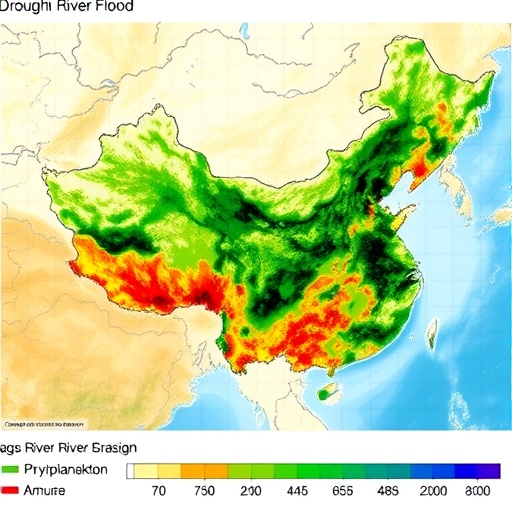
The Yellow River Basin, one of China’s most important and environmentally pressured river systems, is revealing how profoundly water extremes can reshape the microscopic communities that support aquatic food webs. In a basin-scale study published in Scientific Reports, Dong, Wang, Gao and colleagues examine how phytoplankton respond to contrasting hydrological conditions, including unusually high-flow events and periods of reduced water availability. Their analysis places these organisms at the center of a rapidly changing freshwater story: when rivers flood, nutrients and sediments are swept across the landscape; when flows decline, water becomes warmer, more concentrated and slower to move. Each condition creates a different ecological laboratory, and the results offer a detailed view of how river ecosystems may respond as climate change intensifies hydrological instability.
Phytoplankton are often described as the “plants” of aquatic environments, although many are microscopic algae and cyanobacteria rather than true plants. Through photosynthesis, they convert sunlight and dissolved carbon dioxide into organic matter, producing oxygen and forming the nutritional base for zooplankton, fish and other organisms. Their abundance and composition can change quickly when environmental conditions shift. Water temperature, light penetration, nutrient concentrations, flow velocity, turbidity and the time water remains in a channel all influence which species can survive. Because different phytoplankton groups possess different physiological strategies, their communities can function as sensitive biological indicators of river health. A change in the dominant organisms may therefore signal not only a response to current conditions, but also a broader transformation in ecosystem processes.
The Yellow River Basin is especially suitable for studying these dynamics because it contains striking environmental contrasts. The river stretches across regions ranging from high-elevation headwaters to densely populated and intensively cultivated lowlands. Along its course, water availability is uneven, seasonal precipitation is highly variable and human demands place substantial pressure on river flows. Reservoir construction, irrigation, urban development and pollution control all influence the movement and chemical composition of water. Against this complicated background, hydrological extremes can produce effects that extend far beyond a temporary rise or fall in water level. A flood may connect rivers with soils, wetlands and agricultural areas, carrying nutrients and suspended particles downstream. A drought may isolate habitats, reduce dilution and amplify the ecological effects of existing pollutants.
The study’s basin-wide comparative approach is important because phytoplankton responses are rarely uniform from one section of a river to another. In an upstream reach, a sudden increase in discharge may scour the riverbed and transport organisms downstream before they can grow. Farther along the river, the same event may deliver nutrients that stimulate production once the water becomes calmer and clearer. During low-flow conditions, reduced turbulence can allow cells to remain in the sunlit surface layer for longer periods, potentially encouraging blooms. However, intense nutrient concentration, high temperatures or poor oxygen conditions can also favor harmful cyanobacteria over more diverse algal communities. By comparing responses across a large basin rather than examining a single lake or sampling station, the researchers provide a more realistic picture of how local effects combine into regional ecological patterns.
Floods and droughts alter phytoplankton through several interacting mechanisms. High discharge generally increases physical disturbance and can shorten the residence time of water, meaning organisms have less time to reproduce within a particular reach. At the same time, runoff can transport nitrogen, phosphorus, organic matter and trace contaminants into the river. Suspended sediment may block sunlight, limiting photosynthesis even when nutrients are abundant. Once sediment settles and water flow slows, those nutrients can become available to phytoplankton, creating conditions for rapid growth. Drought produces a different sequence of pressures. Lower discharge tends to increase residence time and reduce flushing, but it can also shrink aquatic habitats, raise water temperature and concentrate dissolved substances. The balance between these forces determines whether productivity rises, falls or shifts toward a different group of organisms.
One of the study’s central scientific contributions is its focus on community response rather than on phytoplankton abundance alone. A river can contain the same total amount of algal biomass under two very different ecological conditions. In one case, that biomass may be distributed among many diatom, green algal and cyanobacterial taxa; in another, it may be dominated by a small number of organisms adapted to warm, slow-moving or nutrient-rich water. Ecologists therefore examine metrics such as species richness, diversity, evenness and community composition, alongside chlorophyll concentrations and cell abundance. These measures help distinguish a temporary increase in productivity from a deeper loss of ecological balance. A community dominated by bloom-forming cyanobacteria, for example, may pose risks to drinking-water treatment, fisheries and animal health even if total biomass is not exceptionally high.
The comparison of contrasting extremes also highlights why river management cannot rely on a single definition of “healthy flow.” More water is not automatically better, and less water is not simply a matter of reduced quantity. Flood pulses can refresh floodplains, redistribute nutrients and reconnect habitats, but exceptionally intense flows may wash organisms away, erode banks and carry large pollutant loads. Low flows can create stable conditions for some phytoplankton, yet prolonged drought may reduce habitat connectivity and intensify competition for oxygen and nutrients. These opposing effects mean that environmental assessments must consider the timing, duration, magnitude and rate of change of hydrological events. The same discharge level can have different consequences depending on whether it arrives after a dry period, during a seasonal growth window or alongside heavy nutrient runoff.
The findings carry significance beyond the Yellow River Basin because extreme hydrological events are becoming more consequential in many regions. Climate change is expected to increase the frequency or severity of some floods and droughts, while water withdrawals and land-use change can magnify their ecological impact. Phytoplankton communities respond rapidly enough to provide an early warning of these pressures, potentially allowing managers to detect deteriorating water quality before larger organisms are affected. Monitoring programs that combine flow measurements with nutrient analysis, optical water-quality sensors, microscopy and DNA-based identification could reveal which biological changes are temporary and which indicate long-term ecosystem reorganization. Such information may support more adaptive reservoir operations, targeted nutrient reduction and protection of river sections that serve as refuges during extreme events.
The study ultimately presents the Yellow River as a living network whose microscopic inhabitants register every major shift in the movement of water. Its basin-scale perspective shows that hydrological extremes are not isolated physical disturbances; they are ecological events capable of changing the structure, productivity and stability of aquatic communities. Understanding those changes will be essential as societies attempt to balance flood protection, agricultural demand, urban water security and biodiversity conservation. Phytoplankton may be invisible to most people, but their responses can reveal whether a river is recovering, becoming increasingly stressed or moving toward conditions that favor harmful blooms. In a future defined by more unpredictable water, tracking these tiny organisms could become one of the most powerful ways to see the health of an entire river basin.
Cite Scienmag News
Violet Maxwell. (August 13, 2026). Phytoplankton Responses to Drought and Flood Across the Yellow River Basin. Scienmag. https://scienmag.com/phytoplankton-responses-to-drought-and-flood-across-the-yellow-river-basin/
Violet Maxwell. "Phytoplankton Responses to Drought and Flood Across the Yellow River Basin." Scienmag, 13 August 2026, https://scienmag.com/phytoplankton-responses-to-drought-and-flood-across-the-yellow-river-basin/. Accessed 4 September 2026.
Violet Maxwell. "Phytoplankton Responses to Drought and Flood Across the Yellow River Basin." Scienmag. August 13, 2026. https://scienmag.com/phytoplankton-responses-to-drought-and-flood-across-the-yellow-river-basin/


