


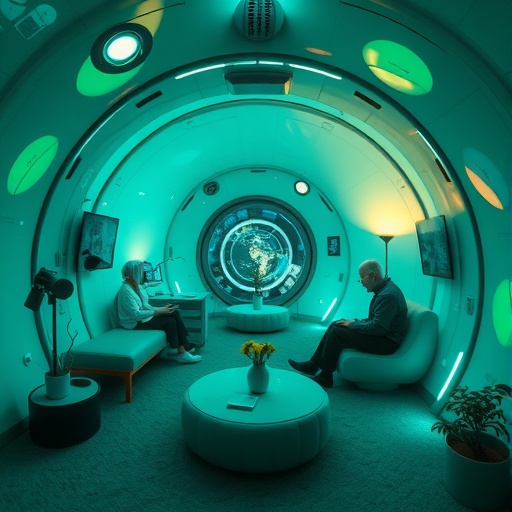
As humanity prepares for longer missions to the Moon and eventual journeys to Mars, engineers are confronting a problem that cannot be solved with stronger spacecraft or better life-support systems alone: how to design habitats that protect the human mind. Researchers at MIT and collaborating institutions have created an interactive platform that maps connections between habitat design and mental, emotional, and social wellbeing. The Human-Environment Connection and Interaction Atlas, or HECIA, is intended to help designers build environments where crews do more than remain alive—they remain psychologically healthy, socially connected, and capable of performing at their best.
Space habitats have traditionally been designed around immediate survival. Pressure control, radiation protection, temperature regulation, food, water, medical capability, and reliable power are essential in environments where failure can be fatal. Yet long-duration missions introduce less visible dangers. Astronauts may experience chronic stress, isolation, boredom, fatigue, homesickness, disrupted sleep, and tension within a small team. On a voyage to Mars, communication delays could make real-time conversations with family impossible, while limited space and constant dependence on crewmates could intensify interpersonal conflict. HECIA brings these behavioral risks into the design process by showing how physical features of a habitat may influence human outcomes.
The platform uses a technical framework modeled on directed acyclic graphs, commonly known as DAGs. NASA uses similar risk-mapping systems to illustrate how mission conditions can lead to physical or operational consequences. In a typical spaceflight DAG, a factor such as distance from Earth may affect access to medical support, food supplies, or communication, which can then influence sleep, cardiovascular health, or cognitive performance. HECIA adapts this approach to behavioral health, extending the chain of relationships to outcomes that are harder to measure but just as important to mission success, including trust, curiosity, autonomy, kinship, nostalgia, anxiety, and social cohesion.
The researchers assembled the atlas through an extensive review of scientific literature and interviews with experts from NASA, academia, and industry. They examined studies on lighting, circadian rhythms, sleep quality, productivity, privacy, circulation, habitat layout, and crew interaction. Research on illumination, for example, has shown that light intensity, timing, and color can affect the body’s internal clock, influencing sleep and alertness. Other studies suggest that the arrangement of corridors, entrances, stairs, and communal areas can shape how often people encounter one another and whether friendships and group cohesion develop. HECIA connects these individual findings into a larger model of cause and effect.
To focus the project on experiences most relevant to confined and isolated environments, the team selected 14 behavioral outcomes from a much broader catalog of human emotions and experiences. These included anxiety, autonomy, nostalgia, curiosity, fatigue, and kinship. The selection was informed partly by “Atlas of the Heart,” a book by University of Houston researcher Brené Brown that categorizes 87 emotions and human experiences. The MIT team then narrowed the list according to which outcomes could plausibly be influenced by the architecture, equipment, and spatial organization of an extreme environment.
Users can explore HECIA in either direction. A designer planning a Mars spacecraft might begin with a major mission condition such as distance from Earth. The atlas can then reveal connected constraints, including limited food, reduced medical capability, and separation from family and friends. These factors may contribute to nostalgia or homesickness. Alternatively, a designer could begin with the desired outcome—such as reducing homesickness—and work backward through the diagram to identify possible interventions. The platform may connect that goal to place attachment, the emotional bond a person forms with a location, and then to design features such as privacy and reconfigurability.
Reconfigurable interiors could be especially valuable during missions lasting months or years. A space that can be rearranged may allow crew members to create personal routines, mark changes in time, or establish areas that feel distinct from the rest of the spacecraft. Privacy can give astronauts opportunities to recover from constant social exposure, while carefully planned shared spaces can encourage positive interaction without forcing people into continuous contact. The atlas does not prescribe a single ideal layout; instead, it highlights relationships that designers might otherwise overlook when working under strict limits on mass, volume, energy, and safety.
One example involves social isolation. HECIA draws attention to research indicating that access paths, stairways, entrances, and transitional spaces can contribute to friendship formation and social cohesion. A habitat designed with connected public spaces may create natural opportunities for brief encounters, while placing private quarters along routes to communal areas could encourage interaction without eliminating personal space. These effects are subtle, but in an isolated crew they may accumulate over time. The same architectural decision that improves circulation could therefore influence trust, communication, and team performance.
The researchers stress that the atlas is not a one-size-fits-all solution. Every habitat will be shaped by its destination, mission duration, crew composition, technology, and emergency requirements. A submarine, polar research station, offshore platform, refugee camp, or disaster shelter will face different constraints from a lunar base or Mars vehicle, but the underlying challenge is similar: people must function in environments that are isolated, confined, and stressful. By making behavioral health visible within engineering diagrams, HECIA could help shift habitat design from a narrow focus on survival toward a broader science of human flourishing. The work, published in npj Microgravity and supported in part by NASA, offers a new way to treat architecture as a form of psychological and operational support for the future of exploration.
References: npj Microgravity; research by MIT and collaborating institutions; NASA-supported study.
Cite Scienmag News
Glenn Wilkins. (August 12, 2026). Designing Space Habitats to Protect Residents’ Mental Health. Scienmag. https://scienmag.com/designing-space-habitats-to-protect-residents-mental-health/
Glenn Wilkins. "Designing Space Habitats to Protect Residents’ Mental Health." Scienmag, 12 August 2026, https://scienmag.com/designing-space-habitats-to-protect-residents-mental-health/. Accessed 4 September 2026.
Glenn Wilkins. "Designing Space Habitats to Protect Residents’ Mental Health." Scienmag. August 12, 2026. https://scienmag.com/designing-space-habitats-to-protect-residents-mental-health/


