


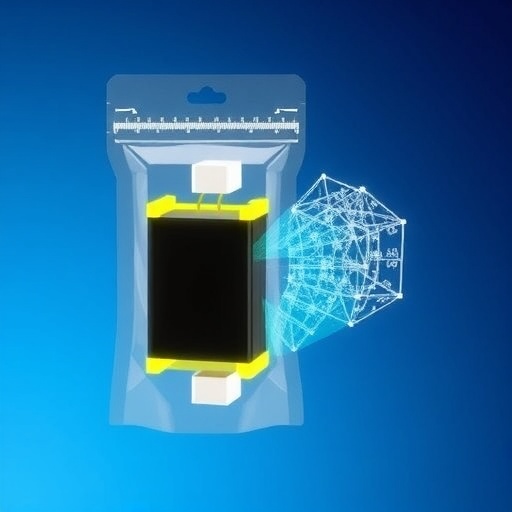
A new strategy could help transform aqueous zinc–iodine batteries from promising laboratory systems into practical large-scale energy-storage devices. In a study published in the Journal of the American Chemical Society, researchers from the Dalian Institute of Chemical Physics (DICP) of the Chinese Academy of Sciences report an electrolyte design that stabilizes both sides of the battery at once. The approach enabled a high-loading zinc–iodine pouch cell with a capacity of 1.4 ampere-hours, stable operation for more than 800 cycles, and an energy density of 455 watt-hours per kilogram based on the active cathode material.
Aqueous zinc–iodine batteries have attracted intense interest because they combine the inherent safety of water-based electrolytes with the low cost and abundance of zinc and iodine. Unlike many lithium-based systems that rely on flammable organic electrolytes, aqueous batteries are far less vulnerable to combustion. Iodine is also capable of storing a large amount of charge through reversible redox reactions. Yet converting that theoretical potential into a durable commercial battery has proved difficult, particularly when the cell is designed to use the full four-electron iodine reaction.
The key chemistry involves the transformation of iodide through multiple oxidation states, represented broadly as I⁻/I⁰/I⁺. Accessing this four-electron pathway can substantially increase the amount of energy stored per unit of iodine. However, the high-valence iodine species generated during charging are chemically reactive and difficult to control. They can form soluble polyiodides, migrate through the electrolyte, and reach the zinc electrode, where they trigger unwanted reactions. These processes reduce the battery’s efficiency, accelerate self-discharge, and cause active material to escape from the cathode reaction zone.
The zinc anode presents a second major obstacle. During charging, zinc ions must be reduced and deposited back onto the metal surface. If the deposition is uneven, needle-like dendrites or rough, porous structures can develop. Such irregular growth may increase electrical resistance, consume electrolyte, and in severe cases create conditions for internal short circuits. At the same time, water can participate in parasitic reactions at the zinc surface, producing hydrogen and changing the local chemical environment. A successful battery therefore needs to control iodine at the cathode while also regulating zinc deposition at the anode.
To solve both problems, the research team, led by Prof. Chen Zhongwei and Prof. Wang Dongdong, systematically screened nitrogen-containing cationic ligands and identified N-methylimidazolium chloride, or MImCl, as a multifunctional electrolyte additive. Its positively charged MIm⁺ component does not remain confined to one location in the cell. Instead, the cations dynamically migrate between the cathode and anode interfaces as the battery operates, acting as mobile chemical regulators in the two regions where instability is most severe.
At the iodine cathode, MIm⁺ coordinates with reactive iodine intermediates. This coordination changes the local chemical environment around the iodine species and helps stabilize the high-valence forms required for the four-electron reaction. By binding or interacting with these intermediates, the additive can also reduce the tendency of iodine to assemble into soluble polyiodides. Suppressing this shuttle effect is crucial because polyiodides can diffuse away from the cathode, cross the electrolyte, and react directly with zinc instead of contributing to useful charge storage.
The same additive performs a different function at the zinc electrode. MIm⁺ modifies the interfacial environment through which Zn²⁺ ions approach and are reduced onto the metal surface. This encourages more uniform nucleation and growth, helping zinc plate into a smoother and more compact layer. During discharge, the regulated interface also supports more even stripping of zinc. The researchers describe this simultaneous control of iodine chemistry and zinc electrochemistry as “dual-interface coordination orchestration,” because one mobile electrolyte component coordinates the behavior of both electrodes rather than treating them as separate problems.
The results are particularly notable because the team moved beyond small laboratory cells and tested high-loading configurations designed to better reflect practical battery operation. In the reported pouch cell, the strategy sustained the demanding zinc–iodine chemistry over more than 800 cycles while delivering 1.4 Ah of capacity. The stated energy density reached 455 Wh kg⁻¹ when calculated using the mass of the active cathode material. That measurement basis is important: it highlights the performance of the iodine-based cathode chemistry, but it does not represent the full packaged-cell energy density, which would also include the electrolyte, current collectors, separator, casing, and other components.
The study offers a broader lesson for aqueous metal batteries. Rather than relying solely on new electrode materials, the researchers show that a carefully selected electrolyte additive can act as an active participant in battery chemistry, moving to the interface where it is needed and coordinating unstable reaction intermediates. If the approach can be validated under larger-scale conditions, with leaner electrolyte quantities, thicker electrodes, and full-cell mass accounting, it could help close the gap between the impressive theoretical capacity of zinc–iodine systems and the durability required for grid storage. The researchers say the work provides new insights into electrolyte-mediated interface regulation and creates a promising route toward safer, higher-energy aqueous zinc batteries.
Web References: https://doi.org/10.1021/jacs.6c11308; https://english.dicp.cas.cn/
References: Journal of the American Chemical Society, DOI: 10.1021/jacs.6c11308
Keywords
Aqueous batteries, zinc–iodine batteries, zinc metal anodes, iodine redox chemistry, electrolyte additives, MImCl, N-methylimidazolium chloride, polyiodide shuttle, pouch cells, energy storage, electrochemistry, zinc deposition, four-electron chemistry
Cite Scienmag News
Bethany Barker. (August 12, 2026). Dual-interface design enables high-performance ampere-hour aqueous zinc-iodine pouch cells. Scienmag. https://scienmag.com/dual-interface-design-enables-high-performance-ampere-hour-aqueous-zinc-iodine-pouch-cells/
Bethany Barker. "Dual-interface design enables high-performance ampere-hour aqueous zinc-iodine pouch cells." Scienmag, 12 August 2026, https://scienmag.com/dual-interface-design-enables-high-performance-ampere-hour-aqueous-zinc-iodine-pouch-cells/. Accessed 4 September 2026.
Bethany Barker. "Dual-interface design enables high-performance ampere-hour aqueous zinc-iodine pouch cells." Scienmag. August 12, 2026. https://scienmag.com/dual-interface-design-enables-high-performance-ampere-hour-aqueous-zinc-iodine-pouch-cells/


