


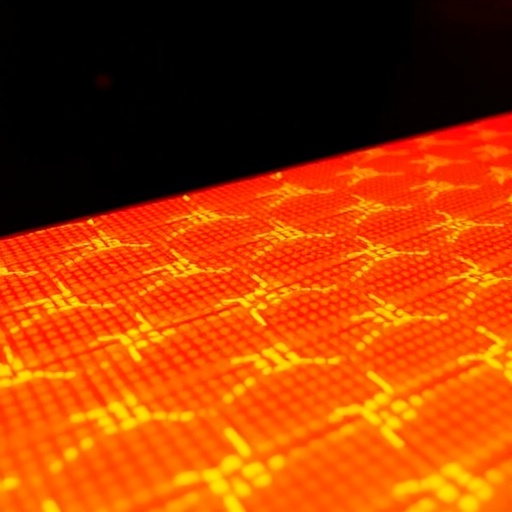
Stretchable OLEDs have long promised screens that could bend, twist and conform to the human body, but turning that vision into a manufacturable technology has proved far more difficult than making a flexible display. A new study by T. Kim, S.B. Kim, D. Lee and colleagues reports a fabrication strategy designed to address one of the most persistent problems in the field: producing high-efficiency, mechanically deformable OLEDs at a scale compatible with practical manufacturing. Published in npj Flexible Electronics, the work introduces residue-controlled laser patterning as a route toward scalable stretchable displays with high external quantum efficiency.
OLEDs, or organic light-emitting diodes, generate light when electrical charges are injected into thin organic layers. Unlike conventional liquid-crystal displays, OLED pixels do not require a separate backlight, allowing devices to be thinner and potentially more flexible. Yet making an OLED stretchable is not simply a matter of placing an ordinary display on rubber. The light-emitting layers, electrodes and interconnections must all tolerate repeated deformation without cracking, delaminating or losing electrical contact. At the same time, the fabrication process must preserve the delicate optical and electronic properties that determine brightness and efficiency.
The research focuses on laser patterning, a manufacturing technique in which precisely controlled laser energy selectively modifies or removes material. Laser processing can create fine patterns rapidly and without the need for conventional mechanical masks, making it attractive for advanced electronics. However, laser ablation can leave behind residues, debris or chemically altered material at the edges of patterned structures. In an OLED, even small amounts of unwanted residue can interfere with charge transport, optical emission, adhesion between layers or the reliability of thin electrodes. The study’s central idea is to control these residues rather than treating them as an unavoidable side effect.
Residue control is especially important in stretchable devices because their structures are often designed with microscopic geometries that distribute strain. Conductive lines may be arranged in serpentine, mesh-like or island-bridge patterns, allowing rigid functional components to move while flexible interconnects absorb stretching. If laser-generated contamination remains around these features, it can create weak points or electrical leakage paths. Under repeated stretching, those defects may expand, causing resistance to rise or causing pixels to fail. By refining the laser-patterning conditions to manage the material left behind, the researchers aim to produce cleaner and more dependable device architectures.
The phrase “high-EQE” in the paper’s title refers to high external quantum efficiency, a key measure of OLED performance. EQE describes how effectively injected electrical charges are converted into photons that escape the device. It depends on several factors, including the efficiency of electron–hole recombination, the quality of the organic emissive layers and the optical design of the device. Stretchable OLEDs often suffer efficiency losses because the materials and structures needed to withstand deformation can disrupt current flow or scatter light. Achieving high EQE therefore suggests that mechanical flexibility has been integrated without abandoning the electronic and optical discipline required for efficient light emission.
The significance of the work extends beyond a single flexible screen. Scalable fabrication is one of the major barriers separating laboratory demonstrations from commercial products. Many experimental stretchable OLEDs rely on small-area processing, specialized transfer steps or manually assembled components. Such approaches can produce impressive prototypes but are difficult to reproduce consistently across large substrates. A laser-patterning process, if carefully controlled, could offer a more adaptable route by digitally defining device features over larger areas. It could also reduce dependence on custom tooling and make it easier to modify patterns for different display layouts.
This manufacturing perspective is crucial as researchers explore displays for wearable electronics, soft robotics, medical sensors and next-generation human–machine interfaces. A stretchable OLED could conform to curved skin, wrap around moving joints or operate on surfaces that change shape. In wearable systems, the display could provide visual feedback while moving naturally with the user. In soft robotics, it might serve as an integrated signaling layer rather than a rigid electronic module. For medical technologies, deformable light-emitting interfaces could eventually support monitoring or communication on dynamic biological surfaces. These applications require more than flexibility: they demand stable brightness, efficient power use and repeatable production.
The study also highlights a broader engineering lesson about advanced electronics: performance often depends on controlling tiny manufacturing imperfections. The residue left by a laser may be invisible to the naked eye, yet its effects can be amplified across thin films and microscopic electrical pathways. At the scale of OLED pixels, a small change in surface chemistry or layer thickness can alter how charges move and how light exits the device. By linking laser-processing conditions to the behavior of the finished OLED, the researchers present fabrication control as a central design variable rather than a final quality check.
Although the reported advance does not instantly place stretchable OLEDs in every smartphone or jacket, it addresses a practical challenge that has kept the technology largely experimental. The combination of scalable patterning, residue management and high external quantum efficiency points toward a more credible manufacturing pathway for deformable displays. As flexible electronics move from headline-grabbing prototypes to products that must survive real-world use, processes capable of delivering both mechanical resilience and electronic performance will determine which ideas make the leap. Kim and colleagues’ work suggests that the future of stretchable screens may depend not only on discovering new materials, but also on mastering the microscopic cleanliness of the tools used to shape them.
Cite Scienmag News
Denise Maddox. (August 11, 2026). Residue-Controlled Laser Patterning Enables Scalable Fabrication of High-EQE Stretchable OLEDs. Scienmag. https://scienmag.com/residue-controlled-laser-patterning-enables-scalable-fabrication-of-high-eqe-stretchable-oleds/
Denise Maddox. "Residue-Controlled Laser Patterning Enables Scalable Fabrication of High-EQE Stretchable OLEDs." Scienmag, 11 August 2026, https://scienmag.com/residue-controlled-laser-patterning-enables-scalable-fabrication-of-high-eqe-stretchable-oleds/. Accessed 6 September 2026.
Denise Maddox. "Residue-Controlled Laser Patterning Enables Scalable Fabrication of High-EQE Stretchable OLEDs." Scienmag. August 11, 2026. https://scienmag.com/residue-controlled-laser-patterning-enables-scalable-fabrication-of-high-eqe-stretchable-oleds/


