


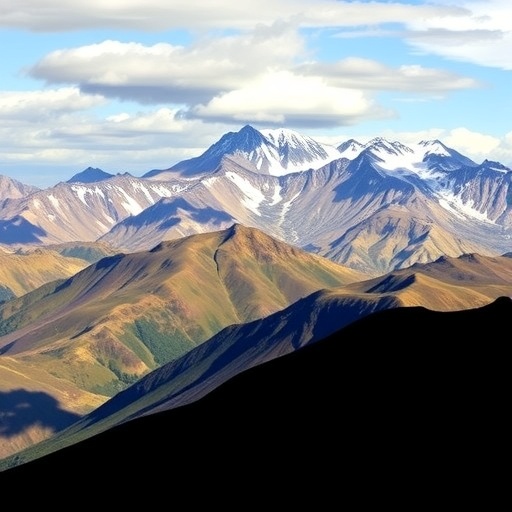
A new study has turned the world’s oldest mountain belts into a geological time machine, revealing that Earth’s tectonic engine may not have evolved in a smooth, one-way progression. By examining how long ancient mountain-building episodes lasted, researchers argue that the planet shifted repeatedly between contrasting tectonic regimes during the Archean and Proterozoic eons. The finding offers a fresh explanation for why Earth’s early crust records bursts of intense geological activity separated by quieter or fundamentally different phases.
The research, led by L. Zou, G. Huang, J. Guo and colleagues, focuses on orogenies—the vast geological processes that create mountain ranges, thicken continental crust and reshape the architecture of continents. Modern orogenies commonly develop where tectonic plates converge. One plate may be forced beneath another in a process called subduction, or two continents may collide, crumpling and stacking layers of rock into mountain belts. These events can continue for tens or even hundreds of millions of years, leaving behind mineral, structural and chemical clues long after the mountains themselves have eroded away.
The team’s central insight is that the duration of an orogeny is more than a measure of how long a mountain range took to form. It is also a window into the behavior of the entire tectonic system. A long-lived orogeny may indicate sustained plate convergence, persistent subduction or the prolonged assembly of continental blocks. Shorter events may reflect a different style of crustal deformation, such as localized collisions, transient mantle upwelling or tectonic reorganization. By comparing the durations of orogenic episodes through deep time, the researchers reconstructed how Earth’s tectonic regime changed across billions of years.
The period under investigation spans the Archean, from roughly 4 billion to 2.5 billion years ago, and the Proterozoic, which extended from 2.5 billion to about 538 million years ago. These eons cover the transformation of Earth from a young planet with a hotter interior and a very different crust into the world that eventually developed the familiar plate-tectonic system. Rocks from this interval are rare, heavily altered and scattered across today’s continents, making any global reconstruction exceptionally difficult. Yet ancient orogens preserve some of the strongest evidence for how early continents interacted.
To determine when an orogeny began and ended, geologists rely on geochronology, the science of dating rocks and geological events. Zircon crystals are particularly valuable because they can survive erosion, burial, melting and metamorphism while retaining chemical signatures from the rocks in which they formed. Uranium-lead dating of zircon can establish when minerals crystallized, while metamorphic minerals and deformational structures can reveal when rocks were buried, heated and compressed. By combining these datasets with field observations and regional geological maps, scientists can estimate the active lifespan of ancient mountain-building systems.
The study’s results point to a pattern of alternating tectonic behavior rather than a simple march toward modern plate tectonics. Across the Archean-Proterozoic transition, the typical duration of orogenic activity changed systematically, suggesting that Earth repeatedly reorganized how its crust and mantle transferred heat and mechanical stress. In one regime, tectonic activity appears to have been sustained over extended intervals, consistent with large-scale, interconnected plate interactions. In another, deformation may have been more episodic or confined to smaller regions. The alternating pattern implies that early Earth could move between tectonic states as its internal temperature, crustal strength and continental mass evolved.
This conclusion challenges the idea that plate tectonics began at a single, sharply defined moment. For decades, researchers have debated whether modern-style plate tectonics emerged in the Hadean, Archean or Proterozoic, or whether it developed gradually through a series of transitional mechanisms. The new analysis supports a more dynamic scenario: Earth may have experimented with several tectonic styles before a stable, globally connected plate system became dominant. Instead of a switch being flipped, the planet’s tectonic engine may have pulsed, stalled, restarted and changed gears.
The implications extend beyond the history of mountains. Tectonic regimes influence the growth and survival of continents, the chemical composition of the atmosphere and oceans, and the circulation of nutrients essential to life. Mountain building exposes fresh rock to weathering, helping regulate carbon dioxide over geological timescales. Subduction carries surface materials into the mantle, while volcanic activity returns deep material to the surface. Changes in the tempo and style of these processes could therefore have altered Earth’s climate, ocean chemistry and habitability during the long interval when life was beginning to diversify.
The findings may also help explain why the geological record contains apparently conflicting evidence about early plate tectonics. Some ancient regions display structures resembling modern subduction and continental collision, while others appear to have formed through processes with no close modern equivalent. If tectonic regimes alternated, both types of evidence could be correct: different regions, or different periods, may have been governed by different mechanisms. The duration of orogenies provides a new organizing principle that links these seemingly disconnected snapshots into a broader planetary story.
As more ancient rocks are dated and more sophisticated models of mantle convection are developed, the approach could become a powerful tool for testing competing theories of Earth’s early evolution. The study does not portray the Archean and Proterozoic as a simple prelude to the modern world, but as an era of repeated tectonic innovation. Its most striking message is that the planet’s mountains preserve not only the history of continents colliding, but also the rhythm of a changing Earth—one that alternated between tectonic regimes before settling into the restless plate-tectonic system that continues to reshape the planet today.
Cite Scienmag News
Violet Maxwell. (August 11, 2026). Changing mountain-building durations reveal alternating tectonic regimes across the Archean–Proterozoic. Scienmag. https://scienmag.com/changing-mountain-building-durations-reveal-alternating-tectonic-regimes-across-the-archean-proterozoic/
Violet Maxwell. "Changing mountain-building durations reveal alternating tectonic regimes across the Archean–Proterozoic." Scienmag, 11 August 2026, https://scienmag.com/changing-mountain-building-durations-reveal-alternating-tectonic-regimes-across-the-archean-proterozoic/. Accessed 4 September 2026.
Violet Maxwell. "Changing mountain-building durations reveal alternating tectonic regimes across the Archean–Proterozoic." Scienmag. August 11, 2026. https://scienmag.com/changing-mountain-building-durations-reveal-alternating-tectonic-regimes-across-the-archean-proterozoic/


