


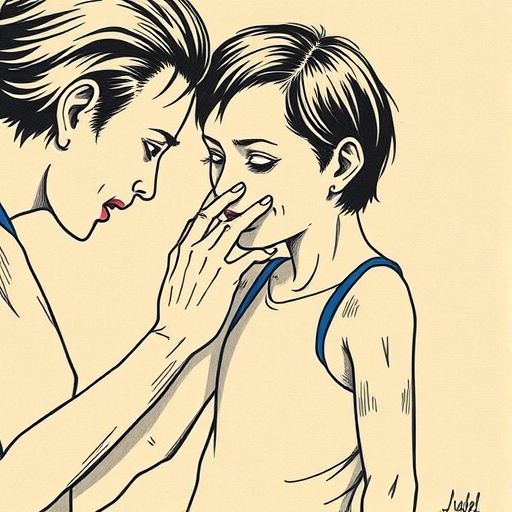
A sensation that can make people laugh, squirm, recoil or plead for mercy may be far more universal than scientists once assumed. New research by Z. Xiong and K. Kilteni suggests that human ticklishness is not merely a quirky product of childhood, personality or culture. Instead, it appears to be a widespread sensory experience with a recognizable bodily structure that is shared across societies.
The study, published in Nature Human Behaviour, examines how people experience tickling, where on the body it is felt most strongly and how cultural background shapes the response. Its central message is striking: although social rules determine when tickling is considered playful, intimate or irritating, the underlying sensory experience follows patterns that are remarkably consistent among humans.
Tickling is often treated as a trivial phenomenon, but scientifically it sits at the intersection of touch, emotion, prediction and social interaction. A tickling stimulus can be physically gentle while producing an intense reaction involving laughter, muscle contraction, withdrawal and a powerful urge to escape. This combination makes ticklishness different from ordinary touch. It is not simply a measure of skin sensitivity; it is a whole-body response generated by the nervous system.
The researchers’ findings indicate that ticklishness is organized across the body rather than distributed randomly. Certain regions are generally more responsive than others, including areas where skin is relatively exposed, richly supplied with sensory receptors or especially vulnerable during social contact. The body therefore appears to possess a structured “tickle map,” shaped by the way the brain represents different body surfaces and interprets incoming touch.
This organization reflects the biology of the somatosensory system, the network that processes information from the skin, muscles and joints. Signals generated by a light touch travel through peripheral nerves to the spinal cord and then to several brain regions, including the primary and secondary somatosensory cortices. These areas help identify where contact occurs and what kind of mechanical stimulation has been delivered. But the ticklish response also recruits systems involved in emotion, attention and bodily awareness, allowing a seemingly harmless touch to become overwhelming or irresistibly funny.
One of the most important clues comes from the difference between being tickled by another person and trying to tickle oneself. Self-generated tickling is usually weaker because the brain predicts the sensory consequences of its own movements. Motor-control regions send an internal estimate of what the touch should feel like, allowing incoming signals to be partially cancelled or reduced. When another person delivers the stimulus, that prediction is less precise. The mismatch between expectation and sensation can amplify the experience, helping explain why external tickling is so difficult to ignore.
The study also emphasizes that ticklishness is deeply social. Laughter during tickling does not always signal amusement, and the response can occur even when a person wants the interaction to stop. Human beings learn the meaning of tickling through relationships, childhood games and cultural conventions. In one setting it may function as affectionate play; in another, it may be viewed as intrusive or inappropriate. These differences can alter how people anticipate and describe tickling, but they do not erase the shared bodily pattern identified by the researchers.
That combination of biological regularity and cultural variation may explain why tickling is so effective as a social behavior. It targets vulnerable body regions, interrupts voluntary control and produces visible reactions that are difficult to fake or suppress. Laughter, twisting, pulling away and vocal protests provide immediate feedback to the person doing the tickling. In friendly circumstances, this can create a rapid loop of action and reaction. In unwanted situations, the same mechanism can make tickling particularly distressing, underscoring the importance of consent even when the activity is framed as harmless fun.
The findings could also help broaden scientific understanding of touch-related disorders and altered bodily perception. People with autism, sensory-processing differences, chronic pain or neurological conditions may experience touch in atypical ways, and studying ticklishness offers a natural model for investigating how the brain combines physical signals with prediction, context and emotion. Because tickling is easy to recognize but difficult to define using a single physical measurement, it may provide researchers with a useful window into subjective experience—the point where neural activity becomes a conscious bodily feeling.
By showing that ticklishness is both culturally shared and anatomically organized, the research challenges the idea that laughter and bodily play are purely learned behaviors. Culture influences the rules surrounding tickling, but the capacity to experience it appears to be rooted in common features of human physiology and brain organization. A sensation that begins with the lightest contact can therefore reveal something surprisingly fundamental: across different societies, human bodies may speak a common sensory language, even when the social meaning of that language changes.
Cite Scienmag News
Glenn Wilkins. (August 11, 2026). Human Ticklishness Is Widespread, Culturally Shared, and Bodily Organized. Scienmag. https://scienmag.com/human-ticklishness-is-widespread-culturally-shared-and-bodily-organized/
Glenn Wilkins. "Human Ticklishness Is Widespread, Culturally Shared, and Bodily Organized." Scienmag, 11 August 2026, https://scienmag.com/human-ticklishness-is-widespread-culturally-shared-and-bodily-organized/. Accessed 4 September 2026.
Glenn Wilkins. "Human Ticklishness Is Widespread, Culturally Shared, and Bodily Organized." Scienmag. August 11, 2026. https://scienmag.com/human-ticklishness-is-widespread-culturally-shared-and-bodily-organized/


