


For decades, scientists have tried to explain why people read some words carefully, skim others, and occasionally stop to reread a sentence. A new study suggests that these apparently inconsistent choices may reflect a hidden logic: human reading is governed by a hierarchy of decisions in which the brain continuously weighs the value of additional information against the time and mental effort required to obtain it. The framework, described by Y. Bai, X. Jin, S. Zhao and colleagues in Nature Human Behaviour, proposes that reading behaviour is not merely a sequence of eye movements, but an adaptive system for managing limited cognitive resources.
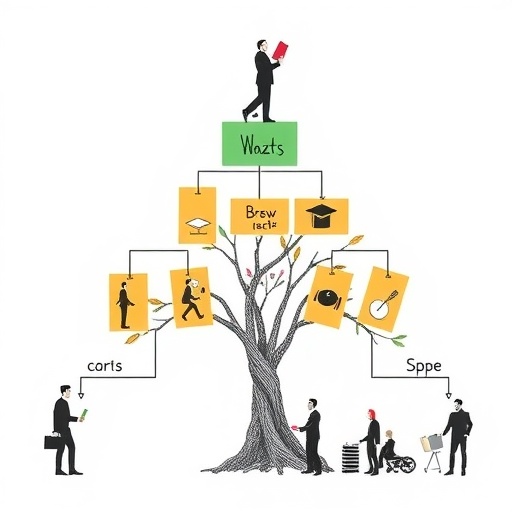
The central idea is known as hierarchical resource rationality. “Resource rationality” describes the tendency to make decisions that are useful and efficient when time, attention, memory and computational capacity are limited. Instead of assuming that readers process every word in the same way, the theory treats reading as a series of nested decisions. At one level, the reader decides whether to continue through a passage. At another, the reader determines how much attention to devote to a sentence or word. At still finer levels, the brain chooses whether to move the eyes forward, pause, or return to earlier text.
This hierarchy helps explain a familiar feature of reading: people do not distribute attention evenly across a page. Short and predictable words are often processed rapidly, while unusual, ambiguous or informative words receive more time. A reader may also slow down before a crucial phrase, skip material that can be inferred from context, or make a regression when a sentence fails to make sense. In the new account, these behaviours are not separate quirks. They are coordinated outcomes of a decision system that estimates how much each additional moment of reading is likely to improve understanding.
The model treats reading as an information-allocation problem. At every stage, the reader has an incomplete internal representation of the text and must decide whether further processing is worth its cost. The potential benefit may be greater certainty about a word, a better understanding of the sentence, or a clearer interpretation of the entire passage. The cost includes the time spent fixating on text, the effort needed to maintain and update information in working memory, and the opportunity cost of delaying progress. A rational reader, in this technical sense, is not perfectly accurate or infinitely patient. The reader is efficient under constraints.
What makes the framework hierarchical is the way decisions at different scales interact. A word can be understood locally, but its importance may depend on the sentence around it. A sentence may appear clear on its own but become significant only within the broader argument of a paragraph or article. The brain therefore has to coordinate fast, low-level operations, such as identifying word forms, with slower, high-level operations, such as tracking meaning and anticipating what will come next. The theory suggests that reading behaviour emerges from this interaction rather than from a single mechanism operating uniformly from left to right.
Eye movements provide a particularly revealing window into this process. During reading, the eyes alternate between fixations, when visual information is gathered, and saccades, rapid movements that reposition the gaze. Readers sometimes skip words, make longer or shorter saccades, linger on difficult passages, or move their eyes backward. Traditional explanations often link each pattern to a specific linguistic property, such as word frequency or sentence difficulty. Hierarchical resource rationality offers a broader interpretation: the same eye movement can reflect changing priorities at different levels of comprehension. A regression, for example, may be triggered not only by a difficult word but by a failure to integrate that word into the developing meaning of the sentence.
The researchers’ approach is significant because it aims to explain several reading phenomena within one computational framework. Rather than fitting isolated rules to individual measures, the model connects observable behaviour—such as fixation duration, skipping and regressions—to latent variables representing uncertainty, expected information gain and processing cost. In computational terms, the reader is selecting actions that maximize expected utility. That utility depends on the goal of reading. Someone searching for a name may skim aggressively, while someone studying a legal contract may accept much higher processing costs in exchange for precision.
This goal sensitivity could help explain why there is no single “normal” reading speed. Reading changes with the demands of the situation, the reader’s prior knowledge and the consequences of misunderstanding. A familiar topic can be processed rapidly because predictions are strong and uncertainty is low. An unfamiliar technical passage may require longer fixations and more rereading because the brain must construct new representations. The theory predicts that these differences should arise naturally from the same resource-allocation principles, without requiring separate mechanisms for every reading context.
The implications extend beyond theories of eye movements. If reading is an adaptive control problem, difficulties in reading may result from disruptions at multiple levels: inefficient word recognition, weak sentence integration, limited working memory, or poor allocation of attention across a document. The framework could therefore guide future research into dyslexia, second-language reading and age-related changes in comprehension. It may also inform the design of digital documents, educational materials and artificial reading systems by showing how layout and information structure influence the costs and benefits of continued processing.
The study’s broader message is that human cognition often looks irregular only when examined one action at a time. A skipped word, a long pause or a sudden return to an earlier sentence may seem like noise, but together these behaviours reveal a brain constantly negotiating between understanding more and spending less. Hierarchical resource rationality turns reading into a vivid example of intelligence under limitation: the mind does not attempt to process everything equally. It selectively invests effort where information is most valuable, building meaning while continually deciding whether the next moment of attention is worth the price.
Cite Scienmag News
Glenn Wilkins. (August 10, 2026). Hierarchical Resource Rationality Explains How Humans Read. Scienmag. https://scienmag.com/hierarchical-resource-rationality-explains-how-humans-read/
Glenn Wilkins. "Hierarchical Resource Rationality Explains How Humans Read." Scienmag, 10 August 2026, https://scienmag.com/hierarchical-resource-rationality-explains-how-humans-read/. Accessed 4 September 2026.
Glenn Wilkins. "Hierarchical Resource Rationality Explains How Humans Read." Scienmag. August 10, 2026. https://scienmag.com/hierarchical-resource-rationality-explains-how-humans-read/


