


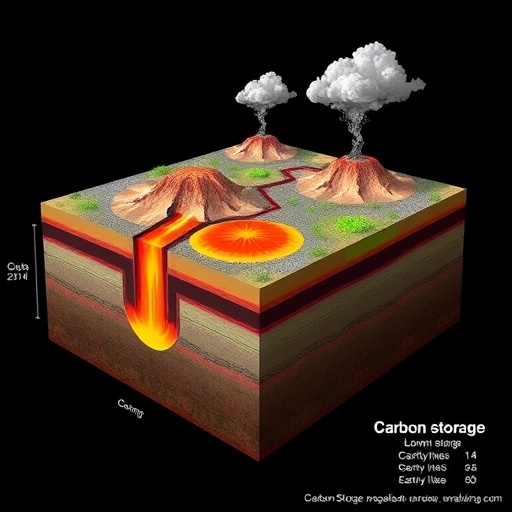
Geological carbon dioxide storage is often presented as one of the largest potential tools for slowing climate change, but a new study warns that the world’s storage projections may be resting on assumptions that are no longer realistic. In a paper published in Communications Earth & Environment, researchers I. de Jonge-Anderson, G. Johnson, A. Merfort and colleagues argue that estimates of how much carbon dioxide can be stored underground—and at what price—must be substantially updated before they can guide credible climate policy.
Carbon capture and storage, or CCS, involves separating carbon dioxide from industrial exhaust or directly from the atmosphere, compressing it into a dense fluid and injecting it deep beneath the Earth’s surface. Suitable formations can include saline aquifers, depleted oil and gas reservoirs, and other porous rocks sealed beneath impermeable layers. Once injected, carbon dioxide is expected to remain trapped through a combination of physical and chemical processes, including structural trapping beneath caprock, residual trapping in pore spaces, dissolution into formation water and, over much longer timescales, mineralization.
The concept sounds straightforward, but the practical challenge is enormous. Storage capacity is not simply the total volume of pore space underground. A formation may contain billions of tonnes of theoretical capacity while offering only a fraction of that amount as usable storage. The carbon dioxide must be injected at an appropriate depth and pressure, wells must be accessible, the caprock must remain secure, and the site must comply with environmental and regulatory requirements. The storage formation must also be close enough to emission sources or transport networks to avoid making the project financially unworkable.
The researchers’ central message is that geological storage projections need to distinguish more carefully between what is physically possible and what is technically, economically and socially feasible. Earlier assessments have often emphasized broad geological potential, sometimes producing very large capacity estimates. But a resource becomes meaningful for climate mitigation only when it can be developed with available technology, connected to a transport system, monitored over time and operated at a cost that industries or governments can support.
Cost assumptions are particularly important because CCS projects involve far more than drilling an injection well. Carbon dioxide must first be captured, a process that can consume significant energy and reduce the efficiency of a power plant or industrial facility. The gas must then be dehydrated, compressed and transported, potentially through pipelines, ships or a combination of both. At the storage site, operators need injection wells, pressure-management systems, monitoring equipment and long-term plans for detecting possible leakage. Each stage adds capital and operating expenses, and those expenses vary sharply from one location to another.
A major technical issue is the difference between storage capacity and injection rate. A region may theoretically be able to hold a vast quantity of carbon dioxide but accept it only slowly because of low rock permeability, pressure limits or the limited number of wells that can be drilled. For climate targets, timing matters. Storing a large amount of carbon dioxide over several centuries is not equivalent to storing it rapidly enough to offset emissions during the next few decades. Feasible projections must therefore consider not only how much carbon dioxide could fit underground, but also how quickly it can be injected and how many sites can operate simultaneously.
Geological uncertainty further complicates the picture. Subsurface formations are rarely known with the same precision as surface infrastructure. Their properties are inferred from seismic surveys, well data, geological models and pressure measurements. Important variables include porosity, permeability, fault networks, caprock integrity and the chemistry of underground fluids. Small changes in these parameters can influence injectivity, storage security and the amount of monitoring required. As new data become available, estimates may rise in some regions and fall in others.
The study’s warning arrives as governments and companies increasingly place CCS at the center of plans for decarbonizing cement, steel, chemicals, hydrogen and natural-gas processing. These sectors can be difficult to electrify because their emissions arise not only from fuel combustion but also from chemical reactions, such as the breakdown of limestone during cement production. Reliable geological storage could provide a destination for captured carbon dioxide, but overstated capacity or unrealistically low costs could create a dangerous illusion of progress while delaying investments in direct emissions reductions, renewable energy and efficiency.
Updated projections could also change which storage regions appear most valuable. A site with exceptional theoretical capacity may be less attractive than a smaller formation located near industrial facilities, ports or existing pipeline corridors. Conversely, a remote basin could become viable if ship-based transport or shared infrastructure reduces costs. The most useful assessments will need to combine geological models with engineering design, energy requirements, land and water constraints, permitting timelines, liability rules and the financial risks faced by project developers.
The researchers do not suggest that underground carbon storage is impossible or unimportant. Instead, their work highlights the need for more realistic accounting before storage is treated as a guaranteed climate solution. Future assessments will need to report capacity in clearly defined categories, separate theoretical potential from deployable capacity and show how assumptions about cost, technology and infrastructure affect the outcome. As the race to build carbon-management systems accelerates, the study’s message is simple but consequential: the amount of carbon dioxide the planet can realistically store may be very different from the amount its rocks appear able to hold.
Cite Scienmag News
Violet Maxwell. (August 10, 2026). Reliable geological carbon storage projections need updated cost and subsurface potential assumptions. Scienmag. https://scienmag.com/reliable-geological-carbon-storage-projections-need-updated-cost-and-subsurface-potential-assumptions/
Violet Maxwell. "Reliable geological carbon storage projections need updated cost and subsurface potential assumptions." Scienmag, 10 August 2026, https://scienmag.com/reliable-geological-carbon-storage-projections-need-updated-cost-and-subsurface-potential-assumptions/. Accessed 4 September 2026.
Violet Maxwell. "Reliable geological carbon storage projections need updated cost and subsurface potential assumptions." Scienmag. August 10, 2026. https://scienmag.com/reliable-geological-carbon-storage-projections-need-updated-cost-and-subsurface-potential-assumptions/


