


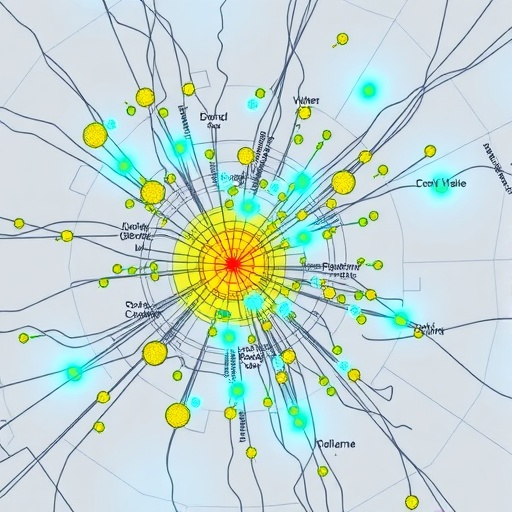
Antimicrobial resistance is often portrayed as a problem confined to hospitals, farms, or pharmaceutical laboratories. A new study published in Nature Communications challenges that narrow view, presenting urban water systems as an interconnected ecological network through which antimicrobial resistance genes may move across an entire city. The research, led by Liu, Qi, Zhang and colleagues, describes a systematic citywide analysis of the links connecting resistance genes in urban aquatic environments.
The study focuses on antimicrobial resistance genes, commonly abbreviated as ARGs. These genes enable bacteria to survive exposure to antibiotics by producing enzymes that destroy drugs, altering cellular targets, preventing antibiotic entry, or actively pumping compounds out of the cell. When ARGs become embedded in mobile genetic elements such as plasmids, integrons, and transposons, they can potentially move between unrelated bacterial species through horizontal gene transfer. This process allows resistance traits to spread even when bacteria are not direct descendants of one another.
Urban water systems provide many opportunities for that exchange. Wastewater treatment plants, sewer networks, rivers, drainage channels, reservoirs, and reclaimed-water facilities are not isolated compartments. They are connected physically and chemically by the movement of water, organic matter, microorganisms, pharmaceuticals, disinfectants, and industrial pollutants. Each location can act as a source, sink, filter, or mixing zone for microbial communities. The central message of the new research is that these environments should be analyzed as parts of one ecological system rather than as separate sampling points.
A citywide perspective is particularly important because wastewater can collect biological material from large and diverse populations. Human sewage may carry bacteria and genetic material from households, hospitals, commercial facilities, and industrial districts. Treatment processes can reduce bacterial abundance and remove many contaminants, but they do not necessarily eliminate every resistance gene or prevent genetic material from reaching receiving waters. Downstream environments can then introduce additional microbial communities, creating conditions in which resistance determinants may persist, recombine, or circulate.
The researchers’ approach, as indicated by the study’s title, examines ecological connectivity: the degree to which different urban water environments are linked through shared resistance genes and microbial processes. Such connectivity can be investigated using high-throughput sequencing, metagenomics, microbial community profiling, and network analysis. Metagenomic techniques allow scientists to detect DNA fragments directly from environmental samples, including ARGs that may belong to bacteria that are difficult or impossible to grow in the laboratory. Statistical and ecological models can then compare locations, identify co-occurring genes, and trace possible pathways across the urban water landscape.
This framework shifts attention from simply asking where resistance genes are found to asking how they are connected. A gene detected in a river, for example, may also appear in wastewater, sediment, or reclaimed water, but the relationship may not be straightforward. Shared genetic signatures can reflect common sources, repeated transport, environmental persistence, or transfer between bacterial populations. By integrating locations across a city, researchers can identify potential hubs where resistance genes accumulate or where multiple microbial communities come into contact.
The findings carry implications for public health, even though the presence of an ARG does not automatically mean that people will become infected with a resistant bacterium. Risk depends on several additional factors, including whether the gene is carried by a pathogenic organism, whether it is located on a mobile genetic element, whether the host bacterium survives in the environment, and whether a route exists for exposure. Nevertheless, environmental resistance reservoirs matter because they can preserve genetic traits that later enter clinically important bacteria. Urban waterways may therefore function as part of the broader antimicrobial resistance ecosystem connecting human, animal, and environmental health.
The study also suggests that managing antimicrobial resistance will require interventions beyond prescribing practices and hospital infection control. Improvements in wastewater treatment, monitoring of sewer networks, protection of receiving waters, and surveillance of reclaimed-water systems could help identify high-connectivity zones and reduce opportunities for gene movement. A citywide map of resistance pathways may eventually support targeted control strategies, directing resources toward locations where treatment upgrades or pollution reductions could interrupt the greatest number of transmission routes.
The broader significance of the research lies in its ecological scale. Antimicrobial resistance is not only a medical phenomenon measured in patients; it is also a biological process shaped by water flow, microbial communities, chemical exposure, and urban infrastructure. By revealing how resistance genes may connect different parts of a city’s water cycle, the study provides a framework for understanding resistance as a distributed environmental network. That perspective could make future surveillance more predictive, helping scientists and public-health authorities detect emerging resistance threats before they become visible in clinical settings.
Cite Scienmag News
Juliet Wilcox. (August 8, 2026). Citywide study maps ecological connectivity of antimicrobial resistance genes across water systems. Scienmag. https://scienmag.com/citywide-study-maps-ecological-connectivity-of-antimicrobial-resistance-genes-across-water-systems/
Juliet Wilcox. "Citywide study maps ecological connectivity of antimicrobial resistance genes across water systems." Scienmag, 8 August 2026, https://scienmag.com/citywide-study-maps-ecological-connectivity-of-antimicrobial-resistance-genes-across-water-systems/. Accessed 3 September 2026.
Juliet Wilcox. "Citywide study maps ecological connectivity of antimicrobial resistance genes across water systems." Scienmag. August 8, 2026. https://scienmag.com/citywide-study-maps-ecological-connectivity-of-antimicrobial-resistance-genes-across-water-systems/


