


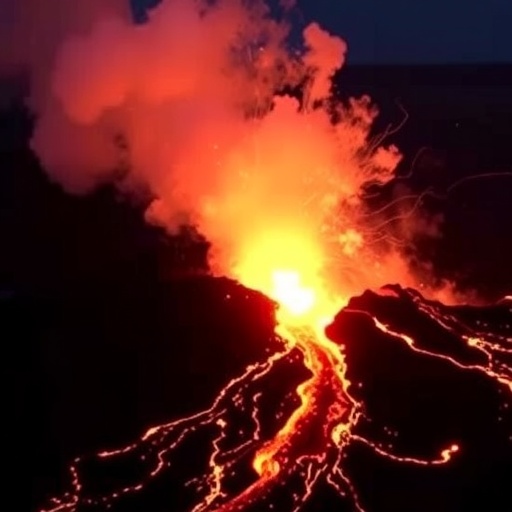
For decades, volcanic danger has been associated with spectacular explosions: towering columns of ash, incandescent fountains and fast-moving pyroclastic flows. A new study suggests that one of the most deceptive hazards may arrive without any dramatic blast at all. During the slow extrusion of thick, silica-rich lava, volcanoes can release ash continuously for extended periods, creating a hidden threat that may be underestimated by communities, aviation authorities and even monitoring systems.
The research, led by Zhang, Tuffen and Wadsworth and published in Nature Communications, focuses on sustained ash emission during lava effusion at silicic volcanoes. Silicic magma contains high levels of silica, making it viscous and resistant to flow. Unlike fluid basaltic lava, which can travel relatively easily, silicic lava often forms domes, spines or short, thick flows near a vent. These eruptions are commonly perceived as less explosive because magma is visibly moving rather than violently fragmenting. The study challenges that assumption, showing that effusive activity can still generate persistent ash emissions with significant consequences.
Ash is produced when magma or solidified volcanic rock breaks into fragments smaller than two millimetres. In explosive eruptions, this fragmentation is usually driven by expanding gas bubbles trapped inside rapidly rising magma. During lava effusion, however, ash can be generated through a more gradual process. As viscous magma is pushed toward the surface, it may develop a brittle outer crust while hotter material continues to rise beneath it. The interaction between these contrasting layers can cause the lava surface, dome margins or recently solidified rock to fracture and disintegrate.
The key physical problem is the unusual behavior of silicic lava. Its high viscosity prevents gases from escaping easily, while cooling rapidly increases its resistance to deformation. This can produce a material that behaves like a fluid deep inside the conduit but like a brittle solid closer to the surface. When the pressure, shear stress or internal gas content becomes sufficiently high, the rigid material may crack and be pulverized. Instead of producing one short-lived explosion, the process can continue as long as fresh magma supplies heat, gas and mechanical stress to the erupting structure.
That distinction matters because sustained ash emission may look modest when compared with a major explosive eruption. The ash plume can be lower, thinner or partially obscured by weather, while the lava itself remains the most visible feature. Yet a prolonged release may contaminate air over a wide area, reduce visibility, irritate the respiratory system and damage machinery. Fine ash particles can enter aircraft engines, interfere with electrical infrastructure and spread far beyond the immediate lava front, particularly when winds transport them through populated regions.
The study also highlights why conventional visual assessments may fail to identify the danger quickly. Observers may interpret the absence of a large eruption column as evidence that the volcano is relatively stable. But ash production can occur through fragmentation at the lava surface or within a growing dome, processes that do not necessarily generate the intense seismic or atmospheric signals associated with explosive eruptions. Monitoring teams therefore need to treat changes in ash output, plume persistence, lava texture and dome deformation as potentially connected signals rather than isolated observations.
For volcanologists, the findings offer a more detailed picture of how magma turns into ash during effusion. The process may involve repeated cycles of pressurization, cracking, collapse and renewal. Gas-rich pockets can expand as magma ascends, weakening the lava from within. At the same time, the outer surface cools and becomes brittle. Friction and deformation then concentrate along narrow zones, where the lava can fragment into fine particles. Each small failure may expose fresh magma to the atmosphere, allowing the cycle to continue and creating a sustained ash source without a single catastrophic trigger.
The discovery has direct implications for hazard forecasting. Emergency plans often divide eruptions into broad categories, treating explosive activity as an immediate high-risk phase and effusive activity as comparatively manageable. The new research indicates that this binary approach is too simple for silicic systems. A volcano can be effusive in terms of lava movement while behaving explosively at a smaller scale through continuous fragmentation. Authorities may need to establish ash-related alerts even when lava extrusion remains steady and no large explosion has occurred.
The message is especially important because silicic volcanoes are capable of changing behavior rapidly. A period of apparent calm or slow lava growth can conceal increasing gas pressure, structural instability or the formation of brittle zones within a dome. Sustained ash emission may therefore serve not only as a hazard in its own right but also as a warning that the eruptive system is mechanically and thermally active. By combining geological observations with gas measurements, seismic data, satellite imagery and real-time ash detection, scientists may be able to recognize these transitions earlier.
The study reframes lava effusion as a process that can be both quiet and dangerous. The absence of a spectacular explosion does not mean that a silicic eruption is harmless, particularly when ash is being produced continuously. As monitoring networks expand and researchers develop better models of magma fragmentation, this hidden form of volcanic activity is likely to become a central concern in eruption response. The volcano may appear to be simply building a lava dome, but above and around it, an invisible stream of microscopic rock can already be affecting the atmosphere, infrastructure and public health.
Cite Scienmag News
Violet Maxwell. (August 8, 2026). Persistent Ash Emissions During Lava Effusion Reveal Hidden Hazard of Silicic Eruptions. Scienmag. https://scienmag.com/persistent-ash-emissions-during-lava-effusion-reveal-hidden-hazard-of-silicic-eruptions/
Violet Maxwell. "Persistent Ash Emissions During Lava Effusion Reveal Hidden Hazard of Silicic Eruptions." Scienmag, 8 August 2026, https://scienmag.com/persistent-ash-emissions-during-lava-effusion-reveal-hidden-hazard-of-silicic-eruptions/. Accessed 3 September 2026.
Violet Maxwell. "Persistent Ash Emissions During Lava Effusion Reveal Hidden Hazard of Silicic Eruptions." Scienmag. August 8, 2026. https://scienmag.com/persistent-ash-emissions-during-lava-effusion-reveal-hidden-hazard-of-silicic-eruptions/


