


The Cambrian Explosion is often described as nature’s most dramatic evolutionary acceleration: in a geologically brief interval, nearly all major animal groups appeared in the fossil record. A new study from China now adds important evidence to the environmental story behind that transformation, showing that oxygen conditions in shallow seas changed in stages rather than all at once. By analyzing nitrogen isotopes preserved in ancient rocks, researchers have reconstructed a dynamic redox landscape across the Tarim Basin during the Terreneuvian Epoch, the earliest interval of the Cambrian Period.
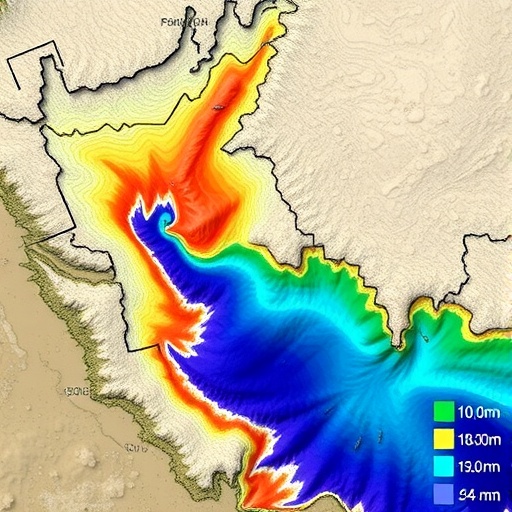
The study focuses on the Penglaiba section in the Aksu area of northwestern China, where rocks of the Yuertusi Formation preserve a complete Terreneuvian succession. At the time, the Tarim Block was an independent paleocontinent positioned along the northwestern margin of Gondwana. Its ancient seafloor contained environments ranging from shallow inner-ramp settings to deeper basin waters, creating an ideal natural laboratory for examining how marine oxygen levels varied across depth and through time.
Researchers from Northwest University, Nanjing University, and the University of Science and Technology of China analyzed high-resolution geochemical records from the Penglaiba section. Their dataset included bulk-rock nitrogen isotopes, expressed as δ15N, organic carbon isotopes, total organic carbon, and total nitrogen. Together, these measurements provide clues about the nitrogen cycle, biological productivity, organic matter preservation, and the availability of oxygen in ancient seawater. The results were then compared with previously published records from deeper and more offshore parts of the Tarim Basin.
Nitrogen isotopes are especially valuable because they can preserve evidence of microbial processes that occur under oxygen-poor conditions. In oxygen-deficient waters, microorganisms remove nitrogen through processes such as denitrification, converting nitrate into gaseous forms that can escape from the marine system. Because these reactions preferentially use lighter nitrogen isotopes, the remaining nitrogen pool can become enriched in the heavier isotope, producing elevated δ15N values. Changes in these values therefore help scientists identify shifts in the intensity of oxygen depletion and nitrogen cycling in ancient oceans.
The lower part of the Yuertusi Formation records a gradual intensification of deoxygenation in shallow marine waters. Increasing evidence of denitrification indicates that oxygen became progressively scarcer in the water column, creating suboxic conditions in the inner-ramp environment. Suboxic seawater contains too little dissolved oxygen for many modern marine organisms and supports a very different microbial nitrogen cycle from that found in well-oxygenated waters. The findings suggest that shallow habitats were not consistently oxygen-rich during the earliest Cambrian, even though they were close to the ancient coastline.
The upper Yuertusi Formation tells a different story. Its geochemical signals indicate a phase of partial reoxygenation, implying that oxygen returned to at least some portions of the shallow marine environment. The researchers describe this as a two-stage redox history: first, progressive deoxygenation and enhanced denitrification, followed by a recovery toward more oxygenated conditions. This pattern suggests that early Cambrian oxygenation was episodic and uneven, rather than a single global event that suddenly transformed every marine environment.
When the new inner-ramp data are combined with records from middle-ramp and deep-basin sections, a persistent depth-dependent redox gradient emerges across the Tarim Basin. The deepest settings were characterized by the strongest evidence of anoxia and nitrogen removal, while shallower inner-ramp waters were comparatively less depleted in oxygen and showed weaker denitrification. The gradient remained recognizable through the Terreneuvian, revealing a vertically structured ocean in which oxygen availability changed systematically with water depth.
This reconstruction has implications far beyond the Tarim Basin. Earlier nitrogen isotope studies from the Yangtze Subprovince of South China identified suboxic shallow-marine conditions during the Terreneuvian, a period associated with the diversification of lophotrochozoans and other early animal groups. These organisms generally had lower oxygen requirements than many later-evolving animals. The new results from Tarim provide an independent record from another ancient paleocontinent, strengthening the possibility that shallow-ocean oxygenation advanced in steps and helped shape the multi-phase trajectory of the Cambrian Explosion.
The study also challenges the simple idea that the Cambrian Explosion depended on an immediate conversion of the entire ocean into an oxygen-rich environment. Instead, early animals may have evolved within a patchwork of habitats, where oxygen levels varied sharply across relatively short distances and fluctuated over time. Periods of reoxygenation could have opened new ecological space, while persistent low-oxygen zones limited competition and created distinctive niches for organisms with modest oxygen demands. As oxygen penetrated progressively farther into shallow marine environments, the available habitats may have expanded in pulses, helping drive successive waves of biological innovation.
Published in Continent and Life Evolution, the study provides a detailed geochemical framework for connecting marine chemistry with early animal evolution. “Our work extends the documented link between shallow-marine redox state and multi-stage early animal evolution from South China to the Tarim Block,” said study author Chao Chang. By filling the previous data gap in the shallowest Tarim environments, the research offers cross-basin support for the hypothesis that stepwise oxygenation of shallow oceans was a global-scale influence on the Cambrian Explosion.
News Publication Date: 4-Aug-2026
Web References: https://doi.org/10.55092/cle20260008
References: Liu S, Wang Z, Ju P, Chang C. Nitrogen isotope constraints on Terreneuvian shallow-marine redox evolution in the Aksu area, Tarim Basin. Continent & Life Evolution. 2026(2):0008.
Cite Scienmag News
Violet Maxwell. (August 7, 2026). Nitrogen Isotopes Reveal Shallow-Sea Redox Changes Near Aksu in Tarim Basin. Scienmag. https://scienmag.com/nitrogen-isotopes-reveal-shallow-sea-redox-changes-near-aksu-in-tarim-basin/
Violet Maxwell. "Nitrogen Isotopes Reveal Shallow-Sea Redox Changes Near Aksu in Tarim Basin." Scienmag, 7 August 2026, https://scienmag.com/nitrogen-isotopes-reveal-shallow-sea-redox-changes-near-aksu-in-tarim-basin/. Accessed 3 September 2026.
Violet Maxwell. "Nitrogen Isotopes Reveal Shallow-Sea Redox Changes Near Aksu in Tarim Basin." Scienmag. August 7, 2026. https://scienmag.com/nitrogen-isotopes-reveal-shallow-sea-redox-changes-near-aksu-in-tarim-basin/


