


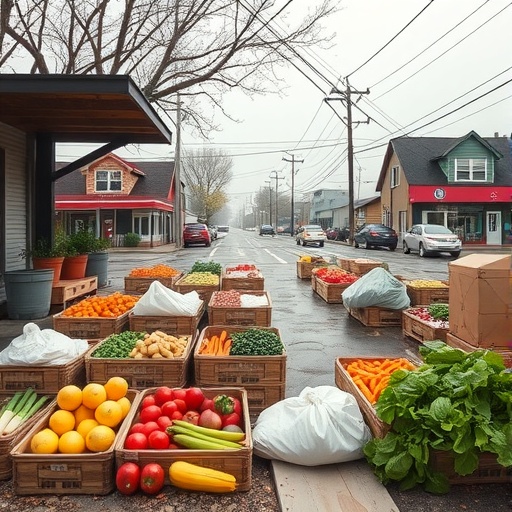
Food deserts are often presented as blank spaces on a map: neighborhoods where supermarkets are scarce, residents must travel farther for fresh food, and diet-related health risks may rise. A new study published in npj Urban Sustainability argues that this familiar picture is too simple. In “Food deserts in context: how site-specific factors reshape food deserts discussion,” researchers Y. Park, J. Na, K. Jang and colleagues call for a more precise understanding of how local conditions determine whether limited food access becomes a genuine threat to community health.
The food desert concept became popular because it offered a powerful way to visualize inequality. By comparing the locations of households with the locations of supermarkets and other food retailers, researchers and policymakers could identify areas that appeared underserved. The approach helped connect urban planning with public health, poverty, transportation and environmental justice. Yet the same map can conceal as much as it reveals. A neighborhood may appear to lack food outlets while residents rely on nearby markets, mobile vendors, community food programs or supermarkets just beyond an administrative boundary.
The central message of the research is that food access is not a universal condition that can be measured identically everywhere. It is shaped by place. Population density, income, car ownership, public transit, street design, housing patterns, local retail culture and the physical distribution of stores can all alter how residents obtain food. Two districts with the same distance to a supermarket may therefore experience very different levels of food security. For one community, a short bus trip may provide reliable access; for another, infrequent service, high fares or mobility limitations may make the same journey effectively impossible.
This distinction is technically important because many food desert assessments rely on geographic thresholds. Analysts may define an underserved area as a neighborhood located beyond a specific distance from a supermarket, often using straight-line measurements or fixed walking distances. Geographic information systems can then produce maps of apparent deprivation. But distance is only a proxy for accessibility. A road network, steep terrain, unsafe crossings or a lack of sidewalks can make a location much harder to reach than its map coordinates suggest. Conversely, dense transit connections may expand practical access beyond the boundaries shown by a simple radius.
The study’s contextual perspective also challenges the assumption that the presence of a supermarket automatically guarantees healthy food access. A store’s size, prices, product quality and operating hours may matter as much as its location. A retailer may be nearby but unaffordable for low-income households, or it may offer limited fresh produce. Food access is therefore multidimensional: it includes not only physical availability, but also economic affordability, cultural suitability, nutritional quality and the ability to shop safely and consistently. Measuring one dimension and treating it as the whole problem can produce misleading conclusions.
Researchers studying these patterns must also contend with the modifiable areal unit problem, a well-known issue in spatial analysis. Results can change depending on how researchers draw neighborhood boundaries or select the geographic units used for comparison. A community may be classified as adequately served when examined at one scale and underserved when examined at another. Administrative borders can further distort the picture, particularly when a store sits just outside a census tract but remains easily accessible to its residents. These technical choices are not neutral; they can influence which communities receive attention and public investment.
Time adds another layer of complexity. Food environments are constantly changing as stores open, close, relocate or alter their prices and product lines. A map based on outdated business data may describe a neighborhood that no longer exists. Residents’ routines also vary by season, work schedule and household responsibilities. A parent may shop during a commute rather than near home, while an older adult may depend on delivery services or a local convenience store. Static maps cannot easily capture these dynamic patterns, making longitudinal and behavior-sensitive research increasingly important.
The contextual approach could have major consequences for policy. If officials rely only on supermarket counts, they may respond by attracting a large retailer without addressing transportation costs, affordability or the needs of residents who cannot travel easily. More targeted strategies could include improving bus routes, supporting smaller independent grocers, expanding farmers’ markets, subsidizing fresh food, funding delivery programs or protecting existing community food networks. The most effective intervention may differ from one neighborhood to the next because the mechanisms producing food insecurity differ.
The research arrives as cities worldwide search for ways to reduce health inequality while adapting to rising food prices, urban growth and climate disruption. Extreme weather can interrupt supply chains and make food access more fragile, especially in communities already facing economic hardship. In this environment, the researchers’ argument is likely to resonate beyond academic geography: a food desert is not simply a place where a supermarket is absent. It is a condition produced by the interaction of space, money, mobility, infrastructure and social life.
By urging researchers to interpret food deserts in their local context, Park, Na, Jang and their colleagues could help shift the conversation from counting stores to understanding lived experience. The most useful question may no longer be “How far is the nearest supermarket?” but “Can people in this place obtain affordable, nutritious and culturally appropriate food reliably?” That change may sound subtle, but it could reshape the maps used by governments, the priorities of urban planners and the way the public understands one of the most visible forms of environmental inequality.
Cite Scienmag News
Phoebe Ingram. (August 7, 2026). Site-Specific Factors Reshape Understanding of Food Deserts. Scienmag. https://scienmag.com/site-specific-factors-reshape-understanding-of-food-deserts/
Phoebe Ingram. "Site-Specific Factors Reshape Understanding of Food Deserts." Scienmag, 7 August 2026, https://scienmag.com/site-specific-factors-reshape-understanding-of-food-deserts/. Accessed 4 September 2026.
Phoebe Ingram. "Site-Specific Factors Reshape Understanding of Food Deserts." Scienmag. August 7, 2026. https://scienmag.com/site-specific-factors-reshape-understanding-of-food-deserts/


