


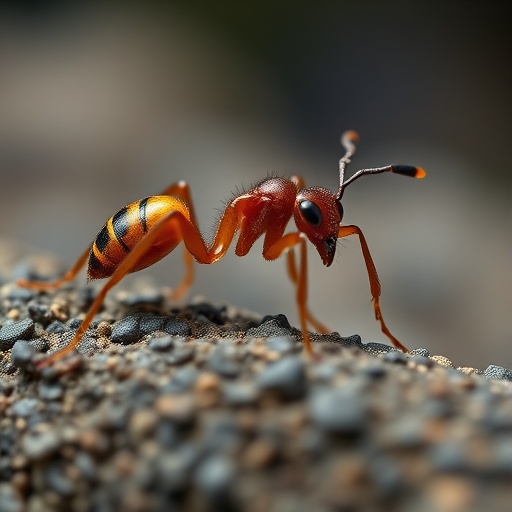
Ants may be tiny, but their movements are anything but simple. Some species can carry loads many times their own body weight, travel hundreds of meters from their nests, and navigate unfamiliar environments with remarkable efficiency. Now, researchers at the Okinawa Institute of Science and Technology Graduate University (OIST) have developed a physics-based model that reproduces how long-legged ants explore laboratory environments. The study, published in PLOS Computational Biology, could offer new insight into animal navigation—and potentially help scientists understand how invasive ants spread through urban ecosystems.
The focus of the research was the long-legged ant, also known as the yellow crazy ant (Anoplolepis gracilipes). Famous for its speed, aggression, and ability to colonize new habitats, this invasive species has expanded across tropical and subtropical regions around the world. In Okinawa, Japan, the ants are common in places such as parking lots, walkways, and outdoor seating areas. That accessibility allowed the OIST team to collect more than 100 individuals and study their movements under controlled laboratory conditions.
Each ant was placed alone in an arena and recorded while exploring an unfamiliar space. Studying ants individually was essential because collective behavior begins with the movements of individual animals. Ant colonies are often associated with pheromone trails, food sharing, and coordinated decision-making, but those complex group behaviors depend on the basic locomotion of each ant. By isolating the animals, the researchers could examine movement without the added influence of nestmates or chemical communication.
To transform the recordings into usable scientific data, the team trained a neural network to track multiple parts of each ant’s body. The system followed the animals as they walked, turned, paused, and changed direction, generating detailed spatial trajectories. These trajectories provided a quantitative record of the ants’ behavior, allowing the researchers to analyze not only where the insects traveled but also how their speed, direction, and body movements changed over time.
The central discovery was that stochastic, or random, modeling provided a powerful way to describe the ants’ behavior. At first glance, random motion may seem incapable of explaining purposeful exploration. In physics, however, stochastic models are widely used to understand systems influenced by countless small fluctuations, including the diffusion of particles and the movements of bacteria. Rather than attempting to measure every factor affecting an ant—such as neural activity, sensory input, temperature, surface texture, or previous experience—the researchers treated its movement as the combined result of many random contributions.
The model incorporates several mathematical techniques commonly used to study diffusion and biological motion. It does not assume that an ant follows a perfectly predetermined route. Instead, it represents movement as a dynamic process in which direction and speed evolve over time, while random fluctuations continually influence the trajectory. This approach makes it possible to capture both the unpredictable details of individual steps and the larger statistical patterns that emerge across many movements.
According to the researchers, the model was able to reproduce several key features of the ants’ experimental trajectories. That means it can generate simulated paths that resemble the way real long-legged ants explore an environment, even though the model does not explicitly recreate every biological mechanism inside the insect. This distinction is important: the model is not intended to replicate the full complexity of an ant brain. Rather, it provides a macroscopic description of locomotion that can be tested, analyzed, and adapted for new conditions.
The ability to simulate ant-like movement could have practical consequences. In future studies, researchers may introduce virtual or real-world factors such as food, water, predators, obstacles, or other species and examine how these stimuli alter the baseline behavior. Such simulations could help scientists investigate how invasive ants locate resources, move through cities, and interact with native animals. Because the long-legged ant is known for rapidly establishing populations in new environments, understanding its exploratory behavior could contribute to more effective monitoring and control strategies.
The OIST team believes the same framework may eventually be adapted beyond ants. Many animals navigate environments using movement patterns shaped by uncertainty, sensory information, and changing conditions. A stochastic model that captures these principles could therefore help compare locomotion and exploration across insects, microorganisms, and other animals. By turning the apparently chaotic movements of a small ant into a mathematical system, the study offers a new way to connect physics, artificial intelligence, and animal behavior—and shows how viral scientific discoveries can begin with something as ordinary as an ant crossing a parking lot.
News Publication Date: 6 August 2026
Web References: https://doi.org/10.1371/journal.pcbi.1014069
References: PLOS Computational Biology, DOI: 10.1371/journal.pcbi.1014069
Cite Scienmag News
Katie Riggs. (August 6, 2026). Random Physics Helps Scientists Model the Movements of Individual Ants. Scienmag. https://scienmag.com/random-physics-helps-scientists-model-the-movements-of-individual-ants/
Katie Riggs. "Random Physics Helps Scientists Model the Movements of Individual Ants." Scienmag, 6 August 2026, https://scienmag.com/random-physics-helps-scientists-model-the-movements-of-individual-ants/. Accessed 4 September 2026.
Katie Riggs. "Random Physics Helps Scientists Model the Movements of Individual Ants." Scienmag. August 6, 2026. https://scienmag.com/random-physics-helps-scientists-model-the-movements-of-individual-ants/


