


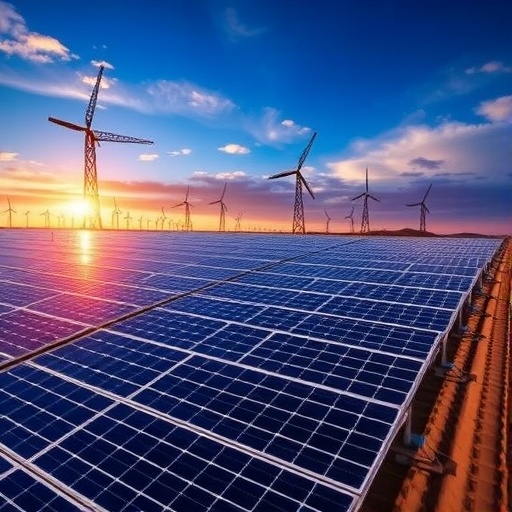
China’s photovoltaic industry may hold one of the most consequential timing decisions in the global energy transition: when, exactly, should solar manufacturers intensify their own decarbonization efforts to deliver the greatest climate benefit? A new study by Q. Lin, C. Li, K. Wang and colleagues argues that the answer is more complicated than simply producing more panels or switching factories to renewable electricity. The research examines how the timing of emissions reductions by Chinese photovoltaic manufacturers could influence the overall climate contribution of solar power worldwide.
The question matters because photovoltaic technology is designed to reduce emissions during operation, yet manufacturing solar modules requires substantial amounts of energy and raw materials. Polysilicon purification, ingot and wafer production, cell processing, module assembly, glass manufacturing and aluminum framing all consume electricity and heat. If that energy comes from carbon-intensive sources, a solar panel begins its life with a significant “embodied” carbon footprint before it ever generates electricity. The climate benefit of the panel depends on how quickly its clean-energy output compensates for those production emissions.
China is central to this calculation. Chinese manufacturers dominate major sections of the global photovoltaic supply chain, including polysilicon, wafers, cells and modules. Decisions made by these companies can therefore affect not only China’s domestic emissions, but also the carbon intensity of solar installations built across Asia, Europe, North America and emerging markets. The study, published in Nature Communications, focuses on this international dimension, asking how industrial decarbonization and global deployment interact over time.
Rather than treating decarbonization as a single action with an identical benefit in every year, the researchers investigate strategic timing. The climate value of reducing manufacturing emissions today may differ from the value of reducing them later, depending on electricity demand, factory expansion, technology turnover, renewable-power availability and the pace of solar deployment. A factory that switches to low-carbon electricity at the right moment can reduce the emissions embedded in millions of modules, while a poorly timed intervention may deliver smaller benefits or face higher costs.
This timing challenge is linked to the concept of life-cycle emissions. Scientists assess a photovoltaic system by accounting for emissions from mining, material processing, manufacturing, transportation, installation, operation and end-of-life treatment. Operational emissions from solar power are extremely low compared with those from fossil-fuel generation, but manufacturing emissions can vary significantly according to production technology and energy sources. The carbon payback period—the time required for a solar system to avoid the emissions released during its production—can therefore change depending on where and how the panel was made.
The study places particular emphasis on the difference between decarbonizing production and expanding production. Rapid growth in solar manufacturing can accelerate the replacement of coal- and gas-fired electricity, producing major global benefits. At the same time, expanding factories may temporarily increase industrial emissions if new capacity is powered by carbon-intensive electricity. This creates a dynamic tension: producing more panels can speed up the energy transition, but the environmental advantage of that expansion becomes larger when manufacturing itself becomes cleaner.
Technological change adds another layer of complexity. Photovoltaic manufacturers are continually improving cell efficiency, reducing material use and introducing new designs such as advanced silicon architectures and tandem cells. Higher-efficiency modules generate more electricity from the same surface area and can reduce emissions per unit of power delivered. However, new technologies may initially require different equipment, additional processing steps or new materials. The climate outcome depends not only on the efficiency of the final panel, but also on the emissions associated with scaling the technology across the supply chain.
The researchers’ analysis points toward a policy strategy that aligns industrial growth with the gradual transformation of the power system. Renewable electricity procurement, low-carbon heat, energy-efficient equipment, cleaner industrial materials and improved recycling could all lower the footprint of photovoltaic manufacturing. Yet these measures may have different effects depending on regional grid conditions and the timing of investment. Coordinating factory upgrades with the expansion of clean electricity could allow manufacturers to avoid locking in emissions-intensive infrastructure for decades.
The findings carry implications far beyond China’s borders. Governments seeking to expand solar power often focus on installation targets, subsidies and grid access, but the study suggests that supply-chain emissions should also be part of national climate planning. Standards for product carbon footprints, transparent supply-chain data and incentives for low-emission manufacturing could reward producers that deliver greater life-cycle benefits. For the global energy transition, the most powerful solar panel may not simply be the one installed fastest, but the one manufactured at the moment when its clean production can multiply its impact across the world.
Cite Scienmag News
Sloane Callahan. (August 6, 2026). China’s Solar Manufacturers Time Decarbonization Efforts to Accelerate the Global Energy Transition. Scienmag. https://scienmag.com/chinas-solar-manufacturers-time-decarbonization-efforts-to-accelerate-the-global-energy-transition/
Sloane Callahan. "China’s Solar Manufacturers Time Decarbonization Efforts to Accelerate the Global Energy Transition." Scienmag, 6 August 2026, https://scienmag.com/chinas-solar-manufacturers-time-decarbonization-efforts-to-accelerate-the-global-energy-transition/. Accessed 3 September 2026.
Sloane Callahan. "China’s Solar Manufacturers Time Decarbonization Efforts to Accelerate the Global Energy Transition." Scienmag. August 6, 2026. https://scienmag.com/chinas-solar-manufacturers-time-decarbonization-efforts-to-accelerate-the-global-energy-transition/


