


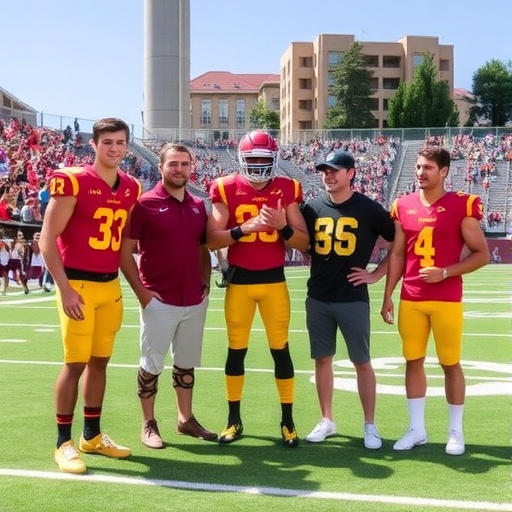
As college football season approaches, a team of students and recent alumni at the USC Viterbi School of Engineering is undertaking a project that could change how one of the sport’s most data-intensive programs prepares for opponents. Researchers in the school’s analytics master’s program are building a searchable database that will organize play-level information from thousands of Football Bowl Subdivision games, transforming scattered records into a technical resource for coaches, analysts and researchers.
Every football game produces an enormous stream of information. The obvious events—touchdowns, tackles, interceptions and penalties—represent only a fraction of what happens on the field. Each play can also be described by down and distance, field position, personnel groupings, offensive formations, defensive alignments, motion, time remaining, score differential and the eventual result. When these details accumulate across seasons and teams, the resulting dataset becomes too large and inconsistent to analyze efficiently without specialized systems.
The USC project is designed to address that problem by creating a structured data warehouse for college football. Rather than storing information as isolated game reports, the warehouse will organize records into related tables that can be queried across teams, seasons, opponents and play types. This approach allows analysts to compare situations systematically, identify recurring patterns and test hypotheses without manually collecting and cleaning data each time a new question arises.
Bruce Wilcox, an associate professor of industrial and systems engineering practice at USC Viterbi, is supervising the effort. He assembled the team at the beginning of the spring semester and expects the first version of the warehouse to be operating by the end of the summer. The project is being led in its day-to-day technical work by Saloni Deepak Prabhu, who earned a master’s degree in chemical engineering from USC in 2025 and became involved with Wilcox’s research group after taking his data-focused courses.
The central challenge is not simply gathering more information. It is making information from different sources compatible. Football data may use different naming conventions for formations, play outcomes, penalties or player positions, while historical records can vary in completeness and precision. A useful warehouse must therefore apply data-engineering methods such as normalization, validation and consistent identifiers. These processes reduce duplication, preserve relationships between games and plays, and make it possible to compare records that were originally collected under different standards.
“We are building a data warehouse so the analysts can get direct access to well-modeled structured data, so that they can spend time on their analysis and the time spent on preparing the data is eliminated altogether,” Prabhu said. In practical terms, the system is intended to move analysts away from repetitive preparation tasks, such as merging files, correcting labels and checking for missing values. Instead, they would be able to focus on statistical analysis, visualization and the interpretation of football strategy.
The project was commissioned by Conor McQuiston, director of football analytics for the USC Trojans. For a football analytics department, a searchable historical database can function as a form of experimental infrastructure. Analysts could examine how teams perform in comparable game situations, evaluate whether particular strategies are associated with better outcomes and explore how decisions change according to field position, score or opponent behavior. The database would not automatically determine which play should be called, but it could provide evidence for assessing the likely consequences of different choices.
McQuiston described the archive as a way to conduct “natural experiments” using the accumulated history of college football. Because thousands of teams have encountered similar situations while trying different strategies, analysts can compare those outcomes as observational evidence. Such comparisons must still be interpreted carefully: football plays are influenced by talent, injuries, coaching, weather and game context, and a correlation between a tactic and success does not prove that the tactic caused the result. Even so, a consistent data structure can help analysts ask sharper questions and identify trends that would be difficult to see in isolated game film or summary statistics.
The USC team eventually hopes to connect play-by-play information with individual player performance. That expansion could allow researchers to study how players contribute within particular formations or strategic contexts, rather than evaluating them only through broad totals such as yards, tackles or touchdowns. Linking player-level and play-level data is technically demanding because athletes change positions, teams and roles, and historical records may identify the same person in different ways. Building reliable connections between those layers will be essential if the warehouse is to support advanced modeling and meaningful comparisons.
The database reflects a broader transformation in sports science, where large-scale data systems increasingly serve as the foundation for decision-making. In football, the most valuable insights may emerge not from a single spectacular statistic but from relationships among thousands of variables. By turning years of game information into structured, searchable evidence, the USC project aims to give analysts more time to investigate what works, why it works and whether a strategy can survive the unpredictable conditions of game day. If the warehouse performs as planned, it could become a behind-the-scenes tool for converting the complexity of college football into faster, more precise and more testable knowledge.
Web References: https://viterbigradadmission.usc.edu/programs/masters/msprograms/industrial-systems-engineering/ms-analytics/; https://usctrojans.com/sports/football; https://viterbi.usc.edu/directory/faculty/Wilcox/Bruce; https://usctrojans.com/staff-directory/conor-mcquiston/6173
Keywords
USC Football, sports analytics, football data, data warehouse, play-by-play analysis, machine learning, industrial engineering, sports science, college football, data engineering
Cite Scienmag News
Denise Maddox. (August 5, 2026). USC Engineering Students Team Up With Trojan Football. Scienmag. https://scienmag.com/usc-engineering-students-team-up-with-trojan-football/
Denise Maddox. "USC Engineering Students Team Up With Trojan Football." Scienmag, 5 August 2026, https://scienmag.com/usc-engineering-students-team-up-with-trojan-football/. Accessed 5 September 2026.
Denise Maddox. "USC Engineering Students Team Up With Trojan Football." Scienmag. August 5, 2026. https://scienmag.com/usc-engineering-students-team-up-with-trojan-football/


