


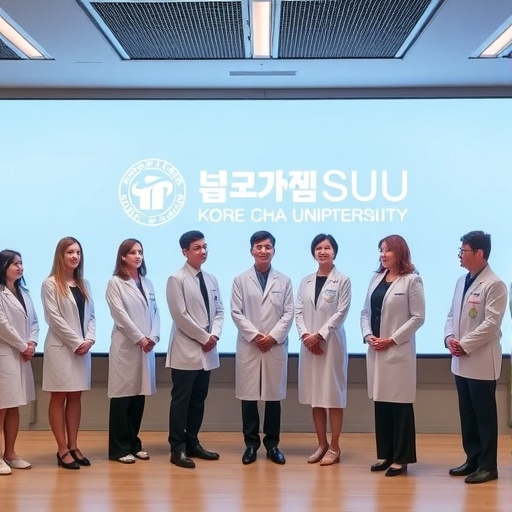
Korea University and the Ulsan National Institute of Science and Technology (UNIST) have launched KUNIST, an ambitious biomedical training and research platform designed to produce a new generation of physician-scientists and biomedical researchers capable of connecting clinical medicine with artificial intelligence, engineering, data science, and biotechnology. The partnership was unveiled at the K-MediST Symposium on June 17 at Seung Myung-ho Hall in the Dongwha Bio Building at Korea University’s Jeongneung Mediscience Park, where researchers and academic leaders presented a long-term strategy for reshaping how medical innovation is developed, tested, and brought to patients.
At the center of the initiative is the K-MediST program, which will train professionals known as K-PRISM researchers—Korea-leading Physician-Scientists in Research, Innovation, Systems Medicine, and Manufacturing and Commercialization. The program is built around five core competencies: clinical problem-solving, convergent research, computation and artificial intelligence, interdisciplinary collaboration, and commercialization. Together, these capabilities are intended to address a persistent challenge in modern medicine: promising discoveries are often developed in isolation from clinical practice, making it difficult to validate technologies in real-world settings or move them efficiently into hospitals and the biomedical market.
Korea University and UNIST plan to tackle that challenge through three interconnected objectives. The institutions will create joint educational programs, establish collaborative laboratories for clinical validation and translational research, and develop an end-to-end commercialization platform to support the transition from laboratory discovery to practical medical technology. Such a structure could help shorten the path between a scientific insight and its application in diagnosis, treatment, medical devices, or healthcare systems by bringing clinicians, engineers, data scientists, and industry specialists into the same research environment from the beginning.
The partnership is also designed to respond to the growing technical complexity of healthcare. Artificial intelligence can identify patterns in medical images and clinical records, but algorithms require high-quality data, clinical expertise, and rigorous validation before they can be trusted in hospitals. Similarly, precision medicine depends on integrating biological information with patient histories, imaging, treatment outcomes, and other clinical variables. By combining UNIST’s capabilities in computation, engineering, and advanced analysis with Korea University’s strengths in clinical medicine and healthcare research, KUNIST aims to create a framework in which biomedical technologies can be evaluated under real clinical conditions rather than remaining confined to experimental settings.
The symposium opened with remarks from Tae Hoon Kim, Vice President for Research at Korea University Anam Hospital and principal investigator of the K-MediST project. Eul Sik Yoon, Executive Vice President for Medical Affairs and President of Korea University Medicine, said the collaboration could become a global model for linking medicine with emerging technologies. Sung Bom Pyun, Dean of Korea University College of Medicine, emphasized that the college had established its Center for Physician-Scientist Development in November 2025 and had built a training system spanning undergraduate and graduate education. He described the selection for the K-MediST Program as recognition of those efforts and as a step toward strengthening Korea University’s role in biomedical research and innovation.
The program’s scale is substantial. During the curriculum presentation, Kihoon Han, Chair of the Department of Biomedical Sciences at Korea University College of Medicine, announced plans to train 80 researchers between April 2026 and December 2030. The cohort will include 64 doctoral-level biomedical researchers and 16 physician-scientists pursuing MD-PhD training. By combining clinical education with research in engineering, computation, and biotechnology, the program seeks to produce specialists who can understand both the biological problem presented by a patient and the technical tools required to solve it.
A joint research center is planned for the Chung Mong-Koo Future Medical Center at Korea University’s Jeongneung Mediscience Park. The facility will unite UNIST’s computational infrastructure and high-performance analytical equipment with Korea University’s clinical research capacity. A Data Living Lab will provide researchers with access to real-time clinical data while enabling close interaction with physicians. This model could support the development of adaptive medical technologies, in which algorithms and devices are repeatedly tested against clinical needs, refined through patient data, and assessed for safety, accuracy, and practical usefulness.
The research agenda presented at the symposium reflects the breadth of the collaboration. Min Hyuk Lim of the UNIST Graduate School of Medical Science discussed medical artificial intelligence and data science, while Woo Young Jang of Korea University Anam Hospital outlined work in precision medicine and bioengineering. Hwang Kim of the UNIST Department of Design addressed digital healthcare and smart hospitals, areas in which user-centered design can determine whether a technically advanced system is actually adopted by patients and healthcare workers. Hyeon Soo Kim, Vice Dean for Academic Affairs at Korea University College of Medicine, presented plans involving medical robotics and extreme medicine, and Se Jun Oh described project management, progress monitoring, and annual evaluation for the K-MediST initiative.
Seungjae Baek, Dean of the UNIST Graduate School of Medical Science and Engineering, said the symposium offered a concrete foundation for future interdisciplinary research and expressed the institutions’ commitment to using advanced engineering technologies to address unmet clinical needs. Tae Hoon Kim concluded that Korea University’s international strengths in clinical medicine and healthcare, combined with UNIST’s scientific and engineering expertise, could establish a new benchmark for physician-scientist education in Korea. If the platform fulfills its ambitions, KUNIST will not simply train researchers in separate disciplines; it will create professionals able to move across the entire biomedical innovation chain, from identifying a clinical problem and analyzing biological or patient data to developing, validating, manufacturing, and commercializing a solution. That integrated model may prove crucial as healthcare becomes increasingly dependent on artificial intelligence, robotics, precision medicine, and large-scale clinical data.
Cite Scienmag News
Blake Davidson. (August 5, 2026). Korea University, UNIST Launch KUNIST Platform to Train Next-Generation Physician-Scientists. Scienmag. https://scienmag.com/korea-university-unist-launch-kunist-platform-to-train-next-generation-physician-scientists/
Blake Davidson. "Korea University, UNIST Launch KUNIST Platform to Train Next-Generation Physician-Scientists." Scienmag, 5 August 2026, https://scienmag.com/korea-university-unist-launch-kunist-platform-to-train-next-generation-physician-scientists/. Accessed 3 September 2026.
Blake Davidson. "Korea University, UNIST Launch KUNIST Platform to Train Next-Generation Physician-Scientists." Scienmag. August 5, 2026. https://scienmag.com/korea-university-unist-launch-kunist-platform-to-train-next-generation-physician-scientists/


