


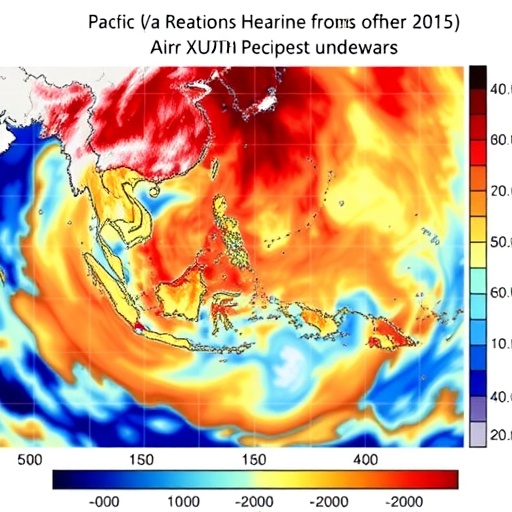
A new study identifies a powerful two-way relationship between the atmosphere and the ocean as the engine behind one of the most persistent marine heatwaves ever observed in the North Pacific. Researchers W. Jiang, G. Forget, Y. Song and colleagues report that the extraordinary warming event that unfolded from 2013 to 2016 was not caused by a single burst of atmospheric heating or an isolated ocean current anomaly. Instead, it was driven and maintained by coupled air–sea interactions that allowed unusual warmth to reinforce itself across a vast region of the Pacific.
The event, widely known as the “Blob,” transformed the North Pacific into an enormous reservoir of excess heat. Sea-surface temperatures rose far above normal over a region extending across thousands of kilometres, affecting marine ecosystems, fisheries, weather patterns and coastal communities. Its persistence made it especially alarming: rather than fading after a short-lived atmospheric disturbance, the heatwave endured through multiple seasons, exposing the limits of explanations based only on surface weather.
Marine heatwaves occur when ocean temperatures remain unusually high for an extended period. Their intensity depends not only on how much heat enters the ocean, but also on how efficiently that heat is retained, redistributed and transported into deeper layers. The new research examines the North Pacific event through this broader ocean–atmosphere lens, showing that conditions above the water and processes beneath the surface interacted continuously. The result was a feedback system capable of both initiating the heatwave and preventing its rapid collapse.
One important component was an anomalous atmospheric circulation pattern over the North Pacific. Persistent high-pressure conditions reduced cloud cover and weakened winds across parts of the ocean. With fewer clouds, more incoming sunlight reached the surface, increasing the amount of solar radiation absorbed by the upper ocean. Weaker winds also reduced turbulent mixing, which normally carries surface heat downward and blends warm water with cooler water below. When that mixing weakened, heat accumulated in a shallow surface layer, causing temperatures to climb more rapidly.
The atmosphere also influenced the ocean through evaporation. Under ordinary conditions, evaporation removes energy from the sea surface because water requires heat to change from liquid to vapour. That process acts as a natural cooling mechanism. When winds weakened and near-surface atmospheric conditions became less favourable for evaporation, the ocean lost less heat to the atmosphere. The combined effects of enhanced solar heating, reduced evaporative cooling and diminished vertical mixing created an efficient thermal trap near the surface.
The ocean, however, was not a passive recipient of atmospheric forcing. As the surface warmed, it altered the exchange of heat and moisture with the air above it, helping to sustain the atmospheric pattern that had contributed to the initial warming. This is the defining feature of a coupled system: the atmosphere changes the ocean, and the ocean feeds changes back into the atmosphere. Such feedbacks can turn a temporary disturbance into a self-reinforcing climate event, particularly when background ocean conditions already favour the retention of heat.
Ocean circulation further shaped the evolution of the heatwave. Currents can transport warm water horizontally, while changes in the depth of the mixed layer determine how much heat is concentrated near the surface. A shallow mixed layer stores heat in a relatively thin volume of water, making surface temperatures more sensitive to incoming radiation and atmospheric conditions. The study’s coupled perspective indicates that these circulation and mixing processes worked alongside atmospheric anomalies, spreading and preserving the heat rather than allowing it to disperse quickly.
The ecological consequences of the North Pacific heatwave were extensive. Marine organisms are adapted to characteristic temperature ranges, and prolonged warming can force species to move, disrupt seasonal cycles and increase physiological stress. The event was associated with unusual distributions of fish and plankton, harmful algal blooms, seabird die-offs and impacts on marine mammals. Warmer water can also reduce the availability of nutrients in the sunlit surface layer by strengthening stratification, potentially altering the productivity of entire food webs. These changes demonstrate why the physical mechanisms behind a marine heatwave matter far beyond the temperature record itself.
The findings also carry a warning for a warming world. Human-driven climate change raises the baseline temperature of the ocean, meaning that natural variability now operates on top of an already warmer system. Under these conditions, air–sea feedbacks may produce marine heatwaves that are more frequent, more intense or longer-lasting. Understanding the heat budget of such events—how much energy enters, leaves, moves or remains in the ocean—will be essential for improving forecasts. Better prediction could help fisheries managers, coastal communities and conservation programmes prepare for ecological shocks before they reach their peak.
By showing that the 2013–2016 North Pacific marine heatwave emerged from an evolving conversation between atmosphere and ocean, the study reframes the event as more than an exceptional patch of warm water. It was a dynamic climate episode in which weakened winds, altered heat exchange, reduced mixing and oceanic feedbacks combined to sustain extreme temperatures over years. The research underscores a central lesson of modern climate science: the most disruptive ocean extremes are often produced not by one factor acting alone, but by several components of the Earth system locking together and amplifying one another.
Cite Scienmag News
Violet Maxwell. (August 5, 2026). Air–sea interactions triggered and prolonged the 2013–2016 North Pacific marine heatwave. Scienmag. https://scienmag.com/air-sea-interactions-triggered-and-prolonged-the-2013-2016-north-pacific-marine-heatwave/
Violet Maxwell. "Air–sea interactions triggered and prolonged the 2013–2016 North Pacific marine heatwave." Scienmag, 5 August 2026, https://scienmag.com/air-sea-interactions-triggered-and-prolonged-the-2013-2016-north-pacific-marine-heatwave/. Accessed 4 September 2026.
Violet Maxwell. "Air–sea interactions triggered and prolonged the 2013–2016 North Pacific marine heatwave." Scienmag. August 5, 2026. https://scienmag.com/air-sea-interactions-triggered-and-prolonged-the-2013-2016-north-pacific-marine-heatwave/


