


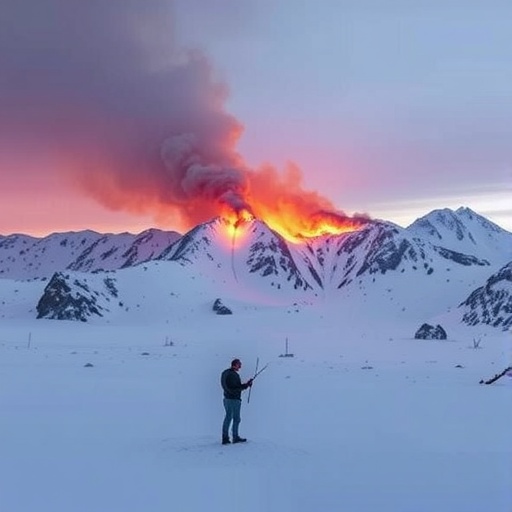
The Arctic is often portrayed as a wilderness ruled almost entirely by temperature, drought, and the slow movement of climate systems. But a new study suggests that another force is helping shape the region’s growing fire problem: human activity. Fires occurred 2.5 times more often in Arctic areas associated with artificial light at night than in climatically similar areas without detectable nighttime illumination, according to an international research team led by the University of Zurich. The findings reveal that the geography of Arctic fire is closely intertwined with the expanding human footprint across the rapidly changing north.
The study, published in Communications Earth & Environment, examined fire occurrence across the European and broader pan-Arctic region between 2001 and 2013. Researchers focused on tundra fires, which can burn vast areas of vegetation and organic soil, release large quantities of carbon, and expose permafrost to additional warming. Although Arctic fires have traditionally been linked primarily to rising temperatures, low humidity, and drought, the researchers set out to determine whether human presence also influenced where fires began.
Direct measurements of human activity are difficult to obtain consistently across the enormous and sparsely populated Arctic. To overcome this problem, the team used satellite observations of artificial light at night as a proxy for human presence. Nighttime illumination can reveal settlements, industrial facilities, transport corridors, energy infrastructure, and mining operations, even in remote areas where population statistics are incomplete. The researchers compared fire locations with illuminated areas and then assessed whether the pattern remained after accounting for climate conditions that are known to affect ignition and fire spread.
The results showed a striking spatial relationship. Arctic fires were more common within lit areas than in unlit locations with comparable climatic conditions. Fire occurrence also increased near illuminated zones, indicating that the association was not limited to the exact pixels or facilities producing visible light. This pattern suggests that human activity may influence surrounding landscapes through roads, camps, machinery, electrical infrastructure, industrial operations, and the movement of people. In a region where natural ignition sources such as lightning can be widely scattered, concentrated human activity may create localized clusters of additional ignition risk.
The researchers emphasize that the analysis does not mean human activity is responsible for every Arctic fire, or that climate change has become secondary. Warmer temperatures can dry vegetation and soils, lengthen the fire season, and increase the likelihood that a small ignition will develop into a large and persistent blaze. Changes in precipitation, snow cover, wind, and atmospheric moisture can also determine whether fires spread. Instead, the study identifies human presence as an additional factor that interacts with these climatic pressures. As the Arctic becomes warmer and more fire-prone, an ignition that might once have failed could increasingly find conditions favorable for rapid expansion.
The strength of the new work lies in its large geographic scale and its attempt to separate human influence from climate. Rather than simply mapping fires around cities or industrial sites, the researchers compared illuminated and unilluminated areas under similar environmental conditions. This approach provides a more informative test of whether human activity is associated with fire occurrence. However, satellite light remains an indirect indicator. Dim or intermittent activities may not be visible, while illumination can also reflect permanent infrastructure without revealing exactly what caused a fire. The findings therefore demonstrate a strong association, but they do not establish that every additional fire was directly ignited by people.
Regional differences added another important layer to the results. The relationship between nighttime illumination and fire occurrence was stronger in some parts of the Arctic than in others. Those variations may reflect differences in land management, emergency response, infrastructure design, industrial practices, access to firefighting resources, and the ability of communities to detect and suppress fires quickly. In areas where prevention systems are limited or response times are long, a human-caused ignition may have a greater chance of escaping control. Conversely, regions with stronger fire management could experience fewer fires despite substantial development.
The consequences extend well beyond the immediate burn scars. Arctic fires can threaten homes, roads, airfields, pipelines, mines, and other infrastructure while sending smoke across national borders and oceans. Smoke from fires in northern Canada has already reached Europe, creating hazy skies far from the original source and raising concerns about air quality. For Arctic communities, smoke can worsen respiratory conditions and disrupt travel, hunting, herding, and other activities. Fire can also damage culturally significant landscapes and habitats that support wildlife and local livelihoods.
The environmental feedbacks may be even more consequential. Arctic soils contain enormous stores of organic carbon, much of it locked in or protected by permafrost. When fire removes insulating vegetation and darkens the ground surface, the soil can absorb more solar energy, increasing the risk of permafrost thaw. Thawing can release carbon dioxide and methane, adding to greenhouse gas concentrations and reinforcing climate warming. Fire can also push tundra ecosystems toward new states dominated by shrubs or other vegetation, potentially altering future fuel loads and making some landscapes more vulnerable to repeated burning.
The researchers say that reducing human-related ignition risks should become an essential part of Arctic climate adaptation. Prevention around settlements, roads, industrial sites, and energy facilities could include stricter controls on equipment, improved monitoring, rapid detection systems, safer land-use planning, and better coordination between communities and industrial operators. The broader message is that Arctic fire risk cannot be understood through climate variables alone. As development expands into a warmer and drier north, the lights that mark human activity may also mark places where prevention can make the greatest difference.
News Publication Date: 31-Jul-2026
Web References: https://doi.org/10.1038/s43247-026-03884-3
References: Communications Earth & Environment, DOI: 10.1038/s43247-026-03884-3
Keywords
Arctic fires, wildfire, climate change, human activity, artificial light at night, tundra, permafrost, satellite observations, fire prevention, Arctic communities, smoke pollution, Earth system science
Cite Scienmag News
Sloane Callahan. (August 5, 2026). Human Activity More Than Doubles Arctic Fire Occurrence. Scienmag. https://scienmag.com/human-activity-more-than-doubles-arctic-fire-occurrence/
Sloane Callahan. "Human Activity More Than Doubles Arctic Fire Occurrence." Scienmag, 5 August 2026, https://scienmag.com/human-activity-more-than-doubles-arctic-fire-occurrence/. Accessed 3 September 2026.
Sloane Callahan. "Human Activity More Than Doubles Arctic Fire Occurrence." Scienmag. August 5, 2026. https://scienmag.com/human-activity-more-than-doubles-arctic-fire-occurrence/


