


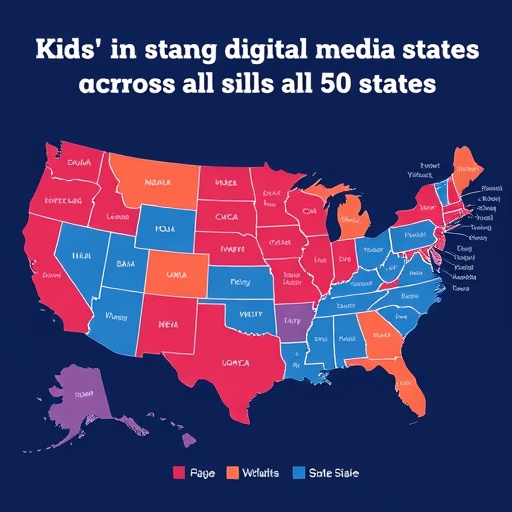
Every U.S. state had introduced at least one bill aimed at regulating social media or other digital platforms for people younger than 18 by March 2026. The rapidly expanding legislative movement has created a maze of proposals covering age verification, parental consent, targeted advertising, platform design and access restrictions. Now, researchers at the University of California, Davis, have launched a public database designed to make that maze easier to navigate for scientists, parents, journalists and policymakers.
The Youth Digital Policy Repository collects state legislation related to children and digital media and organizes it by location, year, policy topic and legislative status. Users can search measures that were introduced, passed, failed or enacted, allowing them to compare how different states are responding to concerns about youth safety online. The database currently contains 379 pieces of U.S. legislation dating back to 2022, with plans to expand its coverage to policies from other countries.
The repository was developed by Samantha Vigil, a Ph.D. candidate in communication at UC Davis, in collaboration with Drew Cingel, an associate professor of communication and the principal investigator of the university’s Human Development and Media Lab. Their work describing the database and the legislative landscape appears in the Journal of Children and Media. The researchers say the tool is intended not only to document what lawmakers have attempted, but also to provide evidence and examples that may shape future policy.
“Adolescent mental health and well-being is such an important outcome,” Vigil said. “This repository provides a centralized source of regulations, both attempted and passed, to inform future legislation.” By gathering proposals that would otherwise remain scattered across state legislative websites, the database can reveal patterns in policymaking, such as which states are experimenting with parental approval systems, which are pursuing age checks and which are focusing on the way platforms design their services.
Building the repository required more than simply collecting bill titles. Undergraduate research assistants identified, read and coded digital-media-related legislation at each stage of the lawmaking process, from introduction through passage, failure or enactment. This approach allows the database to distinguish between a proposal that was merely filed and one that became law, an important technical distinction when researchers evaluate whether a policy has had measurable effects. The team plans to update the repository twice a year, in June and November.
The surge in legislation reflects growing concern among young people and their parents about the psychological and behavioral effects of social media. In a 2025 Pew Research Center survey, 48% of U.S. teenagers between 13 and 17 said social media was harmful to people their age. Among parents, 44% identified social media as the leading threat to their child’s mental health. Those perceptions have intensified debate over whether the responsibility for online safety should rest primarily with families, children or the companies that operate digital platforms.
Cingel said research has linked social media use with poor mental-health outcomes among children and teenagers, although the relationships are complex and do not imply that every young user will experience harm. Platform architecture may be one contributing factor. Infinite scrolling removes natural stopping points, while recommendation algorithms continuously select content based on a user’s previous behavior. These systems can increase the time people spend online and repeatedly expose them to emotionally intense or highly engaging material. For young users, whose cognitive and emotional regulation systems are still developing, those design choices may be particularly consequential.
Governments outside the United States have already moved toward more direct restrictions. Australia passed a law in 2024 banning social-media access for children aged 16 and younger, and the measure took effect in December 2025. In June, the United Kingdom announced plans for a similar ban affecting people under 16, scheduled to begin in 2027. The U.S. approach has so far been more fragmented. State lawmakers have generally been more cautious about proposing outright bans, instead considering age-verification requirements, parental consent, restrictions on targeted advertising and rules governing platform features.
That fragmentation is one reason the UC Davis researchers believe a centralized tracking system is necessary. A state-by-state comparison can show whether similar policies are spreading, whether legislative efforts are being revised after legal challenges and which proposals have survived the political process. It may also help policymakers identify unintended consequences before adopting rules that affect millions of young people and the technologies they use for education, communication, entertainment and social connection.
Vigil argues that regulation should not simply remove children from digital spaces or place the entire burden of protection on parents and young users. Social media, artificial intelligence and other technologies are deeply embedded in childhood, she said, and shutting young people out could also eliminate opportunities and potential benefits. Instead, she favors platform designs that make online environments safer by default. The repository’s authors hope that by making the evolving policy landscape visible, it will support more informed decisions about how technology can be redesigned to protect young people without excluding them from the digital world.
News Publication Date: 24 July 2026
Web References:
Youth Digital Policy Repository: https://www.youthdigitalpolicyrepository.com/#dashboard
UC Davis Human Development and Media Lab: https://medialabs.ucdavis.edu/
UC Davis profile of Samantha Vigil: https://medialabs.ucdavis.edu/people/samantha-vigil
UC Davis profile of Drew Cingel: https://communication.ucdavis.edu/people/drew-cingel
References:
Vigil, S., Cingel, D., Shawcroft, M., Coyne, S., Livingstone, S., and Shawcroft, J. “The youth digital policy repository: A tool for tracking digital media legislation aimed at minors.” Journal of Children and Media. DOI: 10.1080/17482798.2026.2698291
Pew Research Center. 2025 survey on teens, parents and social media’s effects on mental health.
Cite Scienmag News
Courtney Benton. (August 4, 2026). Database tracks kids’ digital media regulation bills across all 50 states. Scienmag. https://scienmag.com/database-tracks-kids-digital-media-regulation-bills-across-all-50-states/
Courtney Benton. "Database tracks kids’ digital media regulation bills across all 50 states." Scienmag, 4 August 2026, https://scienmag.com/database-tracks-kids-digital-media-regulation-bills-across-all-50-states/. Accessed 3 September 2026.
Courtney Benton. "Database tracks kids’ digital media regulation bills across all 50 states." Scienmag. August 4, 2026. https://scienmag.com/database-tracks-kids-digital-media-regulation-bills-across-all-50-states/


