


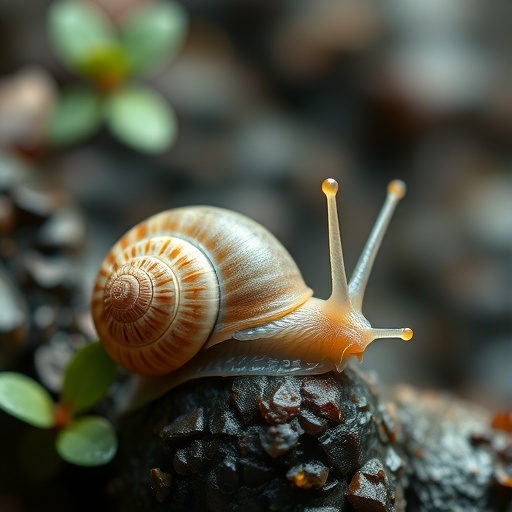
A tiny snail discovered in a cave in southwestern China has become the first freshwater cave snail ever recorded within Chinese territory—and it has no eyes. Named Erhaia dijiang, the newly described species was found in an underground stream in Yuxi City, Yunnan Province, at an elevation of 2,062 meters. Its discovery offers a rare glimpse into the highly specialized organisms that survive in subterranean freshwater systems, while also raising immediate concerns about the species’ ability to persist in an environment where only a handful of individuals have been found.
The species belongs to Erhaiidae, a family of minute freshwater gastropods within the superfamily Truncatelloidea. The research, published in Subterranean Biology, represents an important addition to the known diversity of China’s cave fauna. Although the country contains extensive karst landscapes and thousands of caves, its subterranean freshwater mollusks remain poorly documented. Until now, no freshwater cave snail had been formally reported from Chinese territory, leaving a significant gap in scientists’ understanding of the country’s underground aquatic ecosystems.
Like many organisms that spend their entire lives in darkness, E. dijiang displays a suite of traits associated with life underground. The snail is a true troglobiont, meaning it is adapted to permanent subterranean conditions rather than merely using caves occasionally. Its eyes are completely absent, and the ocular structures have undergone total degeneration. In evolutionary terms, this loss is likely linked to the absence of useful light in its habitat. Maintaining complex visual organs requires energy, so natural selection can favor their reduction when vision no longer improves survival.
The snail’s body is delicate and unpigmented, with slender tentacles that may help it detect chemical and physical signals in the water. Its shell is small, conical, and highly translucent, a combination of features frequently observed in animals living in darkness. Without sunlight, pigmentation offers little protective value, while a reduced and lightweight shell may help a small gastropod move through narrow spaces between gravel and rock. These characteristics make the species immediately recognizable as a highly specialized member of the subterranean fauna.
Its scientific name also reflects its unusual appearance and behavior. Researchers named the species dijiang after Di Jiang, a faceless mountain patron god described in the ancient Chinese text Classic of Mountains and Seas, or Shan Hai Jing. The reference is particularly fitting because the snail lacks eyes and appears almost ghostlike in its underground habitat. Laboratory observations showed that the animals were strongly photophobic: when exposed to light, they actively moved toward dark crevices beneath rocks, behavior consistent with a life shaped by complete darkness.
The discovery also extends the known ecological limits of cave-dwelling snails. At 2,062 meters above sea level, Erhaia dijiang currently holds the highest recorded distribution among known cave snails in the family Erhaiidae. The finding demonstrates that specialized freshwater mollusks can survive in high-elevation karst caves, where underground waterways may remain physically isolated from surface ecosystems. Karst environments are formed as water dissolves soluble rock such as limestone, creating networks of fractures, cavities, underground streams, and interconnected chambers.
Researchers found the snails in shallow water, generally less than one meter deep, among submerged gravel and crushed stone. The cave water remained close to 20 degrees Celsius, providing a relatively stable thermal environment despite seasonal changes outside. During the rainy season, stronger flows occasionally swept a small number of snails through the cave’s outlet. Yet the animals were not found in nearby surface streams and remained concentrated within approximately two meters of the cave entrance, suggesting that their distribution may depend on very specific combinations of water chemistry, flow, substrate, and food availability.
In laboratory conditions, the snails fed on diatoms growing on rock surfaces as well as supplied fish food. Diatoms are microscopic algae enclosed in silica shells and are an important source of energy in many freshwater food webs. Their presence indicates that even a dark cave can support limited primary production, especially near entrances where small amounts of light may penetrate. The snails may also rely on organic material carried underground by water, although the researchers’ observations provide only an initial picture of their feeding ecology.
The greatest concern is the species’ extremely small known population. During a field survey in August 2025, the research team located only three living adults and one empty shell. No juvenile snails were observed, making it impossible to determine whether the population is reproducing successfully or whether the adults represent the last remnants of a much larger group. A population this small could be vulnerable to pollution, changes in groundwater flow, sediment disturbance, tourism, quarrying, drought, or other alterations to the surrounding karst system. The researchers are calling for broader surveys of Chinese caves and rapid conservation planning. For now, Erhaia dijiang is not only a remarkable example of evolution in darkness but also a warning that many subterranean species may disappear before scientists have the opportunity to find them.
News Publication Date: 29-May-2026
Web References: https://doi.org/10.3897/subtbiol.56.188075
References: He Y-M, Xiang H-Q, Yang J-M, Zheng H, Yang S-Z, Zhou Y-F, Zheng J (2026). “A new eyeless species in Erhaiidae (Gastropoda, Truncatelloidea) from a cave in Yuxi City, Yunnan, China.” Subterranean Biology 56: 127–136.
Cite Scienmag News
Gavin Prescott. (August 4, 2026). China’s First Cave-Dwelling Freshwater Snail Named for Mythical Mountain God. Scienmag. https://scienmag.com/chinas-first-cave-dwelling-freshwater-snail-named-for-mythical-mountain-god/
Gavin Prescott. "China’s First Cave-Dwelling Freshwater Snail Named for Mythical Mountain God." Scienmag, 4 August 2026, https://scienmag.com/chinas-first-cave-dwelling-freshwater-snail-named-for-mythical-mountain-god/. Accessed 3 September 2026.
Gavin Prescott. "China’s First Cave-Dwelling Freshwater Snail Named for Mythical Mountain God." Scienmag. August 4, 2026. https://scienmag.com/chinas-first-cave-dwelling-freshwater-snail-named-for-mythical-mountain-god/


