


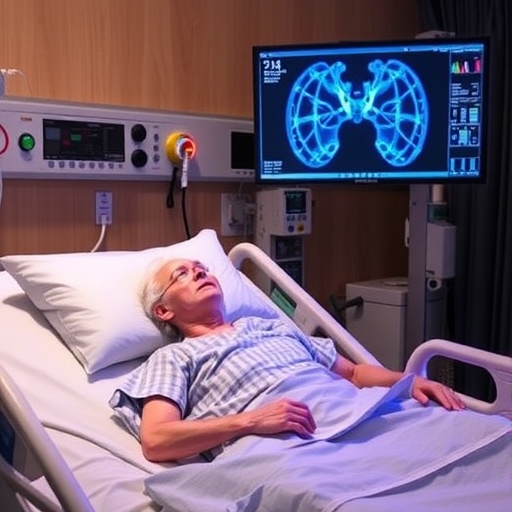
A new clinical trial suggests that artificial intelligence could make one of the most common treatments in hospitals substantially more precise. An automated oxygen delivery system helped hospitalized patients remain within their prescribed oxygen range for 85 percent of the monitored time, compared with 63 percent among patients receiving standard clinician-managed oxygen therapy. The system also reduced exposure to both dangerously low and potentially harmful high oxygen levels, without increasing serious adverse events.
The findings come from the multicenter SAVE-O2 AI trial, led by researchers at the University of Colorado Anschutz Medical Campus and published in JAMA Internal Medicine. The results were presented simultaneously at the Military Health System Research Symposium, highlighting the technology’s possible value not only in hospitals but also in military and emergency-care environments where clinical staff may be stretched thin.
The trial enrolled 300 adults at four U.S. hospitals, including UCHealth University of Colorado Hospital. Participants had acute respiratory illnesses, traumatic injuries, burns or conditions requiring surgical recovery, and all had recently begun receiving supplemental oxygen. They were randomly assigned either to conventional oxygen management, in which nurses or respiratory therapists adjusted flow rates, or to autonomous oxygen titration using the investigational O2matic PRO100 system.
Supplemental oxygen is usually delivered through devices such as nasal cannulas or face masks, with the flow rate adjusted according to intermittent measurements of a patient’s blood oxygen saturation. That saturation is estimated by pulse oximetry, a noninvasive technique that uses light to detect changes in the color of blood circulating through a fingertip sensor. Although pulse oximeters can provide continuous readings, standard hospital practice generally relies on clinicians checking the values periodically and manually changing oxygen delivery.
The automated system used the same basic physiological signal but responded to it continuously. When the patient’s oxygen saturation moved below the prescribed range, the device could increase oxygen flow; when the level rose too high, it could reduce delivery. This closed-loop approach is designed to compensate for the rapid fluctuations that can occur as patients breathe, move, sleep, receive medication or experience changes in their underlying illness. Instead of waiting for the next clinical assessment, the system adjusted oxygen in near real time.
Patients assigned to automated therapy spent 85 percent of the monitored period within their target oxygen range, a 22-percentage-point improvement over standard care. They also spent less time in hypoxemia, the condition in which blood oxygen levels fall too low, and less time in hyperoxemia, when oxygen levels exceed the intended range. The investigators further reported that clinical staff made fewer manual adjustments for patients in the automated group.
The distinction between too little and too much oxygen is clinically important. Insufficient oxygen can deprive organs such as the brain and heart of the oxygen they need to function. Excess oxygen, once widely assumed to be harmless, may also cause problems in some critically ill patients, including oxidative stress and injury to vulnerable tissues. For that reason, modern oxygen therapy increasingly emphasizes maintaining a patient-specific target range rather than simply delivering as much oxygen as possible.
“Oxygen is one of the most widely used therapies in medicine,” said Adit Ginde, the study’s principal investigator and a professor of emergency medicine at the University of Colorado Anschutz School of Medicine. Yet oxygen delivery remains largely dependent on repeated manual adjustments. According to Ginde, autonomous titration could help patients stay within their intended range more consistently while reducing both under-oxygenation and over-oxygenation.
David Douin, the study’s first author and an associate professor of anesthesiology at the University of Colorado Anschutz School of Medicine, said hospitalized patients’ oxygen requirements can change quickly. An automated system can react to those changes throughout the day and night, potentially reducing the periods during which a patient’s oxygen level drifts outside the target range. The trial found no increase in serious adverse events, an important safety result for a device that directly influences a core component of respiratory support.
The researchers caution that improved oxygen control does not by itself prove that the technology improves survival, shortens hospital stays or prevents long-term complications. The study primarily evaluated how much time patients spent within their prescribed oxygen range and how often staff needed to intervene. Future investigations will need to examine clinical outcomes, workload changes, performance in more severely ill patients and the system’s reliability during transport or in settings with limited monitoring resources.
The research has particular relevance to military medicine, where medics may care for wounded service members far from a hospital while simultaneously managing bleeding, airway problems and other life-threatening injuries. Vik Bebarta, chair of emergency medicine and founding director of the CU Anschutz Combat Medicine Research Center, said a device capable of adjusting oxygen independently could remove one recurring task from an overloaded medic’s responsibilities. The team is now planning additional evaluations in emergency transport and prehospital care.
The O2matic PRO100 was investigational in the United States and had not been cleared or approved by the Food and Drug Administration for commercial use. It was rented from O2matic of Denmark for research purposes, while the company had no role in study design, data collection, analysis or publication decisions. The trial was conducted under an FDA Investigational Device Exemption and was supported by the Defense Health Agency’s Combat Casualty Care Portfolio, the Medical Technology Enterprise Consortium and the National Center for Advancing Translational Sciences.
Web References: JAMA Internal Medicine article; University of Colorado Anschutz; O2matic.
References: Ginde A, Douin D and colleagues, SAVE-O2 AI trial, JAMA Internal Medicine; CU Anschutz Combat Medicine Research Center.
Cite Scienmag News
Ophelia Keating. (August 4, 2026). CU Anschutz trial finds AI improves oxygen delivery for hospitalized patients. Scienmag. https://scienmag.com/cu-anschutz-trial-finds-ai-improves-oxygen-delivery-for-hospitalized-patients/
Ophelia Keating. "CU Anschutz trial finds AI improves oxygen delivery for hospitalized patients." Scienmag, 4 August 2026, https://scienmag.com/cu-anschutz-trial-finds-ai-improves-oxygen-delivery-for-hospitalized-patients/. Accessed 3 September 2026.
Ophelia Keating. "CU Anschutz trial finds AI improves oxygen delivery for hospitalized patients." Scienmag. August 4, 2026. https://scienmag.com/cu-anschutz-trial-finds-ai-improves-oxygen-delivery-for-hospitalized-patients/


