


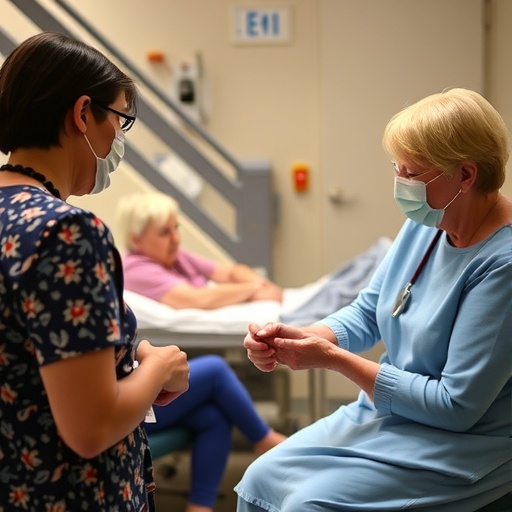
Long-term care residents moving from a nursing facility to an emergency department enter one of the most complex transitions in modern healthcare. The journey may begin with a sudden change in consciousness, breathing, mobility, pain, or behavior, but it quickly becomes a transfer of information, responsibility, and risk between institutions. A new qualitative study published in BMC Geriatrics examines how this cross-setting transition is experienced by the people involved, highlighting a vulnerable point in the healthcare system that is often treated as a routine logistical event.
The study, led by PC Hsu, LY.A. Chen, and YC Chen and colleagues, focuses on residents of long-term care facilities who are transferred to emergency departments. Unlike quantitative research, which typically measures outcomes such as admission rates, waiting times, or mortality, qualitative research investigates how individuals interpret and experience a process. Through this approach, researchers can identify communication breakdowns, conflicting expectations, emotional pressures, and practical barriers that may not appear in hospital databases.
For older adults living in long-term care, an emergency transfer can be medically necessary but physically and psychologically destabilizing. Many residents live with multiple chronic conditions, frailty, dementia, sensory impairment, or limited ability to communicate. These characteristics can make it difficult for them to describe symptoms, understand unfamiliar surroundings, or participate directly in decisions. The emergency department, meanwhile, is designed for rapid assessment and acute treatment, not always for the slower, highly individualized care needs of frail older people.
The transition also creates a handover challenge. Clinical information must travel with the resident, including medication lists, allergies, advance-care preferences, baseline cognitive and functional status, recent symptoms, and the reason for transfer. If any of this information is incomplete, delayed, or misunderstood, clinicians may have to reconstruct the patient’s history under intense time pressure. This can lead to duplicated tests, inappropriate medication decisions, delays in treatment, or care plans that fail to reflect the resident’s usual condition.
A central technical issue is the difference between a patient’s baseline and an acute change. A resident with dementia may appear confused in the emergency department even when their behavior is consistent with their usual state. Conversely, a subtle change in alertness or mobility may indicate infection, dehydration, stroke, or another serious condition. Without reliable baseline information from long-term care staff or family members, emergency clinicians may struggle to distinguish chronic impairment from delirium, a sudden disturbance in attention and cognition associated with substantial risks in older adults.
By examining experiences across care settings, the research addresses the concept of continuity of care. Continuity is not simply the transfer of documents; it includes consistency in clinical goals, communication, decision-making, and personal knowledge of the resident. A successful transition requires coordination among long-term care workers, emergency medical services, hospital clinicians, residents, and families. Each group may possess only part of the relevant information, making the quality of interaction between them as important as the technology used to transmit records.
The study’s qualitative design is particularly valuable because transitions are shaped by human factors. Staff may face time constraints, staffing shortages, unclear responsibilities, or different documentation systems. Families may experience anxiety when they are asked to make urgent decisions without a complete explanation of the resident’s condition. Residents may feel disoriented or powerless as they move between unfamiliar environments. Capturing these perspectives can reveal why formal protocols sometimes fail in practice, even when they appear comprehensive on paper.
The findings are relevant to a wider healthcare challenge: populations are aging while medical care is becoming increasingly fragmented. Long-term care facilities and hospitals often operate under separate administrative structures, with different workflows, electronic records, professional cultures, and performance measures. Emergency departments may focus on rapid diagnosis and disposition, whereas long-term care teams emphasize daily function, prevention, and quality of life. The transition between these systems can therefore become a vulnerable interface where important context is lost.
Improving that interface could involve standardized transfer forms, interoperable electronic records, direct clinician-to-clinician communication, clearer escalation pathways, and explicit documentation of a resident’s baseline function and care preferences. Yet the study’s focus on lived experience suggests that technical solutions alone may not be sufficient. Better transitions also depend on mutual understanding, shared accountability, and recognition that a transfer is not an isolated event but a continuum extending from the long-term care facility to the emergency department and back again.
As healthcare systems search for ways to reduce preventable harm among older adults, the experience of cross-setting transitions deserves greater attention. The study by Hsu, Chen, Chen, and colleagues places this often-overlooked process at the center of inquiry. Its subject is not merely how residents are transported, but how information, clinical judgment, dignity, and responsibility move with them. That perspective may help health services design emergency transfers that are safer, more coordinated, and more responsive to the realities of long-term care.
Cite Scienmag News
Ophelia Keating. (August 2, 2026). Study explores long-term care residents’ experiences transitioning to emergency departments. Scienmag. https://scienmag.com/study-explores-long-term-care-residents-experiences-transitioning-to-emergency-departments/
Ophelia Keating. "Study explores long-term care residents’ experiences transitioning to emergency departments." Scienmag, 2 August 2026, https://scienmag.com/study-explores-long-term-care-residents-experiences-transitioning-to-emergency-departments/. Accessed 3 September 2026.
Ophelia Keating. "Study explores long-term care residents’ experiences transitioning to emergency departments." Scienmag. August 2, 2026. https://scienmag.com/study-explores-long-term-care-residents-experiences-transitioning-to-emergency-departments/


