


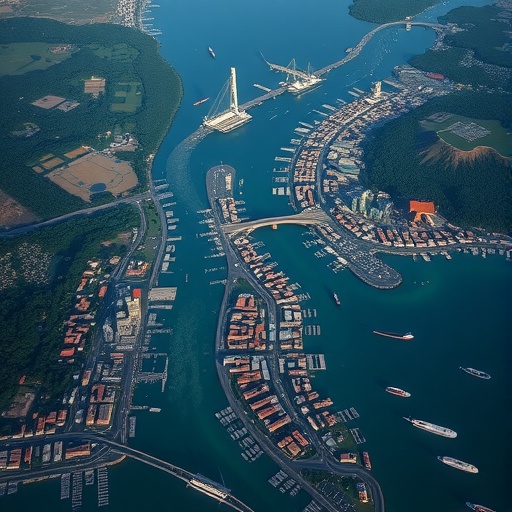
A river can carry more than water and sediment to the sea. It can also transport a chemical record of how landscapes have changed over centuries, including the lasting residue of combustion known as black carbon. A new study by Yi, Geng, Zhong and colleagues, published in Nature Communications, reports that urbanized river deltas leave a distinctive “fossil” signature on the black carbon exported to the ocean. The finding suggests that rapidly growing coastal cities may be reshaping the chemistry of marine carbon flows in ways that remain detectable long after the original particles were produced.
Black carbon is the carbon-rich material formed when fuels, vegetation or other organic matter burn incompletely. It includes soot, charcoal-like particles and other highly condensed forms of carbon that can resist degradation. Once released into the environment, black carbon may settle in soils, become buried in sediments or enter rivers during erosion and runoff. Some of it ultimately reaches the ocean, where it can be stored for long periods or transformed by sunlight and microbial activity.
The new research focuses on what happens when rivers pass through heavily urbanized deltas before meeting the sea. Deltas are dynamic environments where rivers slow, divide into channels and deposit sediment across densely populated lowlands. Their waters often receive material from upstream forests, agricultural regions and soils, but also from roads, construction zones, industrial areas and cities. This mixture makes deltas powerful collectors of environmental signals—and potentially important sources of carbon that would otherwise remain locked in terrestrial landscapes.
The phrase “where the river turns old” reflects a central idea of the study: urbanized deltas can expose and remobilize carbon that has been stored for long periods. In natural systems, black carbon may become buried in soil or sediment and gradually acquire a chemically altered character. When urban development changes drainage patterns, increases erosion or disturbs sediment, older carbon can be released and transported downstream. The resulting material may look very different from recently produced soot entering the environment from contemporary fires or combustion.
Distinguishing these sources is technically challenging because black carbon is not a single compound. It is a continuum of carbon-rich materials with different structures, from lightly charred organic matter to highly aromatic soot composed of fused carbon rings. Scientists therefore rely on molecular composition, oxidation behavior, radiocarbon content and other geochemical indicators to determine where the material came from and how long it has persisted. Together, these measurements can reveal whether river-borne black carbon is modern, fossil-derived or recycled from ancient environmental reservoirs.
The study’s significance lies in connecting those chemical fingerprints to urbanization at the scale of a delta. Cities are often treated as sources of new pollution, but the research indicates that they can also act as processors of previously stored carbon. As channels are engineered, wetlands are drained and sediment is moved, urban development may alter the balance between burial and export. A delta can therefore send the ocean not only freshly generated black carbon, but also a mixture containing carbon that has been repeatedly stored, transformed and released.
That distinction matters for climate science. Black carbon can influence climate directly by absorbing sunlight when suspended in the atmosphere, while its effects in soils, rivers and oceans depend on its stability and reactivity. Highly resistant particles may contribute to long-term carbon storage if they are buried in sediments. More reactive forms can be broken down, oxidized or converted into dissolved carbon compounds. If urbanization changes the age and chemical composition of black carbon delivered to coastal waters, it may also alter how much carbon is preserved, degraded or redistributed in marine ecosystems.
The findings also provide a new way to read the environmental history of cities. Sediments accumulating at the mouths of urbanized rivers may preserve a layered archive of industrialization, land-use change and past fire activity. A rising proportion of fossil-like black carbon could indicate not only present-day emissions, but the erosion of older carbon pools disturbed by roads, foundations, dredging and altered flood regimes. This makes black carbon a potential tracer of hidden landscape transformation, complementing more familiar indicators such as heavy metals, plastics and nutrient pollution.
For coastal managers, the message is urgent because deltas are under pressure from population growth, sea-level rise, extreme storms and river engineering. Protecting wetlands and stabilizing soils could help keep older carbon in place, while improving control of combustion emissions would reduce the supply of newly produced black carbon. The study does not portray urbanized deltas as simple pipelines carrying pollution from land to sea. Instead, it reveals them as chemically active zones where carbon is sorted, aged and reassembled before crossing the coastline.
By showing that urbanized deltas can imprint a fossil signature on exported black carbon, Yi and colleagues expand the environmental story of cities beyond the air we breathe and the water we drink. The research suggests that the legacy of combustion is written into river chemistry and carried across the continental shelf. Every particle reaching the ocean may contain clues about fire, industry, soil, sediment and urban growth—turning a river delta into a moving archive of human impact and the long afterlife of carbon.
Cite Scienmag News
Violet Maxwell. (August 1, 2026). Urbanized river deltas leave fossil signatures in black carbon exported to oceans. Scienmag. https://scienmag.com/urbanized-river-deltas-leave-fossil-signatures-in-black-carbon-exported-to-oceans/
Violet Maxwell. "Urbanized river deltas leave fossil signatures in black carbon exported to oceans." Scienmag, 1 August 2026, https://scienmag.com/urbanized-river-deltas-leave-fossil-signatures-in-black-carbon-exported-to-oceans/. Accessed 3 September 2026.
Violet Maxwell. "Urbanized river deltas leave fossil signatures in black carbon exported to oceans." Scienmag. August 1, 2026. https://scienmag.com/urbanized-river-deltas-leave-fossil-signatures-in-black-carbon-exported-to-oceans/


