


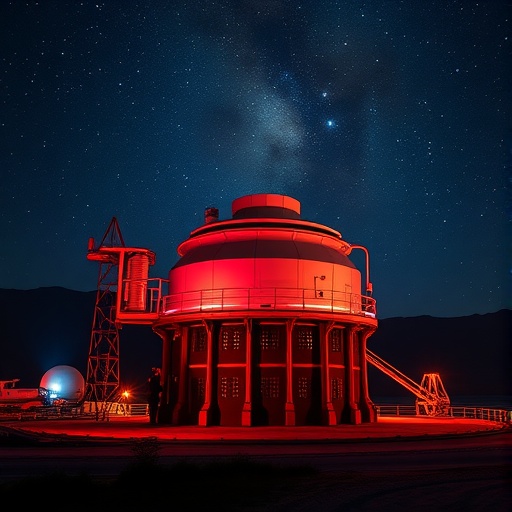
Chinese scientists have identified an exceptionally rare isotope, hafnium-153, during the commissioning phase of the High Intensity heavy-ion Accelerator Facility (HIAF) in Huizhou, Guangdong Province. The observation, achieved shortly after HIAF began trial operations on July 21, represents the facility’s first reported physics result and provides an early demonstration of its ability to investigate nuclei at the far edges of existence. The discovery places HIAF among the emerging global centers capable of detecting isotopes produced only in extremely small quantities.
The result, published in Science Bulletin, focuses on hafnium-153, a neutron-deficient isotope located near the proton drip line. The proton drip line marks the region where nuclei contain so few neutrons relative to their number of protons that additional proton emission becomes energetically possible. Nuclei approaching this boundary are especially valuable to nuclear physicists because their unusual proton-to-neutron ratios expose weaknesses in existing theories of nuclear structure and help define the limits of nuclear stability.
Hafnium-153 contains 72 protons and 81 neutrons, making it significantly more proton-rich than the stable hafnium isotopes found in nature. Its existence is important because nuclear models must account for whether such a highly unbalanced nucleus remains bound, becomes weakly bound, or rapidly disintegrates. By measuring the isotope’s mass and confirming its survival through the experimental system, researchers obtained new evidence for how nuclear forces operate in an extreme environment where conventional patterns of stability begin to break down.
The experiment began with a beam of bismuth-209 ions generated by HIAF’s Booster Ring, or BRing. These energetic ions were directed onto a graphite target, causing projectile-fragmentation reactions. In this process, the incoming bismuth nuclei collide with carbon atoms and break apart, producing a broad mixture of radioactive fragments. Among the debris were the rare hafnium-153 nuclei, whose production probability was so low that only a handful could be expected even under high-intensity operating conditions.
The resulting mixture, known as a cocktail beam, was then sent through the HIgh rigidity Radioactive Ion Beam Line, or HIRIBL. This beamline separates reaction products according to their magnetic rigidity, a quantity determined by the momentum and electric charge of each ion. Efficient separation was essential because the desired hafnium-153 nuclei were surrounded by far more abundant isotopes and reaction products. HIRIBL allowed the researchers to filter and transport the nuclei of interest toward the facility’s precision measurement system.
The purified radioactive ions were injected into HIAF’s Spectrometer Ring, known as SRing, where the team used isochronous mass spectrometry. This technique is designed to determine the mass-to-charge ratio of short-lived nuclei without requiring them to reach an equilibrium orbit in the storage ring. Ions with different masses circulate with carefully related revolution times, allowing their identities to be inferred from timing signals produced during repeated passes through the ring. Because the method can register individual ions, it is particularly powerful for studying isotopes that are created only a few times.
Despite hafnium-153’s extremely low production cross section—the probability that the isotope will be formed in a collision—the researchers detected ten individual ions. Each event carried significant scientific weight because the isotope’s identification depended on the combined analysis of its timing behavior, magnetic rigidity, and position within the mass spectrum. The measurements indicate that hafnium-153 is either bound or weakly bound, meaning it can exist as a nuclear system rather than immediately ejecting a proton. The finding agrees with predictions from several contemporary nuclear mass models, while also supplying an experimental benchmark for future refinements.
The result was independently supported by experiments at the Radioactive Isotope Beam Factory operated by RIKEN in Japan. The near-simultaneous observations by two separate facilities strengthen the case that hafnium-153 has been reliably identified and demonstrate the international importance of mapping the proton-rich frontier. Independent confirmation is especially valuable in rare-isotope research, where conclusions may initially rest on only a few detected events and where backgrounds from neighboring nuclei can be difficult to eliminate.
Researchers say the observation highlights the combined performance of HIAF’s major components rather than the capability of a single instrument. The high intensity of the heavy-ion beam increases the number of rare nuclear reactions, HIRIBL provides the separation power needed to isolate fragile radioactive products, and SRing supplies the single-ion sensitivity required for precision mass measurements. Together, these systems create a platform for investigating nuclei that cannot be produced in useful quantities with conventional stable-beam experiments.
HIAF’s first physics result also points toward a broader research program involving the discovery of new isotopes, measurements of nuclear masses and lifetimes, and studies of matter under extreme proton-neutron imbalance. As beam intensity and experimental efficiency improve, the facility is expected to reach still rarer regions of the nuclear landscape. Each newly observed isotope can alter the boundaries used in nuclear models, offering clues about the origin of the elements, the behavior of matter inside explosive stellar events, and the fundamental forces that hold atomic nuclei together.
News Publication Date: 2-Jul-2026
Web References: https://doi.org/10.1016/j.scib.2026.06.056
References: Science Bulletin, DOI: 10.1016/j.scib.2026.06.056
Keywords
Hafnium-153, rare isotopes, nuclear physics, proton drip line, HIAF, isochronous mass spectrometry, radioactive ion beams, nuclear structure, heavy-ion accelerator, nuclear landscape
Cite Scienmag News
Katie Riggs. (August 1, 2026). China’s HIAF records first physics result by observing Hafnium-153. Scienmag. https://scienmag.com/chinas-hiaf-records-first-physics-result-by-observing-hafnium-153/
Katie Riggs. "China’s HIAF records first physics result by observing Hafnium-153." Scienmag, 1 August 2026, https://scienmag.com/chinas-hiaf-records-first-physics-result-by-observing-hafnium-153/. Accessed 3 September 2026.
Katie Riggs. "China’s HIAF records first physics result by observing Hafnium-153." Scienmag. August 1, 2026. https://scienmag.com/chinas-hiaf-records-first-physics-result-by-observing-hafnium-153/


