



view more
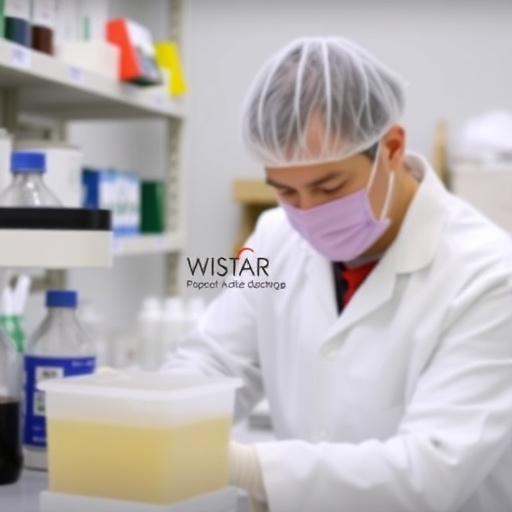
Credit: The Wistar Institute
A new study from The Wistar Institute has uncovered an unexpected link between fructose — a common dietary sugar — and the spread of an aggressive form of ovarian cancer. Published in Nature Aging, the study found that cancer cells not killed by chemotherapy send signals to neighboring tumor cells, helping them become more capable of spreading. The researchers identified fructose as a key messenger in this process, revealing a previously unrecognized way that treatment-surviving cancer cells may promote the spread of cancer.
“Some cancer cells that survive chemotherapy aren’t dividing anymore, but they’re still biologically active,” said Aidan Cole, Ph.D., a postdoctoral fellow in the lab of Katherine Aird, Ph.D., at The Wistar Institute and first author on the study. “Instead, they continue to release molecules that send signals to nearby cells. Our study is among the first to show that a nutrient—in this case, fructose—can act as one of those signals.”
Ovarian cancer is treated almost universally with platinum-based chemotherapy, and many patients respond well at first. However, the disease recurs in most patients and almost always spreads through the abdominal cavity. That spread, called metastasis, accounts for roughly 90% of deaths from the disease.
Prior research has suggested that cancer cells not killed by chemotherapy play a role in recurrence in part through the ability of these cells to release a complex mix of signaling molecules. Cole and his colleagues began their research by designing a unique experiment: they collected the molecules released by chemotherapy-surviving cells and found these factors alone could significantly increase the spread of cancer cells.
“As far as we know, this is the first time anyone has shown, in a preclinical model rather than just a dish, that it’s the molecules these cells release — not the cells themselves — that drive the cancer’s spread,” said Cole.
That finding sent the team looking for what was being released that caused the cancer cells to spread. Fructose, it turned out, was being made by the surviving cells and sent as the signal for increased spread. Even more interesting, they found that without chemotherapy treatment, consuming the high levels of fructose found in sugary drinks can also signal cancer to spread. The fructose finding is especially compelling because it raises the possibility that simple dietary changes could help shape how cancer progresses. This is particularly important given the prevalence of fructose consumption in the United States, with high fructose corn syrup accounting for ~8-20% of the daily caloric intake in some individuals. Unlike many cancer risk factors outside of patient control, fructose consumption can be modified by dietary choices. While the effectiveness of limiting fructose intake hasn’t yet been tested directly in patients, the study raises the possibility that nutrition could influence cancer progression in previously unrecognized ways.
The researchers next aimed to understand why fructose increases cancer cell spread. Through a variety of large-scale analytical techniques, including the use of a CRISPR screen, they discovered that fructose suppresses cholesterol within the neighboring cells. Cholesterol is important for cells to stick to each other like a biological glue, so decreased cholesterol allows cells to more easily escape and spread.
The finding that fructose lowers cholesterol production has important clinical implications. Statins, which are taken by 39 million people in the United States, lower cholesterol production. The team found that statins alone decreased the glue between cells to promote escape. The research team is now examining whether these medications could be interfering with the effects of chemotherapy — though they stress this isn’t a reason for patients to stop taking them.
“We haven’t tested this effect in patients yet, but it raises questions about combining cholesterol-lowering drugs with chemotherapy, especially since ovarian cancer is most common in postmenopausal women who are often already on statins,” said Katherine Aird, Ph.D., professor and co-leader of the Molecular and Cellular Oncogenesis Program in the Ellen and Ronald Caplan Cancer Center at The Wistar Institute, and senior author of the study.
The researchers are also looking into how this mechanism might extend beyond ovarian cancer.
“We think other cancers that spread within the torso — pancreatic, colon, liver — could behave similarly. We can’t call it universal yet, but we think the effects are not just limited to ovarian cancer,” said Aird.
She and Cole have already started designing follow-up experiments to test the reproducibility of their findings in a variety of other cancer types.
Co-authors: Raquel Buj, Apoorva Uboveja, Alexander Tom, Amandine Amalric, Baixue Yang, Miho Naruse, Frederick Keeney, Andrew Kossenkov, and Qin Liu from The Wistar Institute; Evan Levasseur, Hui Wang, Katarzyna M. Kedziora, Naveen Kumar Tangudu, Jeff Danielson, Callen T. Wallace, Esther Elishaev, Lauren Borho, Huda Atiya, Lan G. Coffman, Steffi Oesterreich, Aditi U. Gurkar, Francesmary Modugno, and Simon C. Watkins from University of Pittsburgh School of Medicine; Amal Elhaw, Sierra White, Danyang Li, Dorota E. Jazwinska, Matthew S. Laird, George Tseng, Francisco J. Schopfer, Ioannis K. Zervantonakis, Wayne Stallaert, and Nadine Hempel from University of Pittsburgh; Adam Chatoff, Andrea Andress Huacachino, Mariola M. Marcinkiewicz, and Nathaniel W. Snyder from Lewis Katz School of Medicine at Temple University; Felicia Lazure and Ana P. Gomes from H. Lee Moffitt Cancer Center & Research Institute; Hope A. Townsend, Robin D. Dowell, and Aaron Clauset from University of Colorado Boulder; Denarda Dangaj from Ludwig Institute for Cancer Research, University of Lausanne (UNIL); and Benjamin G. Bitler from University of Colorado Anschutz Medical Campus.
Work supported by: National Institutes of Health grants R37 CA240625, R01 CA259111, R01 CA298386, P50 CA272218, T32 GM133332, R01 CA242021, R21 CA267050, R21 CA291905, and U01 AG077923; American Cancer Society grant RSG-19-113-01-CCG; Ovarian Cancer Research Alliance grant MIG-2023-2-1018; Congressionally Directed Medical Research Program grants HT9425-23-1-0436, W81XWH2110338, OC210139, and OC230324; HERA Ovarian Cancer Foundation; Melanoma Research Foundation; Janet Burroughs Ovarian Cancer Foundation; Silicon Valley Community Foundation Chan Zuckerberg Initiative DAF grant 2023-329680; UPMC Hillman Cancer Center; and The Wistar Institute.
Publication information: The chemotherapy-induced senescence-associated secretome promotes cell detachment and metastatic dissemination through metabolic reprogramming, Nature Aging, 2026. Online publication.
Journal
Nature Aging
Method of Research
Experimental study
Subject of Research
Animals
Article Title
The chemotherapy-induced senescence-associated secretome promotes cell detachment and metastatic dissemination through metabolic reprogramming
Article Publication Date
30-Jul-2026
Darien Sutton
The Wistar Institute
dsutton@wistar.org
Office: 215-898-3988
Journal
Nature Aging
Method of Research
Experimental study
Subject of Research
Animals
Article Title
The chemotherapy-induced senescence-associated secretome promotes cell detachment and metastatic dissemination through metabolic reprogramming
Article Publication Date
30-Jul-2026
Tags
Cite Scienmag News
Nathaniel Bowman. (July 30, 2026). Wistar scientists identify fructose as a surprise driver of cancer spread. Scienmag. https://scienmag.com/wistar-scientists-identify-fructose-as-a-surprise-driver-of-cancer-spread/
Nathaniel Bowman. "Wistar scientists identify fructose as a surprise driver of cancer spread." Scienmag, 30 July 2026, https://scienmag.com/wistar-scientists-identify-fructose-as-a-surprise-driver-of-cancer-spread/. Accessed 4 September 2026.
Nathaniel Bowman. "Wistar scientists identify fructose as a surprise driver of cancer spread." Scienmag. July 30, 2026. https://scienmag.com/wistar-scientists-identify-fructose-as-a-surprise-driver-of-cancer-spread/

