


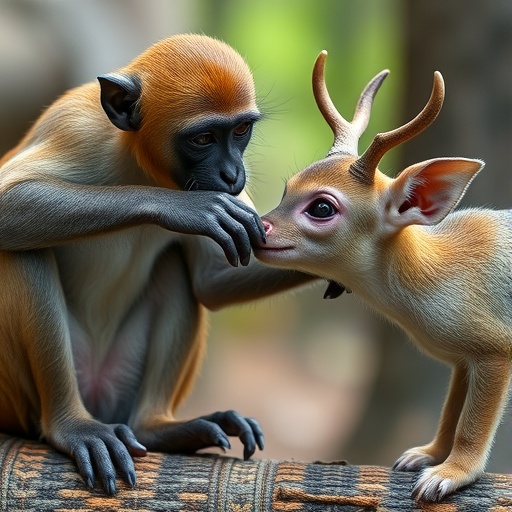
First study to map the surprising friendships primates strike up with dogs, deer, squirrels and other species
Why do humans keep pets? A new international study suggests that some of the behavioural foundations of human-animal companionship may have much deeper evolutionary roots than previously thought.
Researchers from the University of Oxford and collaborators around the world have compiled the first comprehensive review of friendly interactions between non-human primates and other species. The study documents 427 cases involving 88 primate species and 127 partner species, 55 of them non-primates, revealing that monkeys and apes frequently play, groom, hold, carry and even adopt individuals from other species.
Published in Primates, the study combines evidence from the scientific literature (303 cases), media reports (58) and a survey of primatologists (66) to provide the most comprehensive overview to date of cross-species social behaviour in primates.
Among the remarkable examples are stump-tailed macaques grooming domestic dogs in Thailand, tufted gray langurs gently stroking giant squirrels in Sri Lanka, young black-and-white snub-nosed monkeys playing with domestic pigs in China, and ring-tailed lemurs grooming bamboo lemurs in Madagascar. In one extraordinary case, first documented in Brazil in 2006 and compiled in this review, wild capuchin monkeys adopted an infant marmoset and cared for it over many months.
The researchers found that play (139 cases) and grooming (136 cases) were by far the most common forms of interaction. Juveniles were much more likely to play with members of other species, while adult females were more likely to groom them. Adult males were significantly less likely to engage in friendly interspecific interactions.
The study also found that primates most often formed social relationships with closely related species, although many interactions also involved more distantly related animals, including dogs, birds, squirrels and reptiles. Most interactions were initiated by the primates themselves.
Lead author Associate Professor Cyril C. Grueter, from the School of Anthropology and Museum Ethnography at the University of Oxford, said:
‘Humans have long been considered unique in forming close social relationships with other species. Our study shows that many primates also display remarkable curiosity, tolerance and even caregiving towards animals that are not their own species. These behaviours don’t amount to pet-keeping as we know it, but they may represent some of the evolutionary building blocks from which human-animal companionship eventually emerged.’
When animals of different species spend time together, it is usually for practical reasons: easier foraging, or safety in numbers. But these primates went further, playing with, grooming, carrying and curling up alongside other animals for no obvious reward. It hints at a social curiosity, and a readiness to make friends across the species line, that looks strikingly familiar.
Not every encounter ended happily. Curiosity and caregiving could tip into rough handling, and the team recorded 13 cases in which a partner animal died. In one striking example, a male baboon in Saudi Arabia appeared to have kidnapped a domestic puppy, carrying it around for long periods. These cross-species bonds, the authors note, do not always end well.
Beyond shedding light on the origins of human-animal relationships, the authors believe the findings also have implications for conservation and animal welfare.
Dr Grueter continued:
‘Understanding why some species readily form positive relationships with others could help improve the management of mixed-species groups in zoos and sanctuaries. More broadly, these findings provide new insights into the evolution of empathy, social flexibility and the remarkable capacity of primates to engage with animals beyond their own species.’
The authors hope their review will encourage primatologists to record these often-overlooked interactions more systematically during long-term field studies.
-END-
Notes to editors
The study, ‘Heterospecific social behavior in primates: insights into the evolutionary roots of pet-keeping’, is published in Primates.
Press enquiries: cyril.grueter@anthro.ox.ac.uk
Picture credits:
- Japanese macaque (Macaca fuscata) mounting and riding on the back of a sika deer (Cervus nippon) at Yakushima, Japan; photo by Alexandre Bonnefoy and Cédric Sueur.
- Young juvenile black-and-white snub-nosed monkey (Rhinopithecus bieti) playing on a domestic pig at Xiangguqing, Yunnan Golden Monkey National Park, China; photo by Yanpeng Li.
- Stump-tailed macaques (Macaca arctoides) grooming a domestic dog at Khao Tao Mo temple, Thailand; photo by Neil Challis.
- Capped langur (Trachypithecus pileatus) grooming a Phayre’s leaf monkey (Trachypithecus phayrei) in Satchari National Park Bangladesh; photo by Sabit Hasan.
- A tufted gray langur (Semnopithecus priam) stroking a grizzled giant squirrel (Ratufa macroura) in Yala National Park, Sri Lanka; photo by Senthi Aathavan Senthilverl, via Wikimedia Commons, licensed under CC BY-SA 4.0.
- Female northern white-cheeked gibbon (Nomascus leucogenys) holding a mouse at the Shanghai Zoo, China; photo by Cyril Grueter.
- Adult female white-faced capuchin (Cebus imitator) grooming an adult female black-handed spider monkey (Ateles geoffroyi) in Santa Rosa, Costa Rica; photo by Nicholas Chapoy.
About the University of Oxford
Oxford University has been placed number 1 in the Times Higher Education World University Rankings for the ninth year running, and number 3 in the QS World Rankings 2024.
Oxford is world-famous for research and teaching excellence and home to some of the most talented people from across the globe. Our work helps the lives of millions, solving real-world problems through a huge network of partnerships and collaborations. The breadth and interdisciplinary nature of our research alongside our personalised approach to teaching sparks imaginative and inventive insights and solutions.
Through its research commercialisation arm, Oxford University Innovation, Oxford is the highest university patent filer in the UK and is ranked first in the UK for university spinouts, having created more than 300 new companies since 1988. Over a third of these companies have been created in the past five years. The university is a catalyst for prosperity in Oxfordshire and the United Kingdom, contributing around £16.9 billion to the UK economy in 2021/22, and supports more than 90,400 full time jobs.
About the School of Anthropology and Museum Ethnography
The School of Anthropology and Museum Ethnography at the University of Oxford is the largest anthropology department in the UK. Through our uniquely wide-ranging approach we produce internationally recognised research, and our teaching engages with all kinds of contemporary issues. Our department is highly diverse and international, with over 70% of our students taking graduate level degrees coming from outside the UK. Our work is guided by an ethos of openness, tolerance and respect for all.
Journal
Primates
Lizzie Dunthorne
University of Oxford
lizzie.dunthorne@admin.ox.ac.uk
Journal
Primates
Tags
Cite Scienmag News
Gavin Prescott. (July 30, 2026). Monkey friendships with dogs, deer and even pigs offer clues to the evolutionary origins of pet-keeping. Scienmag. https://scienmag.com/monkey-friendships-with-dogs-deer-and-even-pigs-offer-clues-to-the-evolutionary-origins-of-pet-keeping/
Gavin Prescott. "Monkey friendships with dogs, deer and even pigs offer clues to the evolutionary origins of pet-keeping." Scienmag, 30 July 2026, https://scienmag.com/monkey-friendships-with-dogs-deer-and-even-pigs-offer-clues-to-the-evolutionary-origins-of-pet-keeping/. Accessed 3 September 2026.
Gavin Prescott. "Monkey friendships with dogs, deer and even pigs offer clues to the evolutionary origins of pet-keeping." Scienmag. July 30, 2026. https://scienmag.com/monkey-friendships-with-dogs-deer-and-even-pigs-offer-clues-to-the-evolutionary-origins-of-pet-keeping/


