


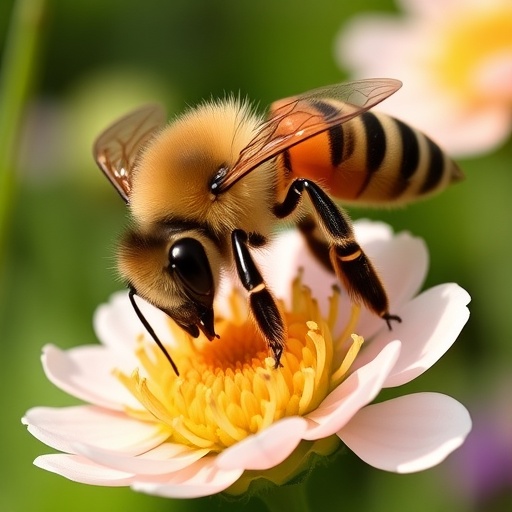
Female sweat bees face a high-stakes decision as they mature: stay in the nest and help their mother raise more offspring, or leave to establish their own reproductive nests. New work from the Smithsonian Tropical Research Institute (STRI) reveals that queen pheromones actively steer which path daughters take—uncovering a fresh mechanism for how cooperation can emerge in insect societies.
Published July 28 in Proceedings of the Royal Society B, the study focused on Megalopta genalis, a flexibly social bee whose daughters may become non-reproductive helpers or leave as solitary queens or founders of new social nests. Researchers suspected that chemical cues from the queen could tip the balance between assisting and striking out alone.
To test this, the team used large-scale artificial nests on Barro Colorado Island in the Panama Canal over multiple years. Hundreds of nests were introduced into the bees’ natural habitat, and researchers marked individuals to document outcomes—whether daughters stayed to work, usurped the queen, or departed to reproduce elsewhere.
The study then moved from behavior to chemistry. Because pheromones are subtle mixtures of compounds, the researchers analyzed chemicals coating live bees repeatedly, capturing how signaling changed through time in the same free-living individuals.
They applied advanced analytical chemistry, including gas chromatography coupled with mass spectrometry, to identify and quantify specific chemical components. Notably, the team performed these measurements directly on the island and tracked colony-linked chemical signaling across the bees’ development.
The results show that queen pheromones shape daughter behavior in two connected ways. First, during a critical developmental window, pheromone levels rose in the queen and suppressed daughters’ ovarian development, limiting immediate reproduction. Second, the pheromone profile signaled reproductive opportunity and queen condition: higher pheromone levels correlated with daughters being more likely to stay and cooperate.
Taken together, the findings suggest queens communicate not just “stay” but also “this investment is worth it,” allowing daughters to align reproductive decisions with the colony’s genetic payoff. As the authors argue, such chemical communication could stabilize early insect social systems long enough for complex cooperative behaviors to evolve.
Cite Scienmag News
Courtney Benton. (July 29, 2026). Queen Bee Pheromones Guide Daughters in Choosing to Stay or Leave. Scienmag. https://scienmag.com/queen-bee-pheromones-guide-daughters-in-choosing-to-stay-or-leave/
Courtney Benton. "Queen Bee Pheromones Guide Daughters in Choosing to Stay or Leave." Scienmag, 29 July 2026, https://scienmag.com/queen-bee-pheromones-guide-daughters-in-choosing-to-stay-or-leave/. Accessed 4 September 2026.
Courtney Benton. "Queen Bee Pheromones Guide Daughters in Choosing to Stay or Leave." Scienmag. July 29, 2026. https://scienmag.com/queen-bee-pheromones-guide-daughters-in-choosing-to-stay-or-leave/


