

Tuesday, July 28, 2026
Science
No Result
View All Result
  • Login
  • HOME
  • SCIENCE NEWS
  • CONTACT US
  • HOME
  • SCIENCE NEWS
  • CONTACT US
No Result
View All Result
Scienmag
No Result
View All Result
Home Science News Biology

AI Camera System Tracks Bumblebees, Offering Affordable Insect Monitoring

July 28, 2026
in Biology
Reading Time: 2 mins read
0
AI Camera System Tracks Bumblebees, Offering Affordable Insect Monitoring

AI Camera System Tracks Bumblebees, Offering Affordable Insect Monitoring

65
SHARES
587
VIEWS
Share on FacebookShare on Twitter
ADVERTISEMENT

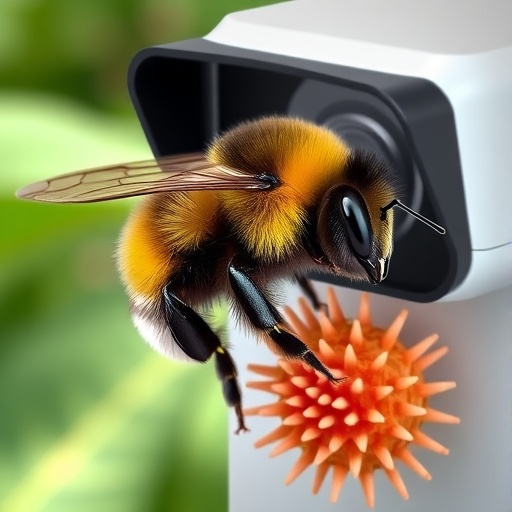
Researchers at Oregon State University have created a low-cost, semi-automated, AI-enabled monitoring approach that uses remote cameras to survey bumblebees and potentially other insects. The work targets a major challenge in conservation biology: obtaining enough reliable population data across large landscapes without relying on expensive or harmful sampling methods.

Insect declines have increased urgency around pollinator monitoring, and several bumblebee species are under consideration for listing under the Endangered Species Act. Yet traditional survey techniques are often constrained by cost, labor, and biological impact. Traps can be lethal, while direct observation with nets is time-intensive and difficult to scale.

The new system builds on earlier findings that trail cameras can capture insect imagery without direct interference. Previous camera-based studies focused largely on nocturnal insects that can be attracted with light, leaving day-active (diurnal) species less studied in camera-lure settings.

To address this gap, the team designed an inexpensive camera station assembled from commercially available components and tested it during bloom in a red clover seed field at the Hyslop Field Research Laboratory in Corvallis. In parallel, researchers collected conventional survey data using hand-netting and blue vane traps to provide an independent benchmark.

Image-based identification relied on two custom deep learning models. Both models processed the captured photographs, but the researchers found that “tiled” models—dividing images into smaller regions before classification—outperformed approaches that evaluated entire images at once.

Attracting bees to the cameras proved to be another key design variable. The researchers tested multiple visual patterns placed behind the camera stations and report that bullseye patterns generated significantly more bumblebee visits than uniform backgrounds.

Across their field deployment, the camera system recorded six bumblebee species, closely matching the diversity observed through netting and traps. This alignment suggests the approach can reproduce conventional survey results while avoiding lethal collection.

The broader implication is scalability: automated, wide-area monitoring could produce richer, higher-volume datasets needed for habitat and protection decisions. With data gaps often complicating listing determinations and critical habitat designations, the team argues that camera-plus-AI pipelines could make those processes more precise.

The findings were published in Remote Sensing in Ecology and Conservation. The research team also emphasizes potential agricultural relevance, since many crops depend on insect pollination and may benefit from improved monitoring of pollinator health and movement trends.

Subject of Research: Bumblebee monitoring using remote cameras and deep learning
Article Title: Low-cost AI-driven remote camera method for surveying bumblebees (exact title not provided)
News Publication Date: Not provided
Web References: https://statusofinsects.github.io/index.html
References: Remote Sensing in Ecology and Conservation (journal name provided)
Image Credits: August Jackson, Oregon State University
Keywords: bumblebees, pollinator conservation, remote sensing, trail cameras, deep learning, species identification, habitat protection, agricultural pollination

Tags: affordable insect conservation toolsAI-powered insect monitoringautomated bumblebee population trackingdaytime insect detection using camerasdeep learning models for insect identificationinnovative approaches to pollinator decline assessmentinsect imagerylandscape-scale insect population data collectionlow-cost camera system for pollinator surveysnon-lethal insect survey methodsremote insect observation technologyscalable pollinator monitoring solutions
Share26Tweet16
Previous Post

Why Pain Signals Effective Treatment for Treatment-Resistant Depression

Next Post

Stanford Trial Finds Safe Treatments Enable Kids With Food Allergies to Eat

Related Posts

TIE1 suppresses fertilization-independent endosperm development by recruiting PRC2
Biology

TIE1 suppresses fertilization-independent endosperm development by recruiting PRC2

July 28, 2026
Forces of Push and Pull Shape How Blood Flows Through Vessels
Biology

Forces of Push and Pull Shape How Blood Flows Through Vessels

July 28, 2026
How the body’s natural recycling system may reduce inflammation
Biology

How the body’s natural recycling system may reduce inflammation

July 28, 2026
Bubble streams help sperm whales sleep deeply underwater
Biology

Bubble streams help sperm whales sleep deeply underwater

July 28, 2026
Chitosan Hydrogel Stabilizes Red Blood Cell Membranes for Environmental Sensors
Biology

Chitosan Hydrogel Stabilizes Red Blood Cell Membranes for Environmental Sensors

July 28, 2026
Nagoya Institute Scientists Identify Molecular Basis of Red-Green Color Vision
Biology

Nagoya Institute Scientists Identify Molecular Basis of Red-Green Color Vision

July 28, 2026
Next Post
Stanford Trial Finds Safe Treatments Enable Kids With Food Allergies to Eat

Stanford Trial Finds Safe Treatments Enable Kids With Food Allergies to Eat

  • Mothers who receive childcare support from maternal grandparents show more

    Mothers who receive childcare support from maternal grandparents show more parental warmth, finds NTU Singapore study

    27656 shares
    Share 11059 Tweet 6912
  • University of Seville Breaks 120-Year-Old Mystery, Revises a Key Einstein Concept

    1061 shares
    Share 424 Tweet 265
  • Bee body mass, pathogens and local climate influence heat tolerance

    682 shares
    Share 273 Tweet 171
  • Researchers record first-ever images and data of a shark experiencing a boat strike

    546 shares
    Share 218 Tweet 137
  • Groundbreaking Clinical Trial Reveals Lubiprostone Enhances Kidney Function

    531 shares
    Share 212 Tweet 133
Science

Embark on a thrilling journey of discovery with Scienmag.com—your ultimate source for cutting-edge breakthroughs. Immerse yourself in a world where curiosity knows no limits and tomorrow’s possibilities become today’s reality!

RECENT NEWS

  • Alpha-synuclein Aggregates Differentially Alter Electrophysiology of SNpc and VTA Neurons
  • Study finds higher healthcare costs linked to inappropriate medication use in seniors
  • Single-Plane Imaging Tracks Dynamic 3D Structures in Living Cells with Focus Feedback
  • Adaptive policies could boost Zambia nutrition security amid future climate shocks

Categories

  • Agriculture
  • Anthropology
  • Archaeology
  • Athmospheric
  • Biology
  • Biotechnology
  • Blog
  • Bussines
  • Cancer
  • Chemistry
  • Climate
  • Earth Science
  • Editorial Policy
  • Marine
  • Mathematics
  • Medicine
  • Pediatry
  • Policy
  • Psychology & Psychiatry
  • Science Education
  • Social Science
  • Space
  • Technology and Engineering

Subscribe to Blog via Email

Enter your email address to subscribe to this blog and receive notifications of new posts by email.

Join 5,146 other subscribers

© 2025 Scienmag - Science Magazine

Welcome Back!

Login to your account below

Forgotten Password?

Retrieve your password

Please enter your username or email address to reset your password.

Log In
No Result
View All Result
  • HOME
  • SCIENCE NEWS
  • CONTACT US

© 2025 Scienmag - Science Magazine

Discover more from Science

Subscribe now to keep reading and get access to the full archive.

Continue reading
