

Tuesday, July 28, 2026
Science
No Result
View All Result
  • Login
  • HOME
  • SCIENCE NEWS
  • CONTACT US
  • HOME
  • SCIENCE NEWS
  • CONTACT US
No Result
View All Result
Scienmag
No Result
View All Result
Home Science News Chemistry

How Molecular Cooperation Between Polymers and Primitive Membranes Enabled Life

July 28, 2026
in Chemistry
Reading Time: 2 mins read
0
How Molecular Cooperation Between Polymers and Primitive Membranes Enabled Life

How Molecular Cooperation Between Polymers and Primitive Membranes Enabled Life

65
SHARES
587
VIEWS
Share on FacebookShare on Twitter
ADVERTISEMENT

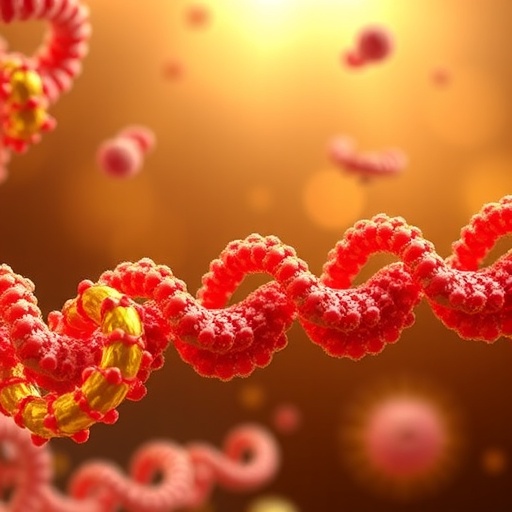
Researchers at Hebrew University report a simple chemical link that could help explain how early Earth chemistry transitioned toward cell-like organization. Their work shows that fatty acids—amphiphiles capable of forming primitive membranes—can be conjugated with hydroxy acids that readily generate short oligomers. Rather than acting independently, the two components cooperate, producing hybrid lipid–polymer structures that assemble more efficiently and persist longer in water.

The key idea is that hydroxy acids can polymerize into short chains, but these oligomers typically hydrolyze and fragment rapidly in aqueous environments. By attaching hydroxy acids directly to lipid-like amphiphiles, the researchers created conjugates in which the amphiphilic domain organizes into compartment-like assemblies while the tethered oligomer becomes more resistant to breakdown.

Under conditions designed to be compatible with early Earth scenarios, the conjugated molecules self-assembled into tiny, vesicle-like structures. Importantly, they formed at lower concentrations than fatty acids alone, indicating that oligomer growth and amphiphile organization reinforce each other. This coupling suggests a route by which chemical systems could overcome dilution and instability—major obstacles for prebiotic complexity.

Microscopy revealed bubble-like vesicles alongside other small assemblies resembling primitive compartments. Such structures matter because compartments can concentrate reactive species, create microenvironments, and enable selection-like processes to emerge from chemistry rather than from biology.

The team also measured hydrolytic stability. Oligomers that would normally decay quickly in water remained significantly longer when immobilized on lipid-like scaffolds. In effect, the amphiphile protected the oligomer, while the oligomer’s presence improved the assembly behavior of the amphiphile into ordered structures.

Across multiple fatty acid and hydroxy acid combinations, the cooperative effect appeared robust rather than idiosyncratic. This broad compatibility supports the idea that molecular teamwork could have been a common feature of early chemical evolution, not a rare coincidence.

Mechanistically, the study reframes origins-of-life constraints by tying compartment formation to polymer formation through chemical conjugation. Instead of treating membranes and polymers as separate problems, it proposes a coupled emergence in which each component stabilizes the other.

The findings, published in Nature Communications, also point beyond prebiotic chemistry. Because the chemistry uses simple, solvent-free reactions and yields biodegradable products, the hybrid structures may inspire greener materials and scalable approaches to stable self-assembling systems.

In short, the researchers present a viral-sounding but experimentally grounded model: early life may not have required perfect macromolecules—only simple molecules that learned to cooperate.

Subject of Research: Not applicable
Article Title: Hydroxy acid conjugation to lipids increases structural and hydrolytic stability
News Publication Date: 27-Jul-2026
Web References: http://dx.doi.org/10.1038/s41467-026-75192-5
References: Nature Communications (10.1038/s41467-026-75192-5)
Image Credits: Zehava Cohen

Keywords

Origins of life; Fatty acids; Vesicles; Oligomers

Tags: chemical cooperation in origin of lifecompartmentalization in prebiotic systemsearly Earth chemistryhybrid lipid-polymer assembliesoligomer resistance to hydrolysispolymerization of hydroxy acidsprebiotic membrane formationprimitive cell-like structuresrole of amphiphiles in early lifeself-assembly of amphiphilesstability of primitive membranesvesicle formation in prebiotic conditions
Share26Tweet16
Previous Post

Family Medicine Residency Directors Say Programs Do Not Assess Self-Directed Learning Directly

Next Post

Houston Methodist Researchers Create Biodegradable Implant for Targeted Cancer Immunotherapy

Related Posts

Xi’an Jiaotong team finds temperature-dependent single-molecule magnetostrictor behavior
Chemistry

Xi’an Jiaotong team finds temperature-dependent single-molecule magnetostrictor behavior

July 28, 2026
Thermodynamics Explained for Spinning Particles
Chemistry

Thermodynamics Explained for Spinning Particles

July 28, 2026
Advanced Simulations Reveal New Insights Into Proton Transport in Water
Chemistry

Advanced Simulations Reveal New Insights Into Proton Transport in Water

July 28, 2026
Self-Adaptive Cu–Co Catalyst Rebuilds Itself to Turn Nitrate into Green Ammonia
Chemistry

Self-Adaptive Cu–Co Catalyst Rebuilds Itself to Turn Nitrate into Green Ammonia

July 28, 2026
Solvent-bridged electrolytes enable high-energy lithium-ion batteries in extreme conditions
Chemistry

Solvent-bridged electrolytes enable high-energy lithium-ion batteries in extreme conditions

July 28, 2026
Ultrafast Discovery of a Photoinduced Hidden State in Metal-Organic Frameworks
Chemistry

Ultrafast Discovery of a Photoinduced Hidden State in Metal-Organic Frameworks

July 28, 2026
Next Post
Houston Methodist Researchers Create Biodegradable Implant for Targeted Cancer Immunotherapy

Houston Methodist Researchers Create Biodegradable Implant for Targeted Cancer Immunotherapy

  • Mothers who receive childcare support from maternal grandparents show more

    Mothers who receive childcare support from maternal grandparents show more parental warmth, finds NTU Singapore study

    27656 shares
    Share 11059 Tweet 6912
  • University of Seville Breaks 120-Year-Old Mystery, Revises a Key Einstein Concept

    1061 shares
    Share 424 Tweet 265
  • Bee body mass, pathogens and local climate influence heat tolerance

    682 shares
    Share 273 Tweet 171
  • Researchers record first-ever images and data of a shark experiencing a boat strike

    546 shares
    Share 218 Tweet 137
  • Groundbreaking Clinical Trial Reveals Lubiprostone Enhances Kidney Function

    531 shares
    Share 212 Tweet 133
Science

Embark on a thrilling journey of discovery with Scienmag.com—your ultimate source for cutting-edge breakthroughs. Immerse yourself in a world where curiosity knows no limits and tomorrow’s possibilities become today’s reality!

RECENT NEWS

  • Promises and pitfalls of Mediterranean climate adaptation tools
  • Stretchable Antenna Keeps Wearable Health Sensors Aligned With Human Motion
  • Study Finds Alzheimer’s P-tau217 Biomarker Weak in Preclinical Research
  • 3D-Printable Materials Heal Bodies, Enable Better Robots, Recover Critical Minerals

Categories

  • Agriculture
  • Anthropology
  • Archaeology
  • Athmospheric
  • Biology
  • Biotechnology
  • Blog
  • Bussines
  • Cancer
  • Chemistry
  • Climate
  • Earth Science
  • Editorial Policy
  • Marine
  • Mathematics
  • Medicine
  • Pediatry
  • Policy
  • Psychology & Psychiatry
  • Science Education
  • Social Science
  • Space
  • Technology and Engineering

Subscribe to Blog via Email

Enter your email address to subscribe to this blog and receive notifications of new posts by email.

Join 5,146 other subscribers

© 2025 Scienmag - Science Magazine

Welcome Back!

Login to your account below

Forgotten Password?

Retrieve your password

Please enter your username or email address to reset your password.

Log In
No Result
View All Result
  • HOME
  • SCIENCE NEWS
  • CONTACT US

© 2025 Scienmag - Science Magazine

Discover more from Science

Subscribe now to keep reading and get access to the full archive.

Continue reading
