


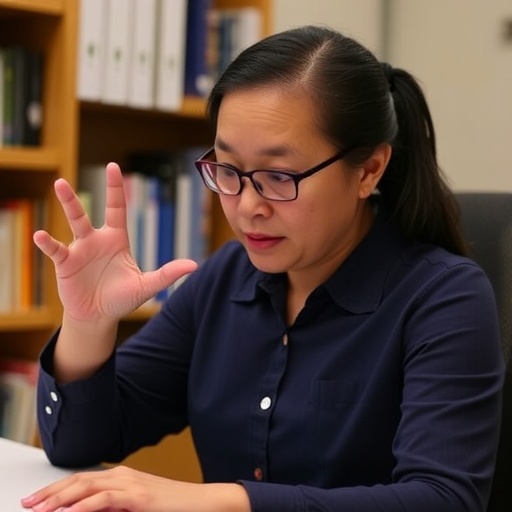
In an increasingly audio-first world, the University of Houston’s Product Experience Design (PXD) Lab is taking a bold step toward tactile literacy. Led by industrial design professor and lab director Min Kang, the team has developed LUCID, a new two-device learning system designed to help blind and low-vision learners move from early Braille recognition to fluent reading. Rather than replacing touch with screens, the design keeps hands-on tactile exploration at the center of instruction while adding intelligent support in the background.
The timing is urgent. Declining Braille literacy has created a gap not just in access, but in motivation and self-direction—two factors that strongly influence whether learners persist through a challenging early stage. PXD Lab’s approach treats Braille as a learnable interface, engineering a pathway that builds confidence at each step instead of asking students to “push through” uncertainty.
LUCID is built around complementary hardware that maps to learning stages. The first device, LUCID-ALT, introduces learners to the Braille alphabet using an enlarged six-dot keypad. This larger form factor is intended to make dot geometry easier to feel precisely, supporting deliberate motor learning as users practice letter patterns through direct touch.
As proficiency grows, LUCID-ARC shifts learners to reading practice with a real-scale Braille display. By transitioning from enlarged input to a display that matches the form learners will encounter beyond training, the system reduces the common barrier of device mismatch. The goal is transfer—turning early tactile familiarity into reading readiness.
Across both stages, AI-assisted audio guidance provides real-time prompting and feedback. This guidance is designed to reduce dependence on constant instructor intervention, while still reinforcing the tactile experience. In practice, the audio layer can help learners correct mistakes quickly, without interrupting the rhythm of hands-on dot exploration.
The project’s design impact has already attracted international attention. Former UH student Varshini Chouthri and Min Kang were recently recognized with the Red Dot Award for LUCID, an honor that underscores the lab’s reputation for human-centered, technology-driven design. The win follows additional Red Dot recognition for NOMAD, an AI-powered hiking system that similarly pushed PXD Lab onto the global stage.
Kang frames the award as evidence of a sustained research ecosystem rather than a one-time breakthrough. In his view, students are trained to design complete systems that respond to real human needs, and LUCID demonstrates that system-level thinking applied to accessibility.
LUCID’s success also reflects a broader trend in emerging assistive technologies: pairing tactile interfaces with intelligent, adaptive feedback. By designing the learning experience as a coherent system—from dot acquisition to fluent reading—PXD Lab is aiming to make Braille literacy more accessible, engaging, and genuinely self-directed.
Cite Scienmag News
Courtney Benton. (July 27, 2026). University of Houston Lab Develops AI-Powered Braille Learning System. Scienmag. https://scienmag.com/university-of-houston-lab-develops-ai-powered-braille-learning-system/
Courtney Benton. "University of Houston Lab Develops AI-Powered Braille Learning System." Scienmag, 27 July 2026, https://scienmag.com/university-of-houston-lab-develops-ai-powered-braille-learning-system/. Accessed 4 September 2026.
Courtney Benton. "University of Houston Lab Develops AI-Powered Braille Learning System." Scienmag. July 27, 2026. https://scienmag.com/university-of-houston-lab-develops-ai-powered-braille-learning-system/


