


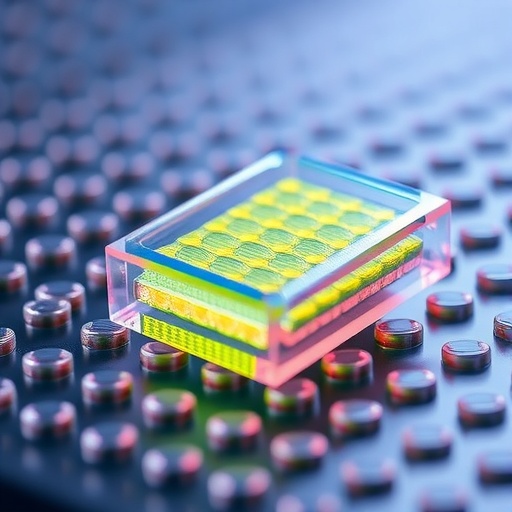
Next-generation energy devices—from fuel cells to water electrolyzers—rely on ion-exchange membranes that pass water and selected ions while blocking everything else. For these systems, efficiency is tightly linked to how membrane chemistry reshapes internal nanostructures, which in turn governs ionic transport and stability. Yet membrane performance has long been constrained by a trade-off: increasing ion conductivity often requires higher water uptake, which can weaken mechanical integrity.
A team from the University of Chicago Pritzker School of Molecular Engineering (PME) partnered with scientists at New York University to probe how backbone chemistry controls membrane structure at the molecular scale. Instead of focusing only on macroscopic performance, the researchers targeted an atomic-level question: how does polymer stiffness and backbone architecture steer the evolution of ionic nanostructures as water moves through the material?
Using a combined experimental and molecular simulation framework, the researchers studied several anion-conducting polyelectrolytes (ACPs) that share the same general function—supporting the motion of negatively charged ions—while differing in backbone architecture. Importantly, all polymers were hydrocarbon-based. This matters because many historical membrane designs used fluoropolymers, and the field is increasingly shifting toward greener, hydrocarbon alternatives.
The study found that water permeation triggers structural evolution within the membranes, and that this evolution depends on how stiff or flexible the polymer backbone is. Different backbone architectures promoted distinct ionic nanostructures, which then determined how water was distributed throughout the membrane. In effect, nanostructure formation becomes a molecular “routing” mechanism for ion-conducting pathways.
A key result was that more flexible backbones achieved higher ion conductivity with less water uptake. That outcome directly addresses the classic performance trade-off by decoupling conductivity from excessive hydration. Rather than requiring the membrane to swell with water, the flexible chemistries allow water to organize locally in ways that support transport without overwhelming the material’s mechanical demands.
At the simulation level, the work provided atomic-resolution insight into structural differences that experiments alone cannot resolve. These molecular details clarify why particular backbone chemistries produce better connectivity among ion pathways and more efficient water management. The implications extend beyond one material set, offering design rules for future ACPs.
The researchers conclude that the goal is not a single “best” polymer, but principles: tune backbone chemistry to create ionic nanostructures that match the water dynamics needed for fast ion conduction. They are now moving toward understanding how counterion identity further influences water behavior and morphology in these membranes, aiming to broaden the design toolkit for environmentally friendly ion exchange systems.
Keywords
Fuel cells, water electrolyzers, ion transport, ion-exchange membranes, polyelectrolytes, nanostructures, molecular simulation, ionic conductivity, backbone stiffness
Cite Scienmag News
Bethany Barker. (July 27, 2026). Researchers Study Membranes to Improve Future Energy Devices. Scienmag. https://scienmag.com/researchers-study-membranes-to-improve-future-energy-devices/
Bethany Barker. "Researchers Study Membranes to Improve Future Energy Devices." Scienmag, 27 July 2026, https://scienmag.com/researchers-study-membranes-to-improve-future-energy-devices/. Accessed 6 September 2026.
Bethany Barker. "Researchers Study Membranes to Improve Future Energy Devices." Scienmag. July 27, 2026. https://scienmag.com/researchers-study-membranes-to-improve-future-energy-devices/


