


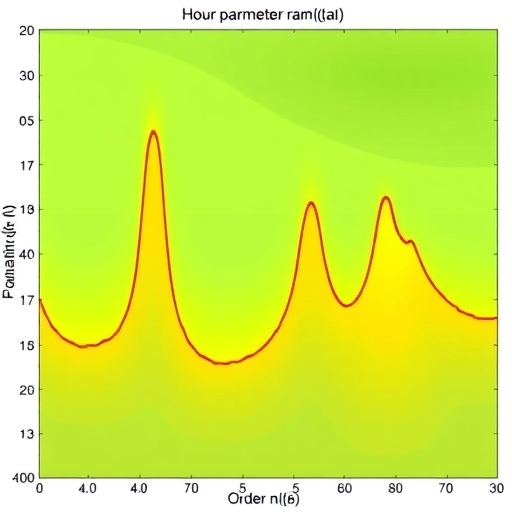
A continuous phase transition is usually diagnosed through critical exponents and scaling laws. Yet the deeper fingerprint of criticality is statistical: the order parameter does not fluctuate randomly in a purely Gaussian way near the transition, but instead develops distinct non-Gaussian probability distributions. Although this idea has been anticipated for decades, experimental access to the full order-parameter statistics has been limited.
Now, a team led by Matthieu Allemand and colleagues has directly measured the probability distribution of an order-parameter amplitude across a continuous transition in an interacting lattice Bose gas. Using single-atom-resolved detection in momentum space, they capture how the system evolves as it moves from an ordered superfluid regime into a disordered phase.
Rather than focusing only on mean values, the researchers reconstruct an effective potential from the measured distribution, drawing an analogy to Landau theory. The resulting potential exhibits a non-trivial minimum in the superfluid phase, indicating stable ordering, and this minimum disappears as the transition point is approached.
The most striking result is the emergence of clear non-Gaussian statistics near criticality. High-order cumulants of the order parameter do not simply grow or diminish smoothly: they undergo abrupt sign changes as the transition is crossed, reflecting the reshaping of fluctuation pathways that a Gaussian model would miss.
To interpret these sign reversals, the authors perform numerical studies in homogeneous systems, demonstrating that the cumulant sign-change behavior follows critical scaling. This indicates that the phenomenon is not an experimental artifact but a universal aspect of fluctuation statistics.
However, the experimentally observed pattern is not reproduced by classical models. Instead, the behavior is captured by a low-temperature quantum model, linking the non-Gaussian signatures specifically to quantum critical fluctuation physics.
The study underscores that universality extends beyond thermodynamic singularities and order-parameter averages. It also resides in the detailed statistics of fluctuations—information encoded in the full probability distribution.
This work offers a new route for “viral” critical diagnostics: rather than just extracting exponents, experimentalists can look for cumulant sign changes and effective-potential evolution as direct markers of criticality.
By combining quantum-matter experiments with probability-distribution reconstruction, the researchers show that order-parameter statistics themselves can become a practical microscope for universality.
Cite Scienmag News
Katie Riggs. (July 27, 2026). Non-Gaussian Fluctuations in Order Parameter Across a Phase Transition. Scienmag. https://scienmag.com/non-gaussian-fluctuations-in-order-parameter-across-a-phase-transition/
Katie Riggs. "Non-Gaussian Fluctuations in Order Parameter Across a Phase Transition." Scienmag, 27 July 2026, https://scienmag.com/non-gaussian-fluctuations-in-order-parameter-across-a-phase-transition/. Accessed 4 September 2026.
Katie Riggs. "Non-Gaussian Fluctuations in Order Parameter Across a Phase Transition." Scienmag. July 27, 2026. https://scienmag.com/non-gaussian-fluctuations-in-order-parameter-across-a-phase-transition/


