

Monday, July 27, 2026
Science
No Result
View All Result
  • Login
  • HOME
  • SCIENCE NEWS
  • CONTACT US
  • HOME
  • SCIENCE NEWS
  • CONTACT US
No Result
View All Result
Scienmag
No Result
View All Result
Home Science News Technology and Engineering

Gate-Tunable Mid-Infrared Electroluminescence via Te/MoS2 p-n Heterojunctions

July 27, 2026
in Technology and Engineering
Reading Time: 2 mins read
0
Gate-Tunable Mid-Infrared Electroluminescence via Te/MoS2 p-n Heterojunctions

Gate-Tunable Mid-Infrared Electroluminescence via Te/MoS2 p-n Heterojunctions

65
SHARES
587
VIEWS
Share on FacebookShare on Twitter
ADVERTISEMENT

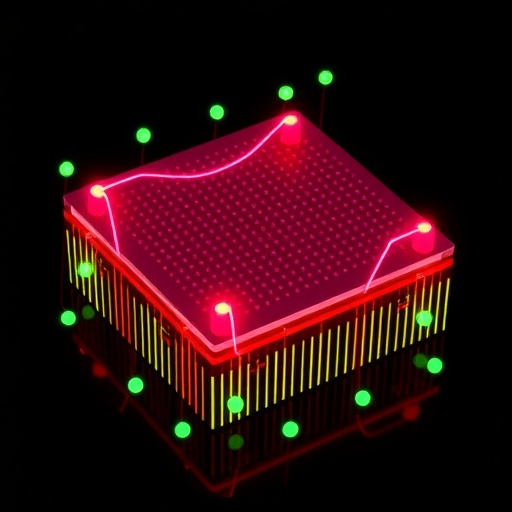
A new study is turning heads in the mid-infrared electronics community by demonstrating gate-tunable electroluminescence from a tellurium/molybdenum disulfide (Te/MoS₂) p–n heterojunction. Published in Light: Science & Applications, the work reports that applying an external gate voltage can actively steer light emission in the mid-infrared range—an important capability for sensing, spectroscopy, and next-generation optical communication.

The researchers fabricate a heterostructure in which Te acts as the p-type component and monolayer or few-layer MoS₂ provides the n-type counterpart. Unlike fixed-emission devices, the device design enables charge injection and recombination to be modulated electrostatically, allowing emission characteristics to shift in real time as the gate field changes.

At the core of the effect is bias-controlled carrier transport across the junction. When a suitable voltage is applied, electrons and holes are driven toward the heterointerface, where radiative recombination produces mid-infrared photons. The emission intensity and spectral behavior evolve with gate voltage, indicating that the electrostatic environment reshapes carrier populations and recombination pathways.

Crucially, the team emphasizes that the mid-infrared output is not merely a passive optical consequence of material properties; it is a tunable device function. This makes the heterojunction a promising platform for “electroluminescence as an actively programmable light source,” rather than a static emitter requiring permanent structural redesign.

The study also highlights the role of interface quality in enabling efficient light generation. Heterojunction interfaces in layered materials are often sensitive to defects, thickness, and contact conditions, all of which influence how effectively carriers recombine radiatively. By optimizing device fabrication and measurement configuration, the authors observe a clear gate-dependent electroluminescence response.

From a broader perspective, gate tunability is especially attractive because it can be integrated into transistor-like architectures. If scalable, such systems could enable compact mid-infrared emitters paired with logic control, reducing the need for bulky laser sources in specialized instruments.

The viral-sci-news angle is straightforward: a simple gate voltage—typical of field-effect devices—becomes a knob for mid-infrared light generation. That combination of tunability and electronic control is likely to spur follow-up work aiming to improve brightness, stability, and spectral range.

Beyond basic physics, the demonstrated approach could help build reconfigurable mid-infrared photonic components. Potential applications include chemical and biological sensing where mid-infrared “fingerprints” matter most, as well as tunable emitters for spectroscopy and imaging.

With Te/MoS₂ heterojunctions now shown to support gate-adjustable mid-infrared electroluminescence, the field may be moving closer to practical, chip-integrated mid-infrared sources—one of the most sought-after functionalities in modern optoelectronics.

Subject of Research: Gate-tunable mid-infrared electroluminescence in Te/MoS₂ p–n heterojunctions

Article Title: Gate-tunable mid-infrared electroluminescence from Te/MoS₂ p-n heterojunctions

Article References: Wang, S., Liang, D., Zheng, Z. et al. Gate-tunable mid-infrared electroluminescence from Te/MoS₂ p-n heterojunctions. Light Sci Appl 15, 333 (2026). https://doi.org/10.1038/s41377-026-02402-6

Image Credits: AI Generated

DOI: 10.1038/s41377-026-02402-6

Keywords: mid-infrared electroluminescence; gate tunability; Te/MoS₂ heterojunction; p–n junction; optoelectronics

Tags: 2D material heterostructures for optical communicationactive control of light emission in 2D heterostructurescharge carrier dynamics in Te/MoS2 deviceselectrostatic modulation of light emissiongate-tunable Te/MoS2 heterojunctionmid-infrared electroluminescencemid-infrared sensing and spectroscopyp-n heterojunction in 2D semiconductorsprogrammable electradiative recombination in mid-infrared range
Share26Tweet16
Previous Post

High-Throughput Chip Delivers Full-Frequency Encoded Illumination Super-Resolution Imaging

Next Post

AI Redesigns Starting Conditions to Improve Protein Evolution Outcomes

Related Posts

Thin Films Adaptively Move on Substrates That Are No Longer Inert
Technology and Engineering

Thin Films Adaptively Move on Substrates That Are No Longer Inert

July 27, 2026
AI Redesigns Starting Conditions to Improve Protein Evolution Outcomes
Medicine

AI Redesigns Starting Conditions to Improve Protein Evolution Outcomes

July 27, 2026
High-Throughput Chip Delivers Full-Frequency Encoded Illumination Super-Resolution Imaging
Technology and Engineering

High-Throughput Chip Delivers Full-Frequency Encoded Illumination Super-Resolution Imaging

July 27, 2026
Emerging Capitalism and Cultural Niche Building in Early Modern Greece
Technology and Engineering

Emerging Capitalism and Cultural Niche Building in Early Modern Greece

July 27, 2026
Immunogenicity and Safety of BNT162b2 in Juvenile Immune-Mediated Inflammatory Disease Patients
Technology and Engineering

Immunogenicity and Safety of BNT162b2 in Juvenile Immune-Mediated Inflammatory Disease Patients

July 27, 2026
Hidden Patterns of Urban Mixing Uncovered in Five Global Cities
Technology and Engineering

Hidden Patterns of Urban Mixing Uncovered in Five Global Cities

July 27, 2026
Next Post
AI Redesigns Starting Conditions to Improve Protein Evolution Outcomes

AI Redesigns Starting Conditions to Improve Protein Evolution Outcomes

  • Mothers who receive childcare support from maternal grandparents show more

    Mothers who receive childcare support from maternal grandparents show more parental warmth, finds NTU Singapore study

    27656 shares
    Share 11059 Tweet 6912
  • University of Seville Breaks 120-Year-Old Mystery, Revises a Key Einstein Concept

    1061 shares
    Share 424 Tweet 265
  • Bee body mass, pathogens and local climate influence heat tolerance

    682 shares
    Share 273 Tweet 171
  • Researchers record first-ever images and data of a shark experiencing a boat strike

    546 shares
    Share 218 Tweet 137
  • Groundbreaking Clinical Trial Reveals Lubiprostone Enhances Kidney Function

    531 shares
    Share 212 Tweet 133
Science

Embark on a thrilling journey of discovery with Scienmag.com—your ultimate source for cutting-edge breakthroughs. Immerse yourself in a world where curiosity knows no limits and tomorrow’s possibilities become today’s reality!

RECENT NEWS

  • Thin Films Adaptively Move on Substrates That Are No Longer Inert
  • How cells locate their ideal matching partners
  • Large-scale crystals may transform next-generation OLED display technology
  • CHEST Releases Pregnancy Guideline on Sleep-Disordered Breathing

Categories

  • Agriculture
  • Anthropology
  • Archaeology
  • Athmospheric
  • Biology
  • Biotechnology
  • Blog
  • Bussines
  • Cancer
  • Chemistry
  • Climate
  • Earth Science
  • Editorial Policy
  • Marine
  • Mathematics
  • Medicine
  • Pediatry
  • Policy
  • Psychology & Psychiatry
  • Science Education
  • Social Science
  • Space
  • Technology and Engineering

Subscribe to Blog via Email

Enter your email address to subscribe to this blog and receive notifications of new posts by email.

Join 5,146 other subscribers

© 2025 Scienmag - Science Magazine

Welcome Back!

Login to your account below

Forgotten Password?

Retrieve your password

Please enter your username or email address to reset your password.

Log In
No Result
View All Result
  • HOME
  • SCIENCE NEWS
  • CONTACT US

© 2025 Scienmag - Science Magazine

Discover more from Science

Subscribe now to keep reading and get access to the full archive.

Continue reading
