


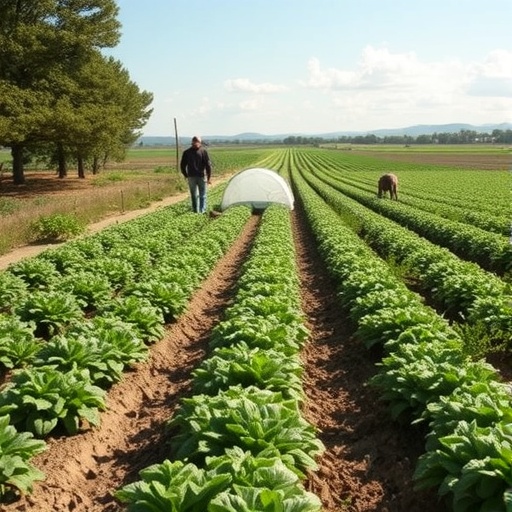
A Yale-led research team has outlined a lower-cost, more environmentally friendly route to tackle PFAS—so-called “forever chemicals”—across heavily contaminated farmland. The approach draws on field data from agricultural sites in Maine and is designed not only to reduce PFAS hazards but also to improve soil conditions so farming can continue rather than stop.
PFAS have become widespread because they persist in the environment and have been used for decades in many manufactured products. Over time, they move through wastewater systems into sewage sludge, which has historically been applied to croplands as fertilizer. That cycle has left soils and groundwater contaminated on a large scale, with global implications.
In the new study, researchers focus on two major PFAS, perfluorooctanoic acid (PFOA) and perfluorooctanesulfonic acid (PFOS), which together account for key components of real-world contamination. The model is aimed at agricultural remediation while also scaling the climate-relevant practice of enhanced weathering.
The remediation sequence starts by spreading a thin layer of crushed, alkaline rock over the affected soil. By raising soil pH, the treatment accelerates the uptake-related removal of PFOS via plants growing in treated fields. This is paired with a second step that transforms harvested biomass into biochar.
Biochar production involves heating the harvested plants—using either stationary or mobile thermal equipment—to thermally destroy PFOS and PFOA. The researchers estimate remediation costs of about $1,460 per hectare, with annual repetition for up to 20 years, leading to just over $29,000 per hectare when farmer income losses during treatment are included.
Crucially, the process also removes carbon dioxide. Carbon capture occurs through enhanced weathering of the applied crushed rock and through the carbon-storing properties of biochar derived from biomass. The team estimates a national removal potential of about 10.5 million metric tons of CO₂ per year.
The work highlights a practical benefit for communities: instead of long-term land loss typical of conventional remediation, the framework aims to restore soil health and return cropland to active agricultural use. “We outline a path that allows farmers to continue to work their land while restoring soil health,” the study’s principal investigator said.
The findings were published in Proceedings of the National Academy of Sciences (PNAS). The research received support from Yale Planetary Solutions and Yale Ventures, along with additional funding from the Schmidt Family Foundation and the UK Natural Environment Research Council.
Keywords
PFAS, forever chemicals, remediation, biochar, enhanced weathering, agriculture, carbon capture, PFOA, PFOS, soil health
Cite Scienmag News
Grant Pearson. (July 27, 2026). Cutting forever-chemical pollution in farmlands at a fraction of costs. Scienmag. https://scienmag.com/cutting-forever-chemical-pollution-in-farmlands-at-a-fraction-of-costs/
Grant Pearson. "Cutting forever-chemical pollution in farmlands at a fraction of costs." Scienmag, 27 July 2026, https://scienmag.com/cutting-forever-chemical-pollution-in-farmlands-at-a-fraction-of-costs/. Accessed 4 September 2026.
Grant Pearson. "Cutting forever-chemical pollution in farmlands at a fraction of costs." Scienmag. July 27, 2026. https://scienmag.com/cutting-forever-chemical-pollution-in-farmlands-at-a-fraction-of-costs/


