

Sunday, July 26, 2026
Science
No Result
View All Result
  • Login
  • HOME
  • SCIENCE NEWS
  • CONTACT US
  • HOME
  • SCIENCE NEWS
  • CONTACT US
No Result
View All Result
Scienmag
No Result
View All Result
Home Science News Space

Europa Shows Limited Fluid Exchange Between Deep Ocean and Shallow Layer

July 26, 2026
in Space
Reading Time: 2 mins read
0
Europa Shows Limited Fluid Exchange Between Deep Ocean and Shallow Layer

Europa Shows Limited Fluid Exchange Between Deep Ocean and Shallow Layer

65
SHARES
587
VIEWS
Share on FacebookShare on Twitter
ADVERTISEMENT

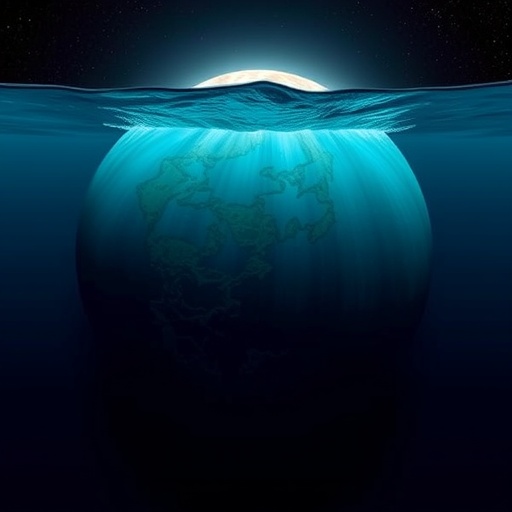
Europa’s moon-sized puzzle just got sharper. Beneath its icy shell, Jupiter’s moon Europa hides a deep subsurface ocean—one of the Solar System’s best bets for places where life could survive. But a long-standing idea suggests that water from that hidden ocean could rise upward through narrow fractures called dykes, pooling as shallow, transient sills. If true, these temporary reservoirs might help explain some of Europa’s mysterious surface features—and could even be tapped for future geochemical investigations.

Now, a new study challenges the effectiveness of that “deep-to-shallow” plumbing. Using coupled high-resolution fluid–thermal simulations, researchers tested how water would behave as it ascends within dyke-like conduits through Europa’s freezing ice. The central question was blunt: can dykes realistically deliver enough liquid water before it refreezes?

First, the team ran an optimistic scenario by essentially removing one major problem—convective heat loss from the ascending fluid. In other words, the researchers calculated an upper-bound case, assuming conditions that should favor maximum survival of liquid water during ascent.

Even under this extreme assumption, the results indicate that the amount of water that can rise through dykes before freezing is too small to create the shallow reservoirs proposed for linking to surface features. That mismatch suggests that the dyke-transport mechanism, while physically plausible in principle, may fail in practice.

Then came the more realistic twist: turbulence. Introducing turbulent flow substantially changed the outcome. The simulations show that turbulent motion increases heat transfer from the rising fluid to the surrounding ice, setting off rapid supercooling.

Once supercooling begins, the system can spontaneously generate frazil ice—tiny ice crystals that form within the flowing liquid rather than only at the boundaries. This not only disrupts transport but also accelerates dyke clogging, effectively shutting down the pathway.

Together, the findings imply that direct fluid exchange between Europa’s deep ocean and shallow subsurface reservoirs is limited. In that case, shallow liquid water—if it appears at all—may instead form through in situ melting closer to the surface rather than by sustained delivery from below.

The study carries an additional warning for missions: shallow reservoirs might not faithfully preserve the chemical fingerprint of Europa’s deep ocean. If local melting dominates, the surface-accessible chemistry could differ substantially from what explorers hope to infer.

Subject of Research: Europa’s subsurface oceans and dyke-mediated transport of liquid water to shallow reservoirs
Article Title: Limited direct fluid exchange between the deep subsurface ocean and the shallow subsurface environment of Europa
Article References: Ojha, L., Barik, A. & Buffo, J. Limited direct fluid exchange between the deep subsurface ocean and the shallow subsurface environment of Europa. Nat Astron (2026). https://doi.org/10.1038/s41550-026-02918-2
Image Credits: AI Generated
DOI: https://doi.org/10.1038/s41550-026-02918-2

Tags: challenges to shallow reservoir formationcryovolcanism and surface geologydeep ocean-surface communicationdyke-mediated fluid transportEuropa subsurface ocean water exchangehigh-resolution fluid-thermal simulationsice shell fracture dynamicsice shell fracture mechanicsimplications for Europa surface featuresliquid water ascent limitationsshallow water reservoirs on Europasubsurface ocean life potential
Share26Tweet16
Previous Post

ENVnet launches global molecular resource for dissolved organic matter data

Next Post

Low-Temperature Oxide-Ion Conduction Discovered in Aurivillius-Phase Sodium Bismuth Tin Oxides

Related Posts

UK Leads NASA Mission to Build Instrument for Finding Earth-like Worlds
Space

UK Leads NASA Mission to Build Instrument for Finding Earth-like Worlds

July 26, 2026
Magnetic Signals in Nuclei Reveal How Stars Build Chemical Elements
Space

Magnetic Signals in Nuclei Reveal How Stars Build Chemical Elements

July 26, 2026
Kilometer-Scale Jovian Moon Characterized for Potential JUICE Flyby
Space

Kilometer-Scale Jovian Moon Characterized for Potential JUICE Flyby

July 26, 2026
Venus Is Far From Dead, Scientists Find
Space

Venus Is Far From Dead, Scientists Find

July 26, 2026
Milky Way Source Found for Extremely High-Energy Particles
Space

Milky Way Source Found for Extremely High-Energy Particles

July 17, 2026
Sun’s Silver Content Exceeds Earlier Estimates, Study Finds
Space

Sun’s Silver Content Exceeds Earlier Estimates, Study Finds

July 17, 2026
Next Post
Low-Temperature Oxide-Ion Conduction Discovered in Aurivillius-Phase Sodium Bismuth Tin Oxides

Low-Temperature Oxide-Ion Conduction Discovered in Aurivillius-Phase Sodium Bismuth Tin Oxides

  • Mothers who receive childcare support from maternal grandparents show more

    Mothers who receive childcare support from maternal grandparents show more parental warmth, finds NTU Singapore study

    27656 shares
    Share 11059 Tweet 6912
  • University of Seville Breaks 120-Year-Old Mystery, Revises a Key Einstein Concept

    1061 shares
    Share 424 Tweet 265
  • Bee body mass, pathogens and local climate influence heat tolerance

    682 shares
    Share 273 Tweet 171
  • Researchers record first-ever images and data of a shark experiencing a boat strike

    546 shares
    Share 218 Tweet 137
  • Groundbreaking Clinical Trial Reveals Lubiprostone Enhances Kidney Function

    531 shares
    Share 212 Tweet 133
Science

Embark on a thrilling journey of discovery with Scienmag.com—your ultimate source for cutting-edge breakthroughs. Immerse yourself in a world where curiosity knows no limits and tomorrow’s possibilities become today’s reality!

RECENT NEWS

  • UK Leads NASA Mission to Build Instrument for Finding Earth-like Worlds
  • Kogakuin and IIT (ISM) Dhanbad launch research on multifunctional energy glass-ceramics
  • Discovering what shapes white blood cells may enable new cancer therapies
  • Can sparkling water be gentler on your teeth than other drinks?

Categories

  • Agriculture
  • Anthropology
  • Archaeology
  • Athmospheric
  • Biology
  • Biotechnology
  • Blog
  • Bussines
  • Cancer
  • Chemistry
  • Climate
  • Earth Science
  • Editorial Policy
  • Marine
  • Mathematics
  • Medicine
  • Pediatry
  • Policy
  • Psychology & Psychiatry
  • Science Education
  • Social Science
  • Space
  • Technology and Engineering

Subscribe to Blog via Email

Enter your email address to subscribe to this blog and receive notifications of new posts by email.

Join 5,146 other subscribers

© 2025 Scienmag - Science Magazine

Welcome Back!

Login to your account below

Forgotten Password?

Retrieve your password

Please enter your username or email address to reset your password.

Log In
No Result
View All Result
  • HOME
  • SCIENCE NEWS
  • CONTACT US

© 2025 Scienmag - Science Magazine

Discover more from Science

Subscribe now to keep reading and get access to the full archive.

Continue reading
