


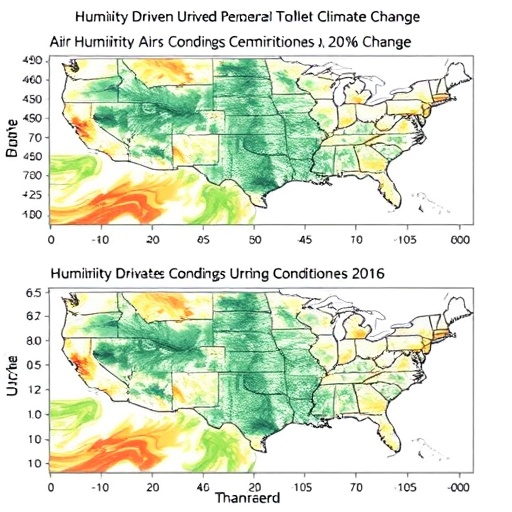
Rising heat is already pushing cities toward higher electricity use, but a new study suggests that humidity—not just temperature—will shape how strongly air-conditioning demand climbs as the climate warms. The research, published in Nature Cities, finds that the energy needed to keep indoor spaces comfortable can increase in very different ways depending on local moisture conditions and how cooling systems respond to damp air.
The authors frame air-conditioning demand as a humidity-driven problem. As relative humidity increases, air conditioners must work not only to lower air temperature but also to remove moisture, which can raise the cooling load. In many regions, this means that comfort targets that were set for a hotter-but-drier future may no longer hold once moisture climbs alongside temperature.
Using climate and energy-demand modeling, the team projects that urban areas will not follow a single trajectory. Instead, the growth of cooling electricity demand diverges across cities as atmospheric conditions shift. Some locations show steeper increases linked to stronger humidity exposure, while others experience comparatively slower growth even under similar temperature changes.
The work highlights a key mechanism: the efficiency and performance of air-conditioning hardware are sensitive to moisture. When cooling coils and filters face higher humidity, the balance between sensible cooling (temperature reduction) and latent cooling (water removal) shifts. That shift can change how much electricity is required for the same indoor comfort level.
Critically, the study treats humidity as a driver with distinct regional signatures rather than a background variable. This approach helps explain why cities that look similar in average warming rates may still experience very different electricity pressures for cooling.
For policymakers, the findings carry an immediate message. Grid planning and building standards that rely primarily on temperature projections may underestimate future demand in humid climates and misallocate investment. Better forecasts that incorporate humidity dynamics could improve resilience as extreme heat events become more frequent.
The results also point to adaptation opportunities. Cooling strategies that reduce latent load—such as improved building envelopes, ventilation control, and dehumidification-aware design—could reduce electricity spikes during the most moisture-stressed periods.
Overall, the study reframes urban cooling as a two-variable challenge: heat and humidity together determine how quickly air-conditioning energy demand grows. With climate change, the “cooling burden” may expand fastest where dampness intensifies, turning comfort regulation into a power-system issue as well as a public-health concern.
Cite Scienmag News
Sloane Callahan. (July 26, 2026). Humidity-Driven Urban Air Conditioner Demand Diverges Under Climate Change. Scienmag. https://scienmag.com/humidity-driven-urban-air-conditioner-demand-diverges-under-climate-change/
Sloane Callahan. "Humidity-Driven Urban Air Conditioner Demand Diverges Under Climate Change." Scienmag, 26 July 2026, https://scienmag.com/humidity-driven-urban-air-conditioner-demand-diverges-under-climate-change/. Accessed 4 September 2026.
Sloane Callahan. "Humidity-Driven Urban Air Conditioner Demand Diverges Under Climate Change." Scienmag. July 26, 2026. https://scienmag.com/humidity-driven-urban-air-conditioner-demand-diverges-under-climate-change/


